

Mon E90 s'est comporté de manière excentrique pendant un certain temps avec une configuration composée de roues ZCP avec des pneus SportContact 7 neufs, des entretoises de 12 mm à l'avant, des entretoises de 10 mm à l'arrière, des amortisseurs de stock avec ressorts d'abaissement eibach, un nouvel alignement de roue (attaché mais en suédois). Bushings ont été vérifiés. Je soupçonne les chocs boursiers et le combo de ressorts Eibach. Toute idée est appréciée.
4,8 kVIEWS
43REPLIES
11APPRECIATES
14/01/2024LAST POST
Si je lis bien, excusez-moi si je n'ai pas besoin d'utiliser mon cerveau pour un peu.
Tu as un toe out, à l'arrière ? C'est ça.
Tu as un toe out, à l'arrière ? C'est ça.
omgzirra_exe a écritSi je lis bien, excusez-moi si je n'ai pas besoin d'utiliser mon cerveau pour un peu.
Tu as un toe out, à l'arrière ? C'est ça.
Oui, pointe totale arrière +1,3 mm et gauche individuelle + 0,6 mm et droite + 0,6 mm
M. C4 a écritomgzirra_exe a écritOui, pointe totale arrière +1,3 mm et gauche individuelle + 0,6 mm et droite + 0,6 mmSi je lis bien, excusez-moi si je n'ai pas besoin d'utiliser mon cerveau pour un peu.
Tu as un toe out, à l'arrière ? C'est ça.
J'appuie la suggestion selon laquelle il s'agit là d'un problème. Tirez pour 1/16 "orteil total IN pour l'arrière et il devrait se sentir beaucoup mieux.
Donc, vous êtes en train de dire que la bonne façon d'avancer est de composer un orteil total dans (négatif) de -1,6 mm (-1/16") et laisser le reste comme c'est à la fois avant et arrière?
Vous ne pouvez pas avoir les pieds à l'arrière. La voiture survirera facilement à la sortie du coin. Vous avez besoin d'un peu de pied arrière.
L'avant devrait être zéro orteil. Je ne pense pas que cette voiture ait besoin d'être mise à l'avant.
L'avant devrait être zéro orteil. Je ne pense pas que cette voiture ait besoin d'être mise à l'avant.
M. C4 a écritDonc, vous êtes en train de dire que la bonne façon d'avancer est de composer un orteil total dans (négatif) de -1,6 mm (-1/16") et laisser le reste comme c'est à la fois avant et arrière?
correct,
Le survirage en sortie de virage et la stabilité en ligne droite.
jusqu'à 1/16e (1,6 mm) au total, toe-in serait idéal pour un tramway.
laisser le neutre avant à 0..
omgzirra_exe wroteSo ideally I should aim for front +/-0 total toe (left and right) and rear -1.6mm total toe in (-0.8mm left and -0.8mm right)?Mr. C4 wrotecorrect,So you guys are saying that the right way forward is to dial in some total toe in (negative) of -1.6mm (-1/16") and leave the rest as is both front and rear?
toe-out will cause oversteer on corner exit and straight-line stability.
up to 1/16th (1.6mm) total, toe-in would be ideal for a street car.
leave the front neutral at 0..
Yes
Thanks guys and let's hope the handling improves.
Reviving my own old thread. I never got this sorted before parking the car away for the season so it is still not handling properly.
Sorry, but isn’t toe in measured in positive value? I remember the alignment guy saying something like that…..
Also found this:
https://help.summitracing.com/app/answers/detail/a_id/5257/~/what-is-toe%3F
Attracted is the alignment sheet after a 2nd alignment was done.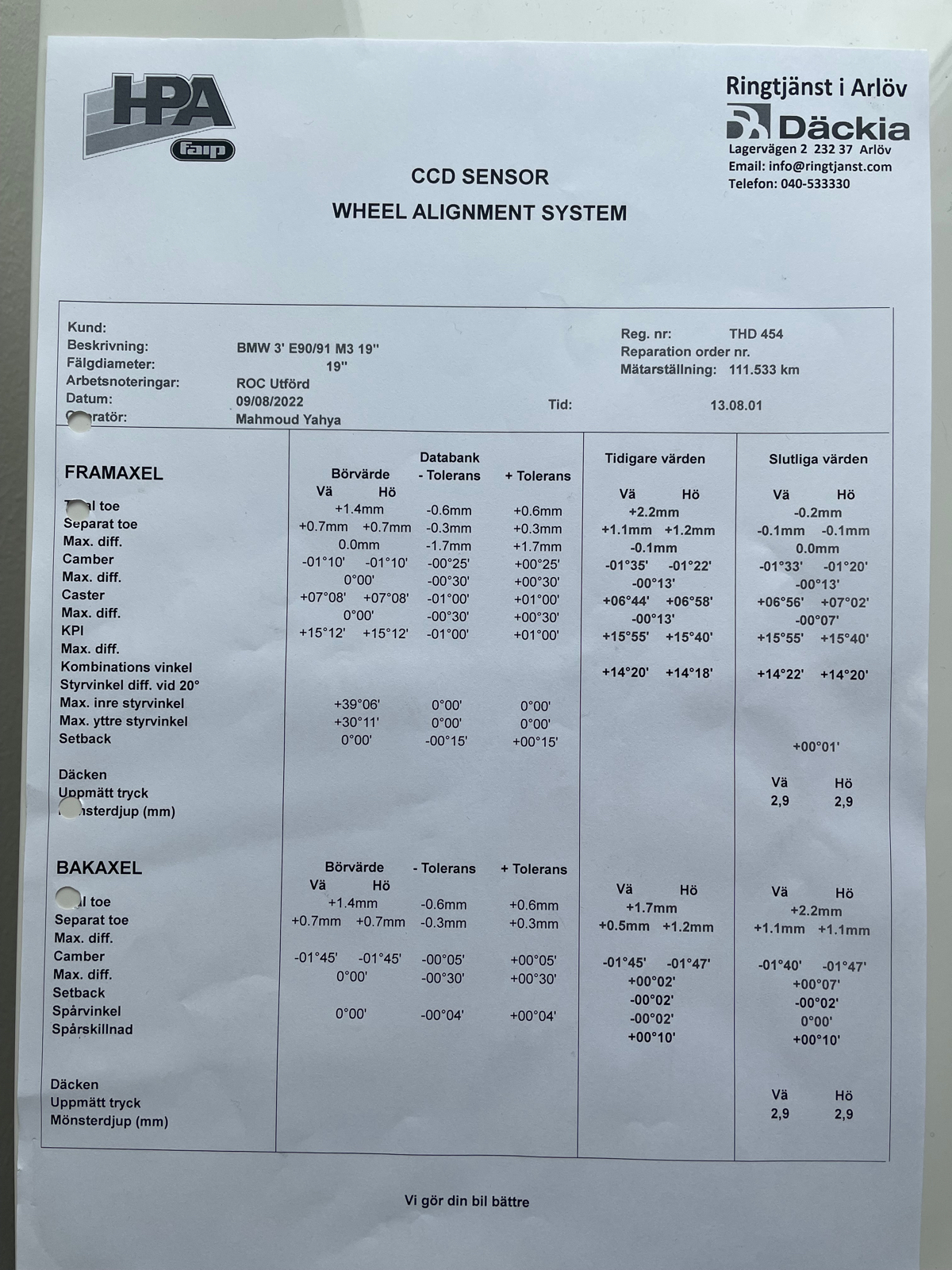
Sorry, but isn’t toe in measured in positive value? I remember the alignment guy saying something like that…..
Also found this:
https://help.summitracing.com/app/answers/detail/a_id/5257/~/what-is-toe%3F
Attracted is the alignment sheet after a 2nd alignment was done.
Installed Bilstein B8's, H&R swaybars and ZCP wheels with Conti SportContact 7 in stock size with 10mm spacers front and rear and the car is still squirmy.
Attaching the recent wheel alignment. It is in Swedish language and the rear axle comes first and with final specs in the far right column.
What the hell is wrong? The Conti's cannot be that bad!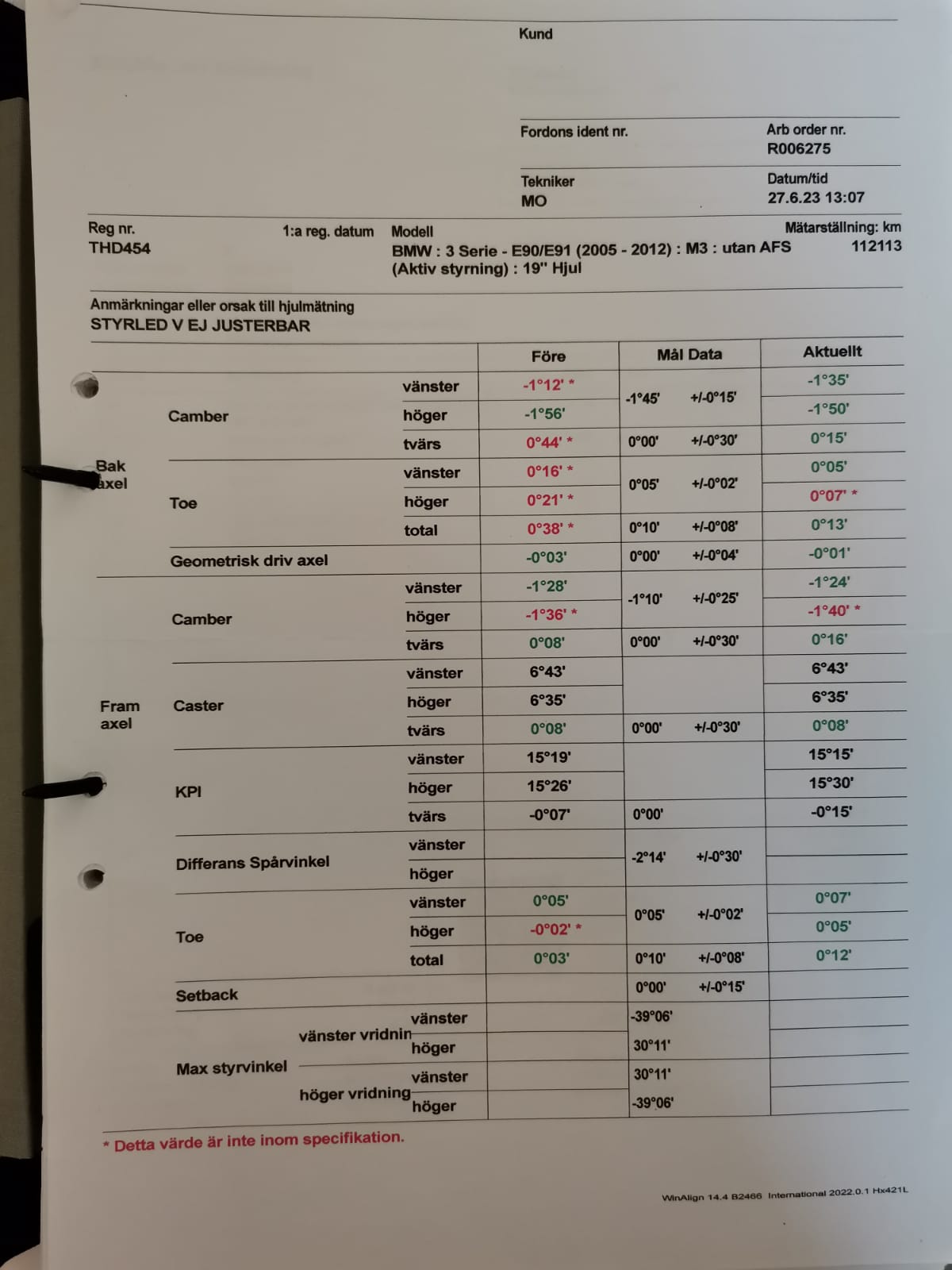
Attaching the recent wheel alignment. It is in Swedish language and the rear axle comes first and with final specs in the far right column.
What the hell is wrong? The Conti's cannot be that bad!
Under what conditions is it 'squirmy'?
Redd wroteStraight line when giving steering input and under braking at high speed.Under what conditions is it 'squirmy'?
I was thinking to give it a go with the following alignment specs.
Front:
Camber: Maintain current alt. slightly more negative if achievable (-1°45’ +/-0°15’)
Toe in/out: 0 (neutral)
Rear:
Camber: Maintain current alt. slightly more negative if achievable (-1°45’ +/-0°15’)
Toe In: 0.15° to 0.20° per side
Total Toe In: 0.25° – 0.40°
Any thoughts on that?
Front:
Camber: Maintain current alt. slightly more negative if achievable (-1°45’ +/-0°15’)
Toe in/out: 0 (neutral)
Rear:
Camber: Maintain current alt. slightly more negative if achievable (-1°45’ +/-0°15’)
Toe In: 0.15° to 0.20° per side
Total Toe In: 0.25° – 0.40°
Any thoughts on that?
Mr. C4 wroteHigh speed hard braking with steering input is squirmy for any car lol. I don't think it's a car problem. My car hard braking at track with steering wheel perfectly straight the rear still feels like it wants to step out. Many cars do that, including high performance cars. You just need to learn to drive around it. Front monoballs, solid subframe and rear spherical conversion help somewhat but won't totally eliminate it.Straight line when giving steering input and under braking at high speed.
Redd wroteI come from a history of over 30years with multiple high performance cars incl. rear engine cars as well as daily drivers with sporty character and none of them has handled this poorly. Even my daily driver F31 328 handles better than this M3! My friend's E93 M3 also handles better! So NO, it is not normal/acceptable.High speed hard braking with steering input is squirmy for any car lol. I don't think it's a car problem. My car hard braking at track with steering wheel perfectly straight the rear still feels like it wants to step out. Many cars do that, including high performance cars. You just need to learn to drive around it. Front monoballs, solid subframe and rear spherical conversion help somewhat but won't totally eliminate it.
Hmm if you say an E93 M3 handles better then it doesn't sound normal. But not sure how to help you without driving the car. You've fixed your alignment, replaced dampers, added sway bars.
The only other thing I can think of is solid rear subframe bushings. With the rubber bushings you get the feeling like the rear end wants to go sideways when you go over ruts or bridge joints in the middle of a turn. It's not actually the tires losing grip (even though it feels like it) but more of the body moving independently of the chassis due to the rubber bushings. Changing to solid subframe bushings eliminates this and also improves chassis rigidity and feel tremendously. But it's not a simple job.
The only other thing I can think of is solid rear subframe bushings. With the rubber bushings you get the feeling like the rear end wants to go sideways when you go over ruts or bridge joints in the middle of a turn. It's not actually the tires losing grip (even though it feels like it) but more of the body moving independently of the chassis due to the rubber bushings. Changing to solid subframe bushings eliminates this and also improves chassis rigidity and feel tremendously. But it's not a simple job.
While installing the new chassis components my mechanic also checked all the bushings in the rear subframe and all were found to be OK.
Yes the bushings 'look' ok but because they are rubber and they exhibit that lateral movement that feels like tires losing grip. With all the work you've already done I suspect that is what you're experiencing now when you say 'squirmy' cos that was the same complaint I had with the car when I first got it. Maybe you can try someone's car which has had solid subframe done to see if the problem goes away.
I don’t know man, my mechanic is a very well seasoned race mechanic, with his own M3 collection of various models so he knows his stuff.
Your cheapest and easiest next step is simply to dial in some slight rear toe IN, as you were previously advised, and see if if cures, or reduces, your problem.
