

Green-Eggs wroteGreen-Eggs I’m going to start calling you Scoop with bearing intel you share. It is factually based without conjecture and useful to the community. Please stick around.When BE started, there were two well known vendors who wanted to be primary investors. Both were told, "thanks, but no thanks." Troy was one of them and was especially obnoxious in his response. The other is in Southern California and won't even let somebody use BE Bolts if the car comes to his shop for rod bearing service. So take what either say with a grain of salt. If either vendor wants to challenge this story, Bert has the emails to back it up.
1.2MVIEWS
3.2KREPLIES
3.1KAPPRECIATES
06-01-2026LAST POST
TX wroteThose pics were from when i took my engine apart to confirm i had a spun rob bearing a couple months ago. The picture was indeed a BE bearing at 28k miles. All looked good except for bearing 1 which spun. I still have the old engine and am waiting for a geared engine stand before i tear it apart, but my 2 leading theories are, leaky injectors caused by running e85 tune diluted oil and caused spun rod, or shop that changes my bearings did it wrong.Apparently these are BE pulled with 28K miles. They look pretty good if they are BE.
https://www.m3post.com/forums/showpost.php?p=26671690&postcount=79
Green-Eggs wroteIntel or dirty laundry? As a disclaimer, I don't know Troy and have never dealt with himTX wroteWhen BE started, there were two well known vendors who wanted to be primary investors. Both were told, "thanks, but no thanks." Troy was one of them and was especially obnoxious in his response. The other is in Southern California and won't even let somebody use BE Bolts if the car comes to his shop for rod bearing service. So take what either say with a grain of salt. If either vendor wants to challenge this story, Bert has the emails to back it up.ok I'll bite....what the...f? Troy is a respected engine builder..
I can't fight the feeling I have from any BE representative or closely tied shop consistently throwing rocks at anyone having a critical look at BE and putting down competitive products.
It's a bad look and is turning more people away than is being considered.
Scharbag wroteEvery single response is a positive feedback to Troy in the first two threads.TX wroteIs he?Mhouse wroteok I'll bite....what the...f? Troy is a respected engine builder..
https://www.bimmerforums.com/forum/showthread.php?2123697-The-real-truth-about-M5board-vendor-Troy-Jeup
https://www.m5board.com/threads/dont-deal-with-troy-jeup.599570/
https://www.m5board.com/threads/troy-jeup-sales-feedback.303241/
He no longer has a website. Just IG and Facebook. Given the above, I would not trust him with my money.
Cheers,
The last thread is from.. 2013. It's 2020, a single man business doesnt need a website to have an online presence. Schirmer doesn't even have one yet as an example, Slicer built his off instagram. Not a way to judge a business' credibility.
Scharbag wroteIs he?
https://www.bimmerforums.com/forum/showthread.php?2123697-The-real-truth-about-M5board-vendor-Troy-Jeup
https://www.m5board.com/threads/dont-deal-with-troy-jeup.599570/
https://www.m5board.com/threads/troy-jeup-sales-feedback.303241/
He no longer has a website. Just IG and Facebook. Given the above, I would not trust him with my money.
Cheers,
TX wroteTroy peddles a lot of snake oil theories.Good digging. I stand corrected. Thank you sir.
Have seen zero actual data or testing from him other than anecdotal claims he makes.
tdott wroteYou beat me to this response.Troy peddles a lot of snake oil theories.
Have seen zero actual data or testing from him other than anecdotal claims he makes.
This post is one post that causes me to question his expertise. Stating that running a 5WXX oil will solve the issue is ludicrous. People running 0W40 have spun rod bearings. People running 10W60 have 200K miles on their stock bearings. The oil weight is not the root cause of this issue.
Epoustouflant wroteI do not follow your logic. Troy is allowed to post a photo of a bearing showing wear and state: "Good example of why I don't prefer BE bearings ... otherwise it would have failed anyway unexpectedly look at this garbage 😂😂 not the first time I have seen this happen to these" yet the vendor is not allowed to ask for additional details?Intel or dirty laundry? As a disclaimer, I don't know Troy and have never dealt with him
I can't fight the feeling I have from any BE representative or closely tied shop consistently throwing rocks at anyone having a critical look at BE and putting down competitive products.
It's a bad look and is turning more people away than is being considered.
Every single response is a positive feedback to Troy in the first two threads.
The last thread is from.. 2013. It's 2020, a single man business doesn't need a website to have an online presence. Schirmer doesn't even have one yet as an example, Slicer built his off instagram. Not a way to judge a business' credibility.
This post (and this thread in general) sums up Troy quite well it seems. People like him give me the heebeegeebees. To each their own, but I would not trust Troy to change my air filter, let alone touch my engine. As they say, if it quacks like a duck...
As for the website, perhaps Troy should update his IG to remove the broken link...
Anywhoo, have a great Monday.
Scharbag wroteClearly Troy has an attitude and is a show me the money type of guy - I can see how it rubs people off the wrong way. Yet the man still has built over 450 S85s worldwide, he knows his customers don't care about forums.I do not follow your logic. Troy is allowed to post a photo of a bearing showing wear and state: "Good example of why I don't prefer BE bearings ... otherwise it would have failed anyway unexpectedly look at this garbage ���� not the first time I have seen this happen to these" yet the vendor is not allowed to ask for additional details?
This post (and this thread in general) sums up Troy quite well it seems. People like him give me the heebeegeebees. To each their own, but I would not trust Troy to change my air filter, let alone touch my engine. As they say, if it quacks like a duck...
As for the website, perhaps Troy should update his IG to remove the broken link...
Anywhoo, have a great Monday.
To be fair to this words, you cut out the part where he says this:
Sounds like common sense to me. Preferences are what they are - unless I'm missing more background info, I can't read more into this other than he prefers dealing with KING bearings and has had good results with them.Good example of why I don't prefer BE bearings and why I don't recommend getting bearing jobs unless shop is extremely experienced.
This entire bearing conundrum is an example of a solution that's been incredibly mis-marketed by bearing manufacturers as they are used to selling directly to engine builders who usually measure cranks and bearings to match.
Their products are now bought by end consumers and marketed on specs, when frankly, 99% of us don't have the hydrodynamic bearing knowledge to make an educated decision on this.
None of the manufacturers have focused on the number 1 benefit for us all; will changing bearings protect my engine with certainty from spinning a rod due to bearing wear?
There has been many theories and attempted causalities - yet none have offered the long term testing to prove this outside of anecdotal evidence of pulled BE, VAC, ACL and WPC coated bearings. Instead, we're left with oil and bearing vendors & installers bashing each other over what they feel works and doesn't, pulling out all the dirt I frankly don't care about to maximize their share of a highly profitable market.
This should have been like buying insurance.
I would have gladly paid more if BE had an installer network that would guarantee my engine wouldn't pop due to engine rod bearing wear, that's an incredible value proposition (the Dinan model)!
But they don't - and installation error is a major component of failures with aftermarket bearings, if anything is be taken away from Troy's post and numerous other stories of failed aftermarket bearings.
I have personally went with ACL & ARP bolts as my shop builds race engines and will measure bearings prior to installation - as should anyone do when replacing bearings.
It made more sense, for me, when considering availability & pricing. (BE's website is down as I type this).
My best recommendation for anyone reading this would be to speak to an engine builder, many will guarantee their work.
Epoustouflant wroteYes I removed the patently obvious remark from Troy's post as it does not affect this discussion. But, to belabor the point, I changed my bearings on jack stands in my garage 39,000KM ago. It is not a difficult job. Just time consuming. Installation error is pretty clear and easy to avoid, especially with fractured caps with unique numbers on them. I am curious to see the "numerous other stories of failed aftermarket bearings" that you reference.Clearly Troy has an attitude and is a show me the money type of guy - I can see how it rubs people off the wrong way. Yet the man still has built over 450 S85s worldwide, he knows his customers don't care about forums.
To be fair to this words, you cut out the part where he says this:
Sounds like common sense to me. Preferences are what they are - unless I'm missing more background info, I can't read more into this other than he prefers dealing with KING bearings and has had good results with them.
This entire bearing conundrum is an example of a problem that's been incredibly mis-marketed by bearing manufacturers as they are used to selling directly to engine builders who usually measure cranks and bearings to match.
Their products are now bought by end consumers and marketed on specs, when frankly, 99% of us don't have the hydrodynamic bearing knowledge to make an educated decision on this.
None of the manufacturers have focused on the number 1 benefit for us all; will changing bearings protect my engine with certainty from spinning a rod due to bearing wear?
There has been many theories and attempted causalities - yet none have offered the long term testing to prove this outside of anecdotal evidence of pulled BE, VAC, ACL and WPC coated bearings. Instead, we're left with oil and bearing vendors & installers bashing each other over what they feel works and doesn't.
This should have been like buying insurance.
I would have gladly paid more if BE had an installer network that would guarantee my engine wouldn't pop due to engine rod bearing wear, that's an incredible value proposition!
But they don't - and installation error is a major component of failures with aftermarket bearings, if anything is be taken away from Troy's post and numerous other stories of failed aftermarket bearings.
I have personally went with ACL & ARP bolts as my shop builds race engines and will measure bearings prior to installation - as should anyone do when replacing bearings.
It made more sense, for me, when considering availability & pricing. (BE's website is down as I type this).
My best recommendation for anyone reading this would be to speak to an engine builder, many will guarantee their work.
Clevite, King, ACL and Glyco all have shared their recommendations for minimum bearing clearance (0.001"/"). Following the recommendations of the bearing manufactures seems pretty reasonable to me. I do not have to be an expert in metallurgy to trust BMW's ridiculous torque specs for their factory rod bolts. Just like I do not have to be an expert to trust Clevite, King, ACL and Glyco for their clearance recommendations.
BE has been very willing to provide warranty if the root cause of failure is a bad rod bearing. This, to my knowledge, has never been the case.
And I am not quite sure what the point of measuring your shells is when you cannot measure the rods and crank without a full teardown. Does the shop have a go/no-go thickness target? If yes, what is it based on? Do they mix and match shells to ensure the target is met (like BE does)? If no, then what is the point?
Cheers,
Scharbag wroteDo you read the links you're sending?Yes I removed the patently obvious remark from Troy's post as it does not affect this discussion. But, to belabor the point, I changed my bearings on jack stands in my garage 39,000KM ago. It is not a difficult job. Just time consuming. Installation error is pretty clear and easy to avoid, especially with fractured caps with unique numbers on them. I am curious to see the "numerous other stories of failed aftermarket bearings" that you reference.
Clevite, King, ACL and Glyco all have shared their recommendations for minimum bearing clearance (0.001"/"). Following the recommendations of the bearing manufactures seems pretty reasonable to me. I do not have to be an expert in metallurgy to trust BMW's ridiculous torque specs for their factory rod bolts. Just like I do not have to be an expert to trust Clevite, King, ACL and Glyco for their clearance recommendations.
BE has been very willing to provide warranty if the root cause of failure is a bad rod bearing. This, to my knowledge, has never been the case.
And I am not quite sure what the point of measuring your shells is when you cannot measure the rods and crank without a full teardown. Does the shop have a go/no-go thickness target? If yes, what is it based on? Do they mix and match shells to ensure the target is met (like BE does)? If no, then what is the point?
Cheers,
BE's warranty matches Clevite, and the link you sent is an exceptional situation in which they required - you guessed it - proof that crankshaft journals and clearances were measured before bearing installation, either by bore gauges or Plastigage. Without these measurements and/or proof they occurred (detailed labor receipt, etc.), there can be no further discussion about warranty repair.
That's 1 of 7 stringent requirements they asked for. There is no BE bearings warranty de facto.
Very few engine builders I discussed with, including Porsche Motorsport & Subaru Rally guys that are local to me, would install rod bearings without measuring them themselves. They will mix and match shells to achieve the proper clearance - this is the way it should be done.
The point of individually measuring each bearing is to validate the manufacturing tolerances, which is exactly what BE does during the binning process when they receive the bearing from Clevite. BE's measurements of the ACL bearings essentially proved that point.
Troy's point is actually critical to this discussion - installation error is a major cause of failure with aftermarket bearings. From my experience, not a single shop that I discussed with will warranty a job with bearings they have no experience with and need to rely on a small company for measurements & support.
My point here is that I'm not just seeing the value in what BE is offering for professional installations as there now many reputable, long standing, less expensive alternatives with which engine builders are used to work and will put their name on the line for.
As a clarification, there are no BE Bearings dealer listed for my region and this might be different to anyone reading this. I'd reiterate anyone looking to have their bearings changed to talk with local engine builders with experience - which was Troy's point you deemed irrelevant.
If you will DIY like you did, I'm definitely seeing the value in reducing the measurement risk to the minimum due to the binning process, but you're taking a gamble on that installation no matter how good of a job you think you do.I don't recommend getting bearing jobs unless shop is extremely experienced
Epoustouflant wroteBE has been involved in more than 1 "warranty" claim. Each time they took it seriously. Each time they found that it was not the fault of the Clevite bearing produced to BE specifications. Answer this: what warranty does ACL, VAC and King offer for their products? What specifically are you looking for from the vendor?Do you read the links you're sending?
BE's warranty matches Clevite, and the link you sent is an exceptional situation in which they required - you guessed it - proof that crankshaft journals and clearances were measured before bearing installation, either by bore gauges or Plastigage. Without these measurements and/or proof they occurred (detailed labor receipt, etc.), there can be no further discussion about warranty repair.
That's 1 of 7 stringent requirements they asked for. There is no BE bearings warranty de facto.
Very few engine builders I discussed with, including Porsche Motorsport & Subaru Rally guys that are local to me, would install rod bearings without measuring them themselves. They will mix and match shells to achieve the proper clearance - this is the way it should be done.
The point of individually measuring each bearing is to validate the manufacturing tolerances, which is exactly what BE does during the binning process when they receive the bearing from Clevite. BE's measurements of the ACL bearings essentially proved that point.
Troy's point is actually critical to this discussion - installation error is a major cause of failure with aftermarket bearings. From my experience, not a single shop that I discussed with will warranty a job with bearings they have no experience with and need to rely on a small company for measurements & support.
My point here is that I'm not just seeing the value in what BE is offering for professional installations as there now many reputable, long standing, less expensive alternatives with which engine builders are used to work and will put their name on the line for.
As a clarification, there are no BE Bearings dealer listed for my region and this might be different to anyone reading this. I'd reiterate anyone looking to have their bearings changed to talk with local engine builders with experience - which was Troy's point you deemed irrelevant.
If you will DIY like you did, I'm definitely seeing the value in reducing the measurement risk to the minimum due to the binning process, but you're taking a gamble on that installation no matter how good of a job you think you do.
Troy's point is irrelevant. It is like saying "only go to a good dentist." It is implied when doing anything to the engine, including an oil change.
As for your shop mixing and matching shells, that would be great if they did it like
 deansbimmer does. Unfortunately, to do it properly, you need to buy a great deal of bearing shells (hurray for statistics) AND have a very specific measurement tool. It is awesome if your shop has one but it is not a typical tool for most shops.
You may not see value in a hand matched set of bearing shells. I do. To each their own.
But enough of this, let's enjoy the S65.
Scharbag wroteI'm with you #savethes65 should be a thing ahah.Epoustouflant wroteBE has been involved in more than 1 "warranty" claim. Each time they took it seriously. Each time they found that it was not the fault of the Clevite bearing produced to BE specifications. Answer this: what warranty does ACL, VAC and King offer for their products? What specifically are you looking for from the vendor?Do you read the links you're sending?
BE's warranty matches Clevite, and the link you sent is an exceptional situation in which they required - you guessed it - proof that crankshaft journals and clearances were measured before bearing installation, either by bore gauges or Plastigage. Without these measurements and/or proof they occurred (detailed labor receipt, etc.), there can be no further discussion about warranty repair.
That's 1 of 7 stringent requirements they asked for. There is no BE bearings warranty de facto.
Very few engine builders I discussed with, including Porsche Motorsport & Subaru Rally guys that are local to me, would install rod bearings without measuring them themselves. They will mix and match shells to achieve the proper clearance - this is the way it should be done.
The point of individually measuring each bearing is to validate the manufacturing tolerances, which is exactly what BE does during the binning process when they receive the bearing from Clevite. BE's measurements of the ACL bearings essentially proved that point.
Troy's point is actually critical to this discussion - installation error is a major cause of failure with aftermarket bearings. From my experience, not a single shop that I discussed with will warranty a job with bearings they have no experience with and need to rely on a small company for measurements & support.
My point here is that I'm not just seeing the value in what BE is offering for professional installations as there now many reputable, long standing, less expensive alternatives with which engine builders are used to work and will put their name on the line for.
As a clarification, there are no BE Bearings dealer listed for my region and this might be different to anyone reading this. I'd reiterate anyone looking to have their bearings changed to talk with local engine builders with experience - which was Troy's point you deemed irrelevant.
If you will DIY like you did, I'm definitely seeing the value in reducing the measurement risk to the minimum due to the binning process, but you're taking a gamble on that installation no matter how good of a job you think you do.
Troy's point is irrelevant. It is like saying "only go to a good dentist." It is implied when doing anything to the engine, including an oil change.
As for your shop mixing and matching shells, that would be great if they did it like
You may not see value in a hand matched set of bearing shells. I do. To each their own.
But enough of this, let's enjoy the S65.
Feels like our gentleman's disagreement may provide some guidance to anyone reading 😁
Bert was able to confirm through an intermediary on Facebook that these are indeed BE Bearings, he gave Bert pictures of the backs to confirm they were BE shells, dated April 2017. Bert also received photos of the original bearings before BE Bearings were installed. The original bearings show something is pretty wrong with the engine beforehand because the wear pattern is not normal, even for the S85 with little clearance. Bert sent the photos to his NASCAR friend, and was told it was likely the original shells were delaminated by 1) fuel dilution, 2) excessive heat, 3) coolant in the oil. The same source said it looked like the one BE shell shown suffered from the same fate.
Epoustouflant wroteThat would be an incorrect assessment. Bert never chimes in to stop people discussing their opinions. Bert, Ernie, and myself all believe that everybody is entitled to say whatever they want, so long as it's not misrepresenting or making false statements. Nobody from BE even responds unless there are questions to answer, or false comments that need to be corrected. If you have examples, then send me a PM and I'll take a look.I can't fight the feeling I have from any BE representative or closely tied shop consistently throwing rocks at anyone having a critical look at BE and putting down competitive products.
Epoustouflant wroteThere are 27 dealers and installers in the lower 48 listed on the BE web site. Unfortunately, you're up in Canada and BE doesn't have an installer in your area listed at their web site. :-(I would have gladly paid more if BE had an installer network that would guarantee my engine wouldn't pop due to engine rod bearing wear, that's an incredible value proposition (the Dinan model)!
LOL, it was down for exactly 5-minutes today while Bert was installing a new UPS for the servers. Five whole minutes!It made more sense, for me, when considering availability & pricing. (BE's website is down as I type this).
Epoustouflant wroteNow it's time for the factual correction. Yes, there's items 1-7, and not all could even be considered "requirements." #1 is a statement. Items 2-5 are the only real "requirements" and certainly aren't "stringent." For somebody asking for a new $20,000 engine, they should be very easy. Nobody is going to give away a $20,000 without proof and the ability to root cause the problem. Items 6-7 are BE's responsibility, not the car owner.Do you read the links you're sending?
BE's warranty matches Clevite, and the link you sent is an exceptional situation in which they required - you guessed it - proof that crankshaft journals and clearances were measured before bearing installation, either by bore gauges or Plastigage. Without these measurements and/or proof they occurred (detailed labor receipt, etc.), there can be no further discussion about warranty repair.
That's 1 of 7 stringent requirements they asked for. There is no BE bearings warranty de facto.
RedScytheM3 wroteWhat's your definition of qualified?Are either of you qualified to debate the intricacies of bearing wear? We know this is a tired and contentious topic, which makes it a great platform for anyone off the internet to come throw around opinions and debate said opinions with very little references and zero citations of primary research literature. Unless you guys are qualified or experienced your debate is pointless. Just share information and leave your opinions out if you're not actively practising in the field
I'm a qualified motor vehicle and a Suzuki (car) master tech, but does that have any relevance here?
Whilst some of my postings is based on the above, most of it is from the bearing manufacturers literature which I've already linked a few pages back in my 'mega' post. You don't have to be practising in the field to read those.
Scharbag wroteI've never claimed the LCI bearings don't fail, in fact I've said the exact opposite.Exactly.
And to all the Sn/Al engines owners who have spun rod bearings, the "theory" that 702/703 bearings are "better" is likely not very comforting.
Hopefully we get some more photos of proper clearance bearings in the next while as some engines have a good amount of use now.
Cheers,
And it isn't just a theory, go look at all the LCI bearings photos in this and autocoutre's thread, see if you can find one that's clearly worn through to copper. Their are some that are questionable, but not clearly worn through like a lot of the earlier bearings.
They do better than the earlier bearings, but I still think they are wearing somewhat excessively.
IamFODI wrote"never allow metal-to-metal contact" = "no wear at all""never allow metal-to-metal contact" = "no wear at all". If the second phrase doesn't apply, neither does the first.
"Assuming no contamination or engine faults" assumes parameters that simply don't exist in the real world. I see what you're getting at, but it's not relevant. Regardless of whether metal-on-metal contact (and thus wear) should happen in an ideal situation, the fact is that it does happen in real situations.
Good call mentioning service lives because it gets to what really counts here. It's not how pretty the bearing looks; what matters is how long it'll last, on average, before it fails in some way.
No hand-wringing about a bearing's appearance is meaningful until we know the relationship between its appearance and its longevity. We know that relationship pretty well for 088/089 bearings. We thought we knew it for 702/703 bearings, too, because we assumed the relationship was basically the same. Now that that assumption has proven false, we are back to the drawing board. For all we know, every 702/703 bearing in this thread had a reasonable chance of making it to 150k+ miles. That suggestion is no more or less premature than the suggestion that they're all excessively worn.
....
I've read a mention or two of tin migration causing a darkening of the top layer. Could just be that.
You missed out a couple of crucial words, I said never allow metal to metal contact when running. That means their is still contact on starting and stopping the engine, so some wear there.
It's not just about the redline. It's also about bearing stresses, which has to do with bearing size, crank and rod metallurgy, stiffnesses, vibrations, etc. etc. Not to mention bearing type.
Yep, agreed, I just didn't bother give the whole (or most) of the list
 .
.Go ahead and grab your pics, but let's be real about what they'll actually do for us.
It'll show how bearings are supposed to wear

I can see the oil grooves left just fine in those pictures, maybe it's your screen?
Remember, when you sanded that bearing, it went silver before the copper showed. Wouldn't have happened if what you describe here were true.
Yes that's true, but I was wondering on the more worn LCI bearings whether they had worn the babbitt layer more than the bearing I had. And perhaps thin enough to make it semi-translucent, hard to say without one of those bearings being sanded down.
Good point on tin migration, do you remember where you read that?
IamFODI wroteThanks, interesting.Assimilator1 (not sure why but I can't seem to get the tag to stick)
Got a few answers from Glyco that I can share. No slam-dunks but one point on which you were right and I was wrong, plus a couple more points of interest.
Direct quote from email:
Quote:
Originally Posted by Glyco
Micro grooves are only present in some aluminum bearings and they do help hold lubrication and remove materials.
When the bearing wears, yes the grooves will disappear where there is more wear. I don’t think this will be a critical issue.
Discoloration by itself should not be a major issue. Many of the materials will form a thin oxide film that will change the color.:
Re tag, after typing @ a list should pop up of member names, maybe that didn't show?
Assimilator1 wroteGonna let this one go. I think I've made my point and don't care enough to risk (further) antagonizing you or anyone else.It'll show how bearings are supposed to wear
Assimilator1 wroteIt's not my screen.I can see the oil grooves left just fine in those pictures, maybe it's your screen?
What you're seeing might be a result of the grooves being worn away in the discolored region, or it might be a result of the camera and/or image format not allowing resolution of the grooves when the rest of the bearing surface has been darkened. It needs to be shot with a much better camera / under better lighting conditions.
...Then it has to be demonstrated to be an issue worth worrying about, which apparently Glyco doesn't think is a given.
Assimilator1 wroteBottom left of the Federal-Mogul pic in this post.Good point on tin migration, do you remember where you read that?
Also, here's a patent held by Federal-Mogul that describes a particular kind of tin migration as likely beneficial.
To be clear, I'm not saying this is what's happening with 702/703 bearings. I only offered it as an example of a source of discoloration that doesn't necessarily suggest a critical issue.
Just had my bearings changed and while they look decent the peace of mind is well worth it. For context I've had my 2011 E92 for 8 years and acquired it with 9000km's originally. I've got it up to 105,000kms and always follow a strict warm up procedure. The oil is changed every 5000kms with dealer 10w60 (Castrol and now Shell). Given the care for the car I was expecting my bearings to be in good shape, but I'll let you be the judge.
Lots of discussion on what bearings to get I went with BE and BE/ARP bolts and had Rocco at RMP Motors in Toronto swap them out and change my worn out motor mounts. Cars running buttery smooth.


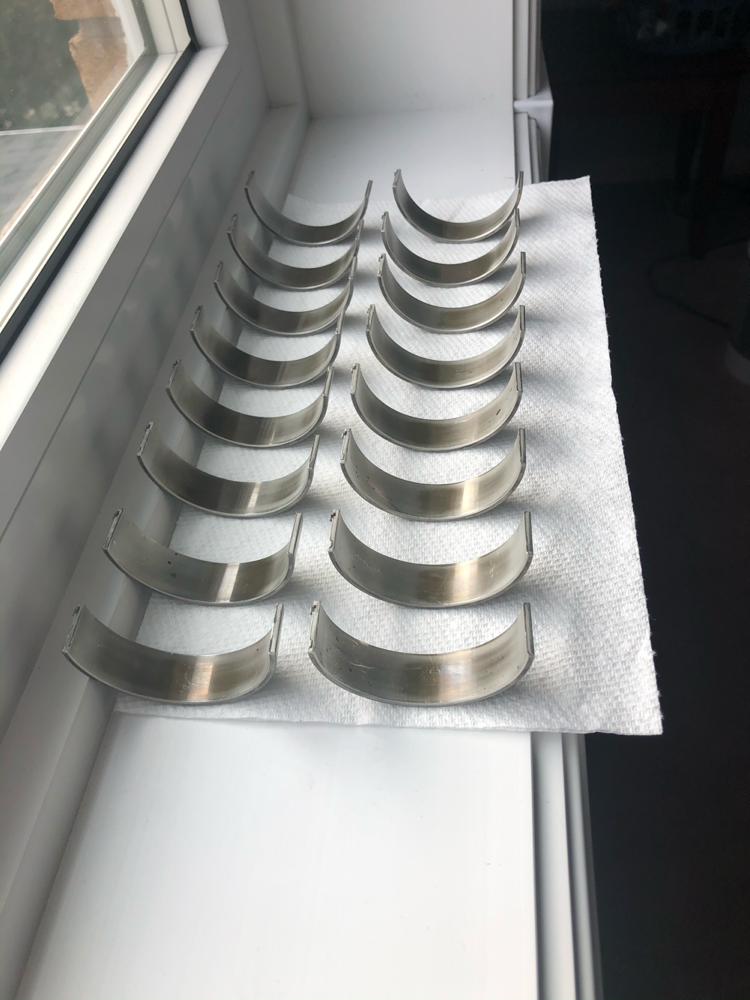
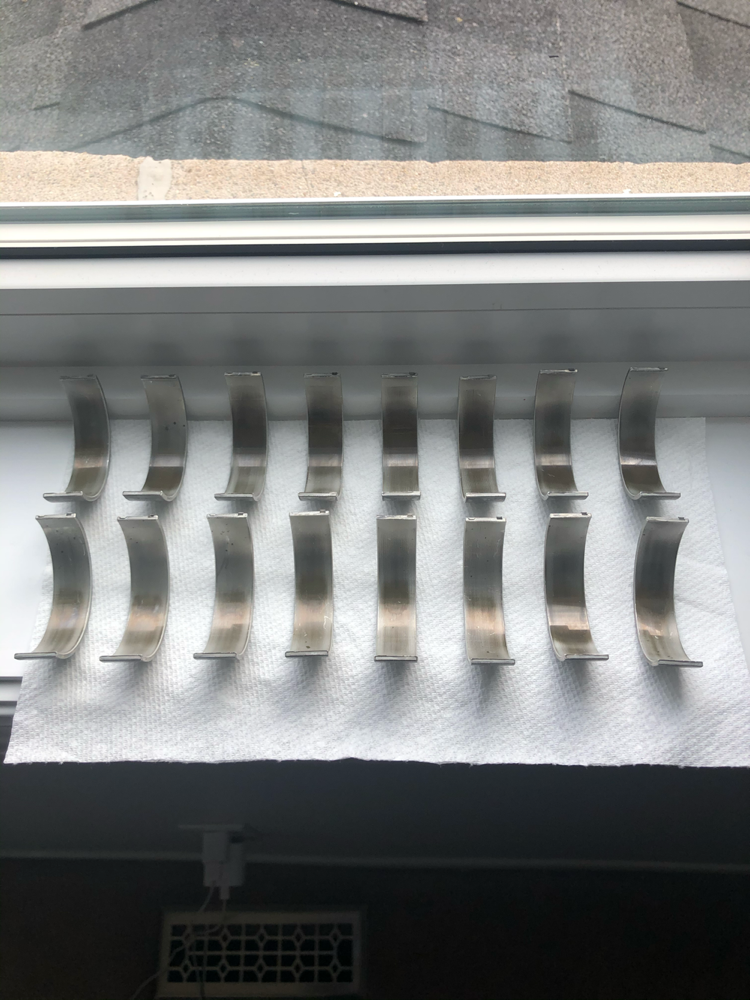

Lots of discussion on what bearings to get I went with BE and BE/ARP bolts and had Rocco at RMP Motors in Toronto swap them out and change my worn out motor mounts. Cars running buttery smooth.
Do people replace the bearings with OEM ones? a reputable local shop was saying they do this type of job but they only use OEM parts.
tonymac1 wroteI've encountered a few locally that will do OE replacements exclusively. Usually is a signal that they've done few or none of these and don't want to research options.Do people replace the bearings with OEM ones? a reputable local shop was saying they do this type of job but they only use OEM parts.
Try asking them to install BE / ACL / VAC and you'll be replied to with "sure, with an extra hourly rate because you bring your own parts and no warranty on the job".
Run.
tonymac1 wroteThis is a telltale sign that the shop isn't familiar with this job or the rod bearing issue. Any shop can be reputable but still not a specialist on a particular platform.Do people replace the bearings with OEM ones? a reputable local shop was saying they do this type of job but they only use OEM parts.
deansbimmer wroteThanks, actually found two distributors in my area for BE bearings and will probably go for these guys if I end up having them replaced.tonymac1 wroteThis is a telltale sign that the shop isn't familiar with this job or the rod bearing issue. Any shop can be reputable but still not a specialist on a particular platform.Do people replace the bearings with OEM ones? a reputable local shop was saying they do this type of job but they only use OEM parts.
2011 with ~59,300 miles. Getting BE bearings installed. Can finally drive the car a little more stress free!

