

Mr. C4 wroteThen I'm all outta ideas. Sorry. Do let us know if u manage to solve the problem.I don’t know man, my mechanic is a very well seasoned race mechanic, with his own M3 collection of various models so he knows his stuff.
4.8KVIEWS
43REPLIES
11APPRECIATES
01-14-2024LAST POST
Mr. C4 wroteIf that's the case, then why are you on here asking other forum members for input?I don’t know man, my mechanic is a very well seasoned race mechanic, with his own M3 collection of various models so he knows his stuff.
Have you asked your mechanic his thoughts?
Rubber wears, has more movement than solid bushings, and that would cause the squirmy feeling you may have.
I noticed on track that my car has a similar feeling at higher speeds moving around track.. My whole rear subframe is OE so I suspect its the bushings also.
I've been in a 1 series BMW that had bad subframe bushings and the car was all over the place. We did solid subframe bushings and the car felt 10x better.
Its worth the few bucks to do it if you're not happy with how your car feels.
-Frank
1FastSicilian wroteWell, in that case I am sorry for asking…. Just searching for other E90 M3 owners that have had similar issues but have found solutions.If that's the case, then why are you on here asking other forum members for input?
Have you asked your mechanic his thoughts?
Rubber wears, has more movement than solid bushings, and that would cause the squirmy feeling you may have.
I noticed on track that my car has a similar feeling at higher speeds moving around track.. My whole rear subframe is OE so I suspect its the bushings also.
I've been in a 1 series BMW that had bad subframe bushings and the car was all over the place. We did solid subframe bushings and the car felt 10x better.
Its worth the few bucks to do it if you're not happy with how your car feels.
-Frank
Mr. C4 wroteAs FastSicilian and I described, we have had those issues and the fix was solid subframe bushings. But somehow it wasn't what you were expecting to hear? Were you having some other fix in mind?Well, in that case I am sorry for asking…. Just searching for other E90 M3 owners that have had similar issues but have found solutions.
Redd wroteThanks for your input, never questioned it or expected anything, I was just looking to hear from other owners that have or have had similar experiences. My intention was not to question or doubt those that guve input. All I did was to quote what my mechanic stated.As FastSicilian and I described, we have had those issues and the fix was solid subframe bushings. But somehow it wasn't what you were expecting to hear? Were you having some other fix in mind?
OP, were you able to fix the handling issue? What did you end up doing to resolve the handling?
Please let us know!!
Please let us know!!
BimmerMan33 wroteHi! No, not really. Had a 2nd alignment done, installed 15mm spacers all around and played with tire pressures and it somewhat improved.OP, were you able to fix the handling issue? What did you end up doing to resolve the handling?
Please let us know!!
Mr. C4 wroteHow many miles have you put on the Conti’s? I wonder if it’s tread squirm that you’re feeling with full height tread blocks on a different brand tire? If you have < 500 miles on them then the mold release agent on the tires could also be contributing to the squirm.Hi! No, not really. Had a 2nd alignment done, installed 15mm spacers all around and played with tire pressures and it somewhat improved.
If it’s not this and you’ve swapped dampers-springs then that pretty much leaves suspension arm bushings and subframe bushings.
I replied because I had this issue but you haven’t taken my advice, or others. Our cars work, yours doesn’t. Go figure!
Toe in rear
Neutral front
Correct tire pressures
I don’t know how else to make this horse drink.
Toe in rear
Neutral front
Correct tire pressures
I don’t know how else to make this horse drink.
Bimmer Barney wroteOP was 08/06/22I replied because I had this issue but you haven’t taken my advice, or others. Our cars work, yours doesn’t. Go figure!
Toe in rear
Neutral front
Correct tire pressures
I don’t know how else to make this horse drink.

16 months and it’s not addressed?!?! I didn’t read through all posts. So rear is toed out? That’s going to make things a bit difficult unless you prefer oversteer all the time while cornering and applying power. Address the basic things first.
Reason for slow progress on the car is because I only drive it 4 weeks per year as I live abroad and only go back home in the summer. Don’t want to spend all those precious 4 weeks chasing car issues 😂as I have other cars to enjoy. The Contis have done about 1250 miles. Attached is the last alignment done in July 2023. Sorry but the report is in Swedish but the rear values first and current values are on the far right on the report.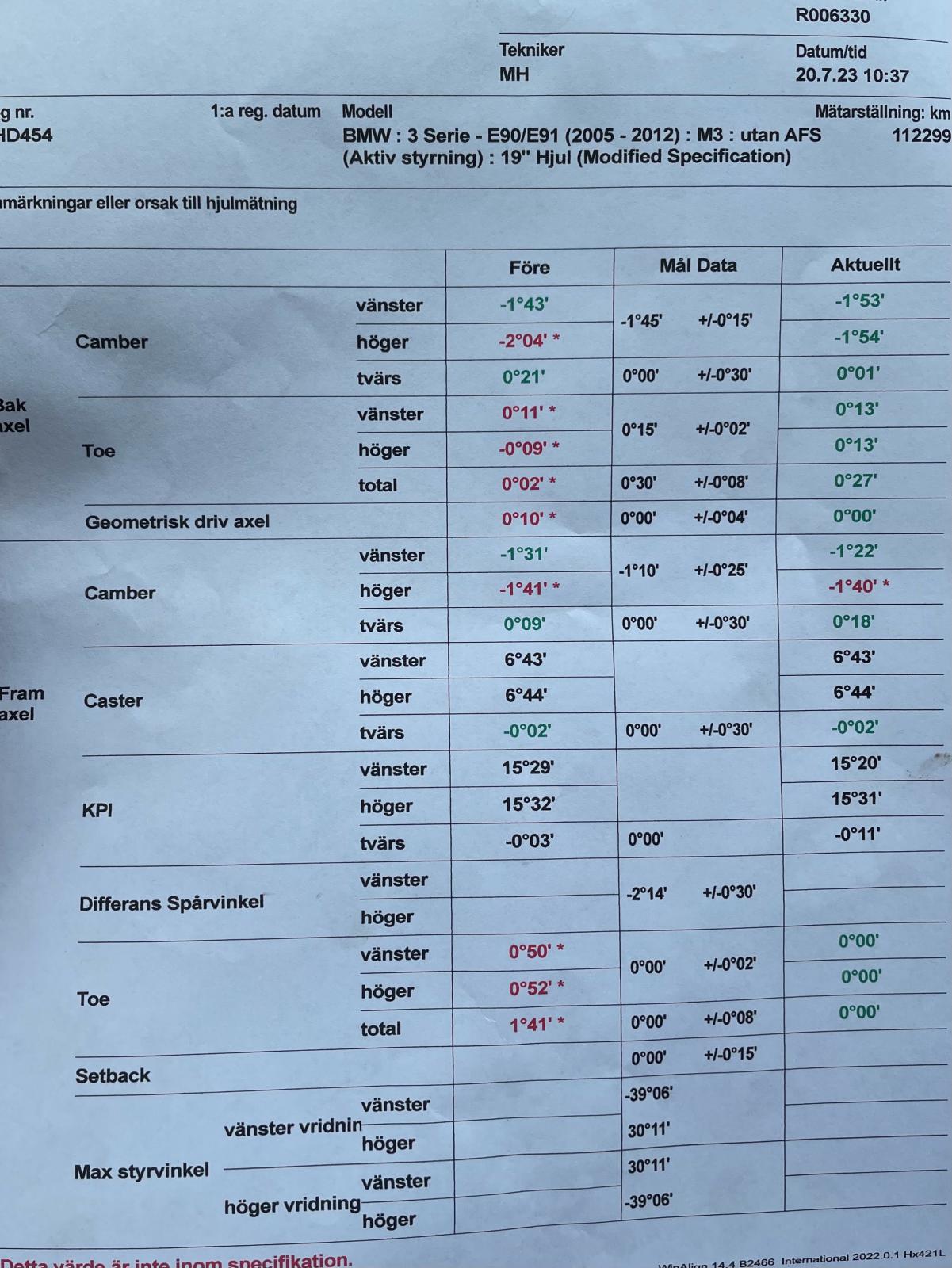
 Mr. C4 I'd be curious to see actual condition of your rear toe arm bushings. Under hard braking, all wheels naturally try to toe out, so maybe you could be experiencing a dynamic toe change that moves you toward zero or even positive toe out in the rear due to rear toe arm bushing deflection? The stock rear toe arms deflect quite a bit in both acceleration and braking changing toe value.
I know on my F82, the rear toe arms deflect enough under acceleration in a straight line to make the car squirm and make the rear end steer to the right. Adding aftermarket race toe arms with bearings and eccentric lockout plates really fixes the rear end both in acceleration and high speed braking. I need to do those arms to my e92 m3 now.
MineralWhiteF80 wroteMy Porsche 996 turbo suffers from the same as what you describe but it produces a hell of a lot more torque. Do you have any partict toe arm kit in mind or that you would recommend?
I know on my F82, the rear toe arms deflect enough under acceleration in a straight line to make the car squirm and make the rear end steer to the right. Adding aftermarket race toe arms with bearings and eccentric lockout plates really fixes the rear end both in acceleration and high speed braking. I need to do those arms to my e92 m3 now.
Mr. C4 wroteI have the SPL Parts rear toe arms with their eccentric lockout kit on my F82 and its basically identical to the E90 rear toe arm. It's quite a common issue with the F8x chassis because they are making so much more torque as well, and the car torque steers much more under acceleration than an E9x. Under braking, both E9x and F8x are going to flex the toe arm bushings equally (assuming all else is equally matched).My Porsche 996 turbo suffers from the same as what you describe but it produces a hell of a lot more torque. Do you have any partict toe arm kit in mind or that you would recommend?
https://www.splparts.com/products/bmw-e9x-e8x-rear-toe-links-m-version-eccentric-lockout.html
I like the SPL design because of the locking clamp/bolt design (like a steering rack tie rod end) versus many other manufacturer's standard 'jam/lock nut' that keeps the arm the same length. The SPL is much easier to adjust and maintain its length. Trying to tighten jam nuts tight enough without changing the toe setting is harder and can be frustrating since the toe adjustment is so delicate.
Stock toe arms already use spherical bearings on both ends. So it's not the toe arms causing dynamic toe change. It's the rubber bushes in the other rear suspension locations - upper control arms, spring arm, etc that deflects under acceleration causing dynamic toe-out.
You can check out my rear spherical conversion thread here. And yes, removing all rear rubber bushings made a dramatic improvement to rear end stability and feel with minor sacrifice in NVH.
https://www.m3post.com/forums/showthread.php?t=1781245
You can check out my rear spherical conversion thread here. And yes, removing all rear rubber bushings made a dramatic improvement to rear end stability and feel with minor sacrifice in NVH.
https://www.m3post.com/forums/showthread.php?t=1781245
Redd wroteGreat info! I don't know why I never thought to look, I simply expected the e9x chassis to have the same bushing/balljoint design as the f8x chassis. Interesting they changed from balljoint to rubber bushing design for the f8x chassis.Stock toe arms already use spherical bearings on both ends. So it's not the toe arms causing dynamic toe change. It's the rubber bushes in the other rear suspension locations - upper control arms, spring arm, etc that deflects under acceleration causing dynamic toe-out.
Bimmer Barney wroteI decided to do a little research on toe in and whether it’s defined as positive or negative. I’ve always thought toe in was negative. However, toe in is not always defined as being negative. There are well known companies/websites and alignment machines that have toe in as being a positive measurement. So it’s possible Swedish alignment machines have toe in as a positive measurement and OP’s car has had rear toe in from the start. It makes no sense that toe in/out measurements are not universally negative/positive, they are usually negative/positive.I replied because I had this issue but you haven’t taken my advice, or others. Our cars work, yours doesn’t. Go figure!
Toe in rear
Neutral front
Correct tire pressures
I don’t know how else to make this horse drink.

Toe-in is universally positive toe. I have not heard of any system/machine where toe-in is negative toe. So I was quite confused when everyone was talking about OP having rear toe-out (-ve toe).
Redd wroteI thought the same thing. Just do a search for toe-in measured as negative or positive. I’d say my search results were 60/40 positive/negative. What I learned is it definitely is not universally measured/defined the same way.Toe-in is universally positive toe. I have not heard of any system/machine where toe-in is negative toe. So I was quite confused when everyone was talking about OP having rear toe-out (-ve toe).
I get confused all the time regarding positive/negative value when doing my alignments that I have now resorted to just looking at the elementary level graphics on the alignment rack screen that shows arrows and the tire graphic moving inward or outward as I turn a bolt 
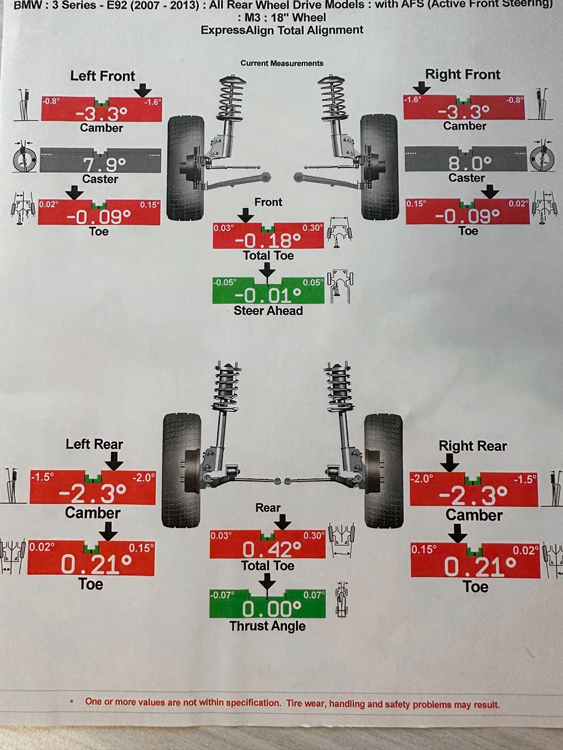
M3SQRD wroteYupp, this is what I stated in one of my early posts. If you look at the results of my last alignment, they are pretty darn good and even, with only the right front camber value being off.I decided to do a little research on toe in and whether it’s defined as positive or negative. I’ve always thought toe in was negative. However, toe in is not always defined as being negative. There are well known companies/websites and alignment machines that have toe in as being a positive measurement. So it’s possible Swedish alignment machines have toe in as a positive measurement and OP’s car has had rear toe in from the start. It makes no sense that toe in/out measurements are not universally negative/positive, they are usually negative/positive.
Too much rear brake bias could cause this .
Change your rear brake pads to less aggressive compound .
Change your rear brake pads to less aggressive compound .
