
Another photo that was posted on a Facebook group. Owner said these have 40k miles of primarily racing on them.
They look pretty good.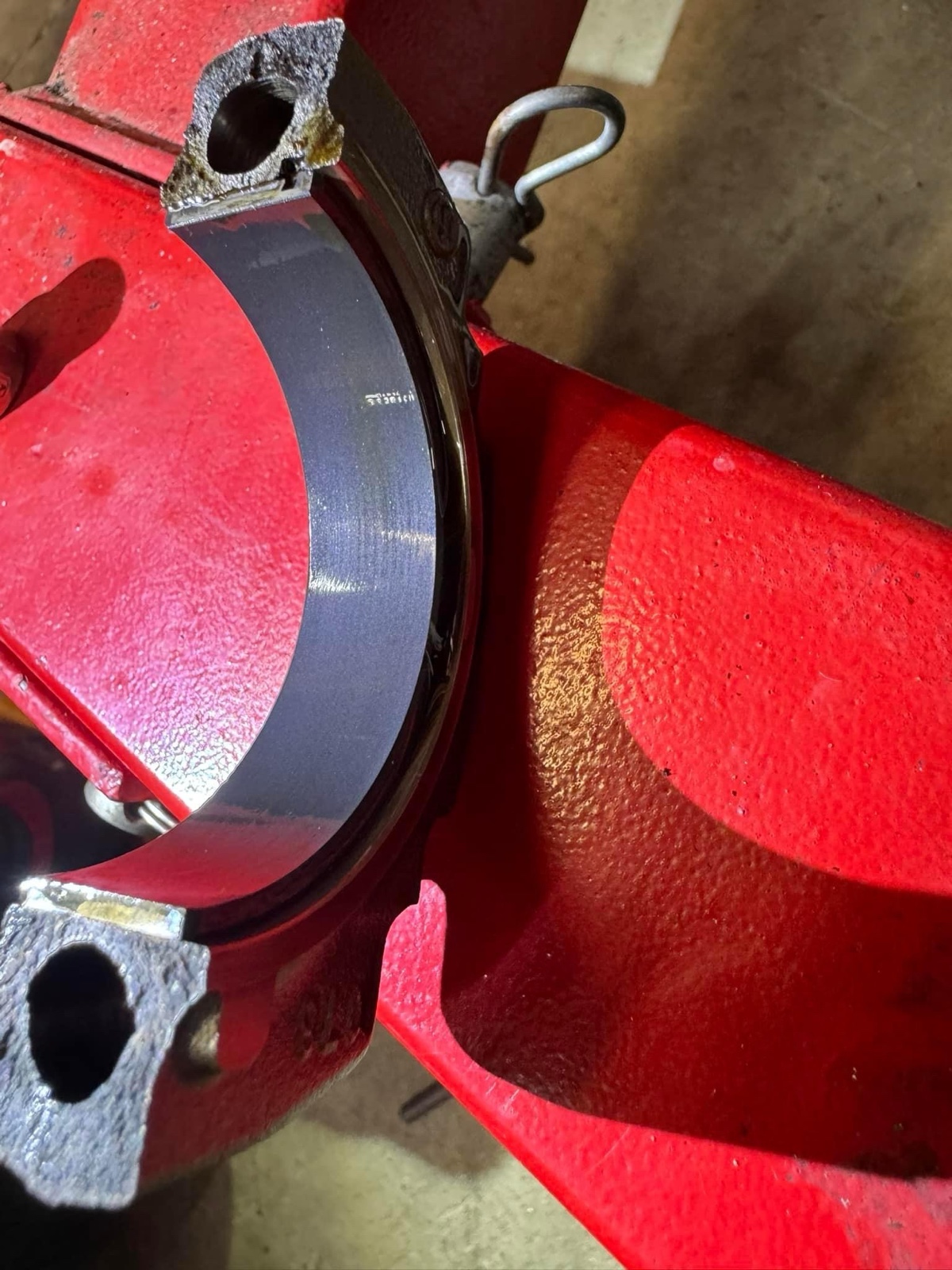
They look pretty good.

Scharbag wroteBMW nominal clearance is 0.046mm, data is taken from the original Glacier Vandervell (not Clevite as claimed) drawing. A copy of this drawing is in my possession, the parts were manufactured in Trento, Italy.This goes round and round.
BMW nominal clearance is less than recommended by EVERY DAMN PROFESSIONAL ENGINE BUILDER ON EARTH!
The failure mode is diagnostic of flow starvation based on available literature (low flow due to tight bearings).
Not one single engine has blown up with properly sized bearings to date (due to rod bearing failure alone).
Many properly sized bearings have been pulled showing pristine shells after many hard miles (search, you can find them).
There is so much good hard data available - I am disappointed that this is still being “debated.”
PaulGros wroteJust because BMW chose a tight nominal clearance does not make it right. Also, design and actual seem to be different. Given we live in reality, actual matters.BMW nominal clearance is 0.046mm, data is taken from the original Glacier Vandervell (not Clevite as claimed) drawing. A copy of this drawing is in my possession, the parts were manufactured in Trento, Italy.
I'm very aware of the various publications, in fact I was part of the team responsible for one of them.
Now, as we have established that the OEM bearings are not too tight, maybe you want to revise your conclusions? For reference, data from BE WIKI actual measurements gives the following if we use average and not best or worst case we find all currently bearings a remarkably similar i.e. less than 0.002mm (.00008") including OEM parts. If it is a clearance issue then failures will be occurring on all brands of bearing. Run the data.
I have seen failed aftermarket bearings, I'm sure if you search you will also find cases here. I do agree, they haven't failed due to clearance, in the same way many OEM bearings haven't failed due to clearance.
There is more misinformation than facts on this subject. So the debate continues.
Scharbag wroteNot to throw any fuel on the fire, I already have BE/ARP stuff installed in my car, but if you look closely at that photo does it not look like the coating is coming off toward the parting lines? I dont think that is a red reflection from whatever it is sitting on.Another photo that was posted on a Facebook group. Owner said these have 40k miles of primarily racing on them.
They look pretty good.
iamtrashman wroteIIRC the PTFE coating will come off over time. 40K race miles and these look pretty good.Not to throw any fuel on the fire, I already have BE/ARP stuff installed in my car, but if you look closely at that photo does it not look like the coating is coming off toward the parting lines? I dont think that is a red reflection from whatever it is sitting on.
And if I am understanding the Mahle paper correctly, maybe that coating coming off is just normal bearing behaviour and not a cause for concern anyway.
Anyway, I dont have much of a horse in this race, I dont feel like changing my bearings to BE is going to cause my engine to explode, but lets be honest about how much data we have about "good" looking aftermarket bearings coming out of engines. What is it, 0.1% (being pretty generous here) as many photo examples as we have of used OEM bearings?
The OEM ones don't visually look great coming out of engines especially with high miles but SOME of them actually do look alright, I think it would be silly to say that isnt the case, unless we saw as many aftermarket ones come out and had just as many visual examples, the 3-5 images of used ones I have seen seem to have a looooot of faith riding on them.
Just some food for thought. I still am of the opinion that I havent seen many factory bearings come out "looking" good. Whether or not they were all about to fail I dont have the expertise to say.

PaulGros wroteCan you please provide the shell thicknesses and shaft diameter that went into these calculations. Neither are published by BMW, and both are necessary to allow people to understand how these numbers were derived. Since you have a copy of the blueprint, both will be on there.1. OEM bearings theoretical clearance is 0.029 - 0.062mm with nominal 0.046mm – source OEM drawing.
iamtrashman wroteI raised the same point with the original poster. I circled the parts you mentioned and asked if he had more pictures. He doesn't and he stated it was a lighting issue and there was no damage. I took his answer at face value, he has the bearings, I only have a picture on Facebook :-)Not to throw any fuel on the fire, I already have BE/ARP stuff installed in my car, but if you look closely at that photo does it not look like the coating is coming off toward the parting lines? I dont think that is a red reflection from whatever it is sitting on.
And if I am understanding the Mahle paper correctly, maybe that coating coming off is just normal bearing behaviour and not a cause for concern anyway.
Anyway, I dont have much of a horse in this race, I dont feel like changing my bearings to BE is going to cause my engine to explode, but lets be honest about how much data we have about "good" looking aftermarket bearings coming out of engines. What is it, 0.1% (being pretty generous here) as many photo examples as we have of used OEM bearings?
The OEM ones don't visually look great coming out of engines especially with high miles but SOME of them actually do look alright, I think it would be silly to say that isnt the case, unless we saw as many aftermarket ones come out and had just as many visual examples, the 3-5 images of used ones I have seen seem to have a looooot of faith riding on them.
Just some food for thought. I still am of the opinion that I havent seen many factory bearings come out "looking" good. Whether or not they were all about to fail I dont have the expertise to say.
Green-Eggs wroteAs it's not my data to disclose I will need to check. It was provided to me with a note explicitly stating it should not be shared. I think any company would be the same with an OEM print.Can you please provide the shell thicknesses and shaft diameter that went into these calculations. Neither are published by BMW, and both are necessary to allow people to understand how these numbers were derived. Since you have a copy of the blueprint, both will be on there.
 PaulGros
Product wroteNot too bad considering the mileage!Work completed @ MPORIUM BMW, LLC
Fantastic folks over there.
2010 M3 sedan DCT
147,852k miles on original bearings.
Assimilator1 wroteI have the complete data analysis from the OEM bearings that was rerun 02.02.2024 when I asked if the OE drawing could be checked. The following was rechecked:So far their has been very few photos shown of pulled increased clearance bearings (btw I also have not seen any cases so far of increased clearance bearings pulled having failed, bar other causes).
There are a few examples I have here (also include std clearance coated bearings):-
Good condition, aftermarket bearings pulled
1. Deansbimmer - (122k miles total) 52k miles supercharged with VAC/Clevite bearings (increased clearance), 14/1/20 - https://www.m3post.com/forums/showpost.php?p=25681122&postcount=1386
2. toolshed - 31k miles, BE bearings, 26/7/18 (only 1 shell shown) - https://www.m3post.com/forums/showpost.php?p=23505818&postcount=1114
3. Malek - 33.5k miles, old design VAC/Clevite (slightly reduced clearance! Also a close up of an LCI bearing), 30/12/14 - https://www.m3post.com/forums/showthread.php?t=1073979
4. maicol76 - 6-12k miles, lots of track use, VAC bearings, https://www.m3post.com/forums/attachment.php?attachmentid=1796920&stc=1&d=1522589580
5. SYT_Shadow - 25k miles on BE bearings, mostly track use. (No1 mains spun).Photos taken from 'blown engine thread pt2' - https://www.m3post.com/forums/showpost.php?p=25986925&postcount=93
6. scrippy - 98k miles on WPC bearings, replaced due to cracked sumps and oil loss! Photo is poor quality, but bearings seem good. https://www.m3post.com/forums/showpost.php?p=22895612&postcount=612
7. akkando (from FB) - 40k miles, poor quality pics - https://www.m3post.com/forums/showpost.php?p=27059222&postcount=1947
8. Green-eggs - 4k track miles, nearly exclusively, ~1000hp!! BE bearings https://www.m3post.com/forums/showpost.php?p=27404422&postcount=2197
9. tlrid3r - OEM WPC shells, 48k miles, mostly track use, 15w/50! Only 2 shells shown - https://www.m3post.com/forums/showpost.php?p=28216892&postcount=2406
10. turbotko - WPC shells, 50-60k - https://www.m3post.com/forums/showpost.php?p=29218229&postcount=2614
11. CamasM3e93 - 65k miles, VAC Clevite, supercharged! - https://www.m3post.com/forums/showpost.php?p=30624523&postcount=2885
12. charliev68 - 40k miles, WPC ???? - https://www.m3post.com/forums/showpost.php?p=30692357&postcount=2936
One thing I wonder, seeing as the new Mahle MS S65 bearings have increased clearance vs OEM (and I do recall that you said they did that because of the composition they choose for their own bearings, different compositions require different clearances).
I wonder what would their simulation program say the clearance should be for the OEM CL113 bearings?
If it came out at 0.046mm still, then that would bolster your case for the OEM clearance not being the problem.
However if it came out noticeably larger then that, then it could indicate that the OEM clearance was insufficient and contributory to the worn bearings.
Not too bad considering the mileage!
The picture is a little on the small and dark side though, could you see copper on any of the bearings?
PaulGros wroteI love the "I've got a secret but I won't tell"I have the complete data analysis from the OEM bearings that was rerun 02.02.2024 when I asked if the OE drawing could be checked. The following was rechecked:
Contact pressure
Bearing Hoop stress
Housing Hoop stress
Clearances
No anomalies were seen when compared to the original data. Unfortunately I can't share this data.
It's interesting that your list also contains OEM WPC treated bearings. My understanding of the process is it has a negligible impact on material dimensions, yet they are showing no wear even though clearance in theory is unchanged?
Brandoch wroteMore I can't tell - it's covered under a non disclosure agreementI love the "I've got a secret but I won't tell"
Move this stuff to your own thread, this is getting impossible to follow now.

powerbait wroteReally? 5/40 and no issues? This is really confusing me. So many say stick with 10/60.Finally got around to doing these. 2010 with 60,621 miles, factory serviced with 10w60 while it was still under the maintenance plan with the last dealer service being around 27.5k miles. The next OCI, about 5k miles, servicing it myself I switched to Mobile 0w40 for a few OCIs, also tried some LiquiMoly 5w40 for a couple of OCIs but the last couple have been Mobil 5w40. I've done 6-7 HPDEs with a few being 2-day events. I am religious about warming the car up, and ensure it gets exercised up to its 8600 redline every time I drive it. It's been running a TTFS tune since 36K miles.
PaulGros wroteWhat I meant was, that this is a picture thread. EVERYONE who is discussing the technical and engineering aspects should create a new thread on that.More I can't tell - it's covered under a non disclosure agreement
Move it to a new thread? I'm responding to a specific question I was asked and tagged in?

KawBoy wroteLooks a bit sad, like most do regardless of mileage. You clearly punished the car without warm up and changed oil per BMW 15k recomendation tops.Engine had about 27k miles on it.
Helmsman wroteNot the case here; engine always run for about a minute or so before taking off [old school] and engine oil is religiously changed at 3k miles intervals.Looks a bit sad, like most do regardless of mileage. You clearly punished the car without warm up and changed oil per BMW 15k recomendation tops.
KawBoy wroteHaha, got it mate, I was trying to joke around a bit with regards to the various on going RB wear discussions...Not the case here; engine always run for about a minute or so before taking off [old school] and engine oil is religiously changed at 3k miles intervals.

Helmsman wroteI know you were pulling my legs Helms!Haha, got it mate, I was trying to joke around a bit with regards to the various on going RB wear discussions...
Ps. Thought I was OCD with 5k interval, but there is always someone who is worse..!
