11.7KVIEWS
47REPLIES
6APPRECIATES
01-26-2025LAST POST
So several months ago I switched from 10/60 to 5/40. After the switch I was pleased with how rev happy it was, but the car seemed to have lost a little punch, which bothered me as I expected the opposite. I looked around here and discovered that although the majority felt that their car seemed quicker on 0w40, several people had the same feeling I did, that the car just didn't seem as stout after the change. Of course they were promptly told they were wrong, thinner oil equals more power, placebo effect, etc, but after doing some research on my next oil recently I came across this on the corvette forum which got me thinking about it again:

"Thinner oil will typically increase HP because of less viscous drag and reduced pumping losses, compared to thicker oils. That is why very serious Race efforts will generally use watery thin oils in their engines. But, an exception to this increase in HP would be in high rpm hydraulic lifter engines, where thinner oil can allow the lifters to bleed-off at higher rpm."

That's a small part of a very good write up that can be found here:

http://www.corvetteforum.com/forums/c3-tech-performance/3353781-0w40-vs-5w30-vs-0w30.html

But that got me wondering if possibly this can happen with our high rpm hydraulic lifter s65 engine? Anyone have any knowledge on the subject? Could bmw have spec'd the 10/60 for this reason? I'm posting this because I'm trying to find a mechanical reason why my car seemed to lose something when I switched to the 5/40, which mechanically doesn't make a lot of sense. Any input welcome.
I switched to motul 5w40 about 600 miles ago from 10w60, car is much smoother etc. Can't say I have noticed any loss in power at all though. Im supercharged so this may be affecting that but shes pulling just as strong as ever.
Do love how the car feels with the 5w40 though, so even if I was loosing a tad of power I would still keep it. Pending blackstone report that is
Your engine lost nothing with the 5W40, it is still a 40W at operating temperature. Do back to back dynos and then we can talk. Until then, you are just buying into a myth, the oil is not getting pushed out of the lifters at high RPM. The amount of HP gain/loss from oil is negligible at best. Besides, the S65 is rev happy even with the 10W60.
I noticed nothing going to M1 0w40 except that I get up to operating temp much more quickly than before.
BMRLVR wrote
Your engine lost nothing with the 5W40, it is still a 40W at operating temperature. Do back to back dynos and then we can talk. Until then, you are just buying into a myth, the oil is not getting pushed out of the lifters at high RPM. The amount of HP gain/loss from oil is negligible at best. Besides, the S65 is rev happy even with the 10W60.
That's exactly what I decided to do after making the original post last night, dyno before taking out the 5/40 and again after switching to whatever I decide upon. Seems like the only way to quantify (or not) my perception. I'm not looking for peak number changes so much as looking for any changes to the area under the curve. Not sure what myth I'm buying into though because until last night I'd never heard of this thin oil/lifter connection:).
Doc,

I've dyno'ed my car with M1 0W40, the chart looks like any other chart from Dynojet, the engine makes power all the way to redline, flat torque curve after 2500rpm or so.

My car made 357hp/262ft-lb on a 104F day here in So. Cal.

I keep on telling myself with a tune/test pipe/lower temperature, my car could be pushing 400whp!! :)

Image hosted on: hyperrevmoto.com
Your dyno flattens out at top
Leonardo629 wrote
Doc,

I've dyno'ed my car with M1 0W40, the chart looks like any other chart from Dynojet, the engine makes power all the way to redline, flat torque curve after 2500rpm or so.

My car made 357hp/262ft-lb on a 104F day here in So. Cal.

I keep on telling myself with a tune/test pipe/lower temperature, my car could be pushing 400whp!! :)

Image hosted on: hyperrevmoto.com
Thanks for sharing. You don't have one from when you were on 1060 do you? That'd save me a lot of time and money:). The way your powerband flattens out in the highest rpm range is interesting too. Most dyno's I have seen climb to redline. This actually seems to work with the lifter theory, not against. You are pretty flat after 7k.
it only appears so because all three lines are so close together.

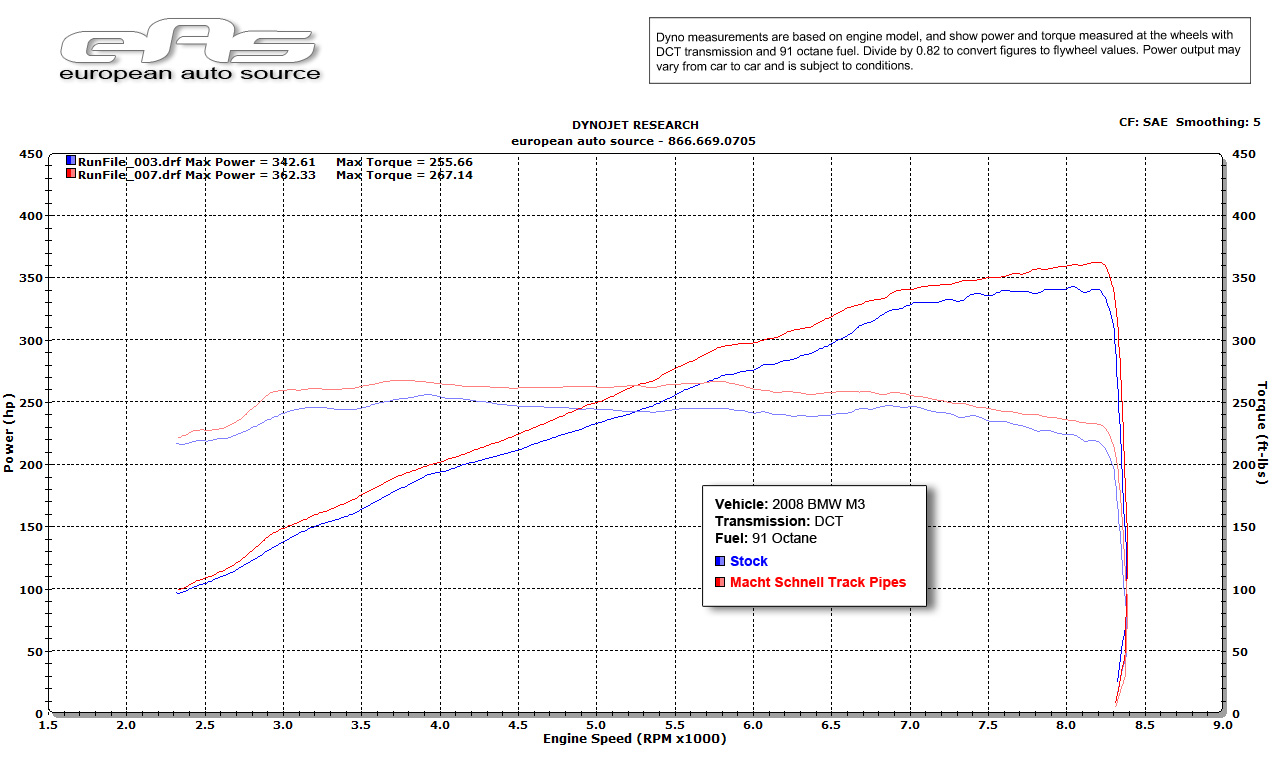
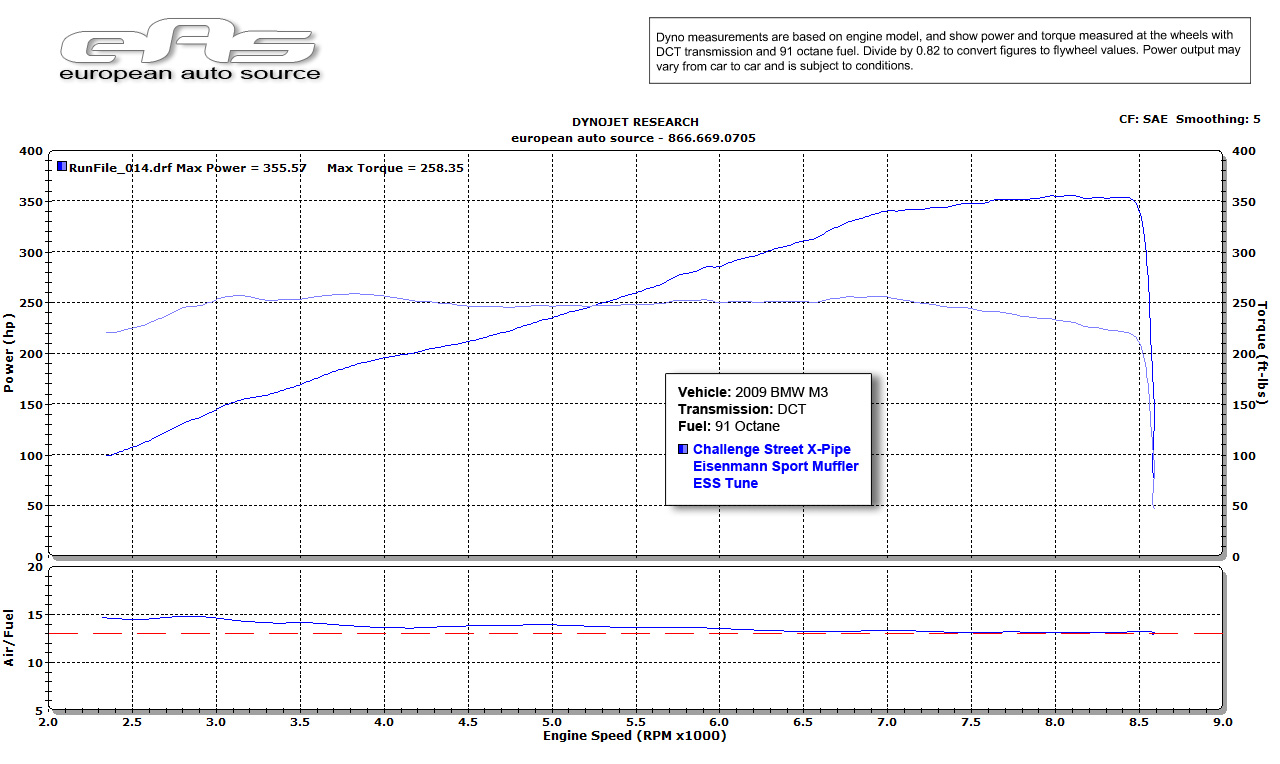
Here's another one from EAS

Image hosted on: farm9.staticflickr.com

Image hosted on: farm9.staticflickr.com
Yeah, it does make it difficult to tell. Not sure if its anything at all. I was comparing to this:
Attached image
well..I guess I have a lifter problem LOL....not switching back to 10W60 though

**all S65s sorta flatten out a bit after 7000RPM**
Probably has more to do with mods than anything.......but the car was designed for using a 1060 with a vis @ 100c of around 21 wheras a 0w40 is in the high 12's to low 14's (except redline which is 15.6 and what I'm considering switching to). That's a helluva difference there. And if a large drop in viscosity does/could cause lifter bleed off you'd expect it to happen in that rpm range. I have no idea what effect that'd have on the powerband though and it's really pointless to speculate without a before dyno on 1060.
Maybe the Porsche engineers will learn from this thread. They spec 0W40 for the GT3 that revs to 9000 and uses hydraulic lifters.
pbonsalb wrote
Maybe the Porsche engineers will learn from this thread. They spec 0W40 for the GT3 that revs to 9000 and uses hydraulic lifters.
We all know 0W40 is used so it doesn't make too much power, the gap is needed between GT3 and GT3 RS.
It's interesting the usual suspects arrive and dismiss the thought by the OP with no objective or thoughtful response. Just like bearing clearance is a tgeory, why not consider reasons bmw actually chose 10w60. I pointed out another which also was scoffed at.
1. Vanos relies on oil pressure to operate.accurately.
2. Lifters rely on oil pressure.

Why would changing oil not impact these things and many others?
Leonardo629 wrote
We all know 0W40 is used so it doesn't make too much power, the gap is needed between GT3 and GT3 RS.
In fairness , it's oil pressure that matters so size of oil channels, bearing clearance, oil pump used all totally dictate oil pressure in addition to oil. So you can't make a blanket comparison since Porsche species that oil, they obviously ensured it provided optimus pressure
Here's the thing: Porsche didn't originally spec 10w60 for the GT3 and then the Porsche community decided to go 0w40 (against porsche recommendations) so I don't see a correlation. I'd be shocked if the factory spec'd oil wasn't the best choice for the GT3. I'm sure the engine is designed and tested with 0w40 in mind. However, that really has no bearing on what happens at 8000 rpm in the s65 when you reduce the recommended viscosity by 30%. Some data on that would be nice. In 8 years has no one ever dyno'd the same car, same day with different viscosity oil? Any other kind of tests?
8600RPM wrote
It's interesting the usual suspects arrive and dismiss the thought by the OP with no objective or thoughtful response. Just like bearing clearance is a tgeory, why not consider reasons bmw actually chose 10w60. I pointed out another which also was scoffed at.
1. Vanos relies on oil pressure to operate.accurately.
2. Lifters rely on oil pressure.

Why would changing oil not impact these things and many others?
Thank you! My point exactly is that we are changing from bmw recommended oil based solely on the bearing clearance/cold start wear issue, without thought to what other effects (if any) this might have.
If other car enthusiasts had documented this sort of issue on a wide scale, I would bite. But they have not as far as I can tell. Honda and Porsche both run thin oil in high rpm hydraulic lifter motors without issue.

I have noticed some dynos flattening out on the top end and always assumed it was misfire or timing related -- old plugs or weak coils or fuel octane that did not allow maximum timing. Maybe the OP is onto a discovery, but I'll wait for conclusive dyno testing before changing from 0W40 to 10W60.
pbonsalb wrote
If other car enthusiasts had documented this sort of issue on a wide scale, I would bite. But they have not as far as I can tell. Honda and Porsche both run thin oil in high rpm hydraulic lifter motors without issue.

I have noticed some dynos flattening out on the top end and always assumed it was misfire or timing related -- old plugs or weak coils or fuel octane that did not allow maximum timing. Maybe the OP is onto a discovery, but I'll wait for conclusive dyno testing before changing from 0W40 to 10W60.
I'll be dynoing it around Halloween before and after the oil change but I'm not going to put 10/60 back in so I'm not sure how much data it'll provide. I like the idea of a 0w because of cold start wear, but the pu 5/40 I'm using now has a viscosity at 100c of 13.1, which worries me considering tws is in the mid 18's, so I am looking at the redline 0w40 which has the highest viscosity I have seen at 15.6. I'm surprised more people here don't use it. I know some of the bitog guys say it increases wear metals due to the add pack but it seems to have the best of both worlds. A 0w with a viscosity almost 20% higher than any other 0w or 5w40 seems like a great choice. Not sure if it'll show any diff on a dyno though...not that dramatic of a change.

Keep in mind that all of this is conjecture on my part. I dropped viscosity, noticed a difference, and have been curious since. I'd all but decided it really was in my head until I stumbled on the article I quoted in the first post. That was the first thing I'd ever read that mentioned the lifter bleed/thin oil connection....and of course I immediately thought "hey, I have a high revving hydraulic lifter engine that experienced a change in power and after going thin". I could be completely wrong and am certainly not married to the idea, but the fact that no one has done much research into the effects of drastically reducing the oil viscosity on the s65 is puzzling.
If I was losing 20 rwhp due to valve float from collapsing lifters up top, I would put 10W60 back in rather than try a compromise oil that might lose only 10 rwhp up top.

My understanding is that a year or two ago the engineers at BMW revised the oil spec for the S65 to include any weight LL-01 rated oil such as Mobil 1 0W40, Castrol 10W60, and Castrol Edge Professional 5w30. I assume BMW would not have revised the spec to include lighter weight oils if it could result in valve float
That supposed document was nothing more than an error in labelling. At no time as bmw approved anything but 10w60 for use other than emergency top offs with a lower weight.

Again, you can't say any hydraulic lifter engine is the same. It's oil pressure that is key so if an engine is designed with a grade to begin with, the design would incorporate the oil pressure they targeted
We are changing oil pressure in an engine not designed for it. Whether it matters who knows