497.5KVIEWS
1.2KREPLIES
181APPRECIATES
08-12-2026LAST POST
M3MPH1S wrote
Hah yeah, I didn't get into the self maintenance stuff until recently and just followed the computer. I've seen a lot of people on here go with ~7500 but ill probably try 9 or 10k next time and see how it goes
Without TBN and TAN (each are $10 extra), it's hard to determine an appropriate change interval.

Arbitrarily picking the interval will just lead you to waste money or overwork the oil.
GMCHEM83 wrote  
Good catch ! This is when the oil reports DO come in handy, when they alert us of wear like this as it's happening...or yeah, maybe the oil just hasn't been changed in a very long time. Hope you get it all figured out soon.


GM
Thank you!
dparm wrote
Without TBN and TAN (each are $10 extra), it's hard to determine an appropriate change interval.

Arbitrarily picking the interval will just lead you to waste money or overwork the oil.
Fair enough, I'll add them next time. Thanks for the tip.
picked up this 08 last year with 25k miles. first blackstone report attached. thoughts appeciated.
Attached image
4_mpower wrote
picked up this 08 last year with 25k miles. first blackstone report attached. thoughts appeciated.
I'd start saving up for a rod bearing replacement (or buy an extended warranty).
^ damn :/

I ordered a BS oil analysis kit and about to do my first oil change on a 2011.5. My question is I've read that for 2011+ BMW changed the rod bearings and that lead content was no longer an accurate factor for determining the bearings condition in oil analysis reports... is this true? Is it still worth doing the oil analysis on a 2011+ and can rod bearing health still be determined? And if so what are the signs/factors to look at compared to looking at lead content on the earlier engines? Thanks!
BigRussia wrote
^ damn :/

I ordered a BS oil analysis kit and about to do my first oil change on a 2011.5. My question is I've read that for 2011+ BMW changed the rod bearings and that lead content was no longer an accurate factor for determining the bearings condition in oil analysis reports... is this true? Is it still worth doing the oil analysis on a 2011+ and can rod bearing health still be determined? And if so what are the signs/factors to look at compared to looking at lead content on the earlier engines? Thanks!
A 2011+ shows increased ppm's of aluminum .
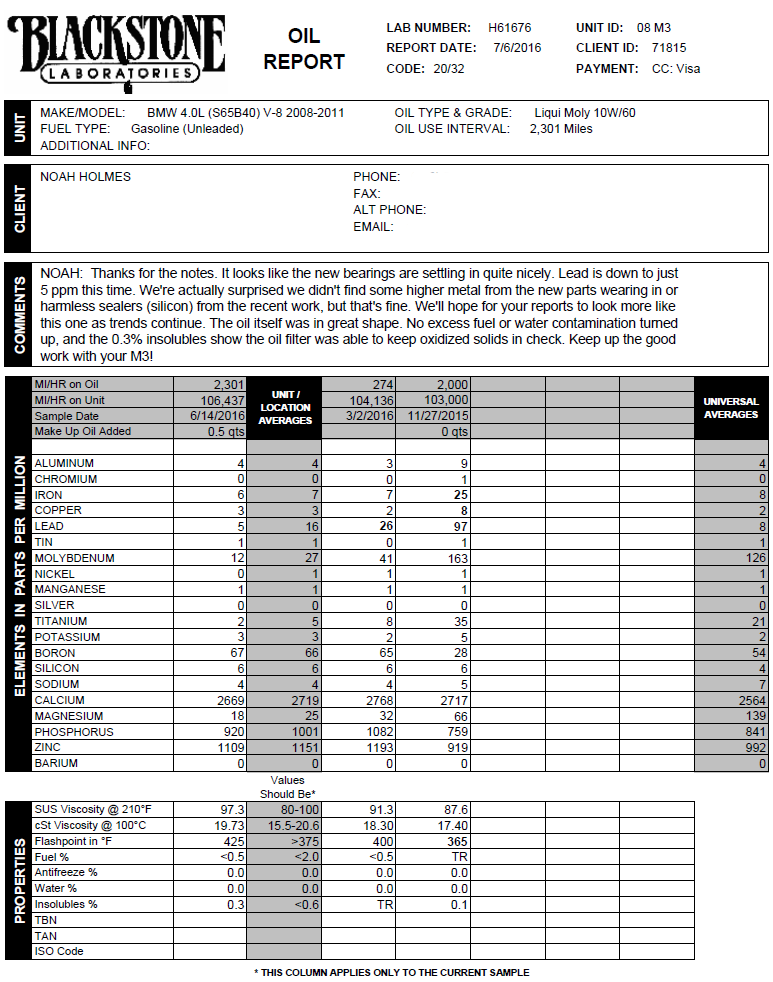
So, here are the results of my Blackstone UOA. This is my first oil test since I installed the new rod bearings back in March.

2,301 miles on the oil and three track days in 100*F California weather.

Image hosted on: img.photobucket.com
Oils used in reverse chronological order:
Redline 5W50
Redline 5W50
Redline 10W60 w/2 qts 5W40
Castrol 10W60

Mileage is in kilometers, not miles.

Went back to Redline 10W60 for the most recent change.

Attached image
I am curious ---what were your reasons to go back to 10-60 Redline from the 5-50?
I am using the 10-60 (summer only driving), though I am interested in the 5-50
Thanks
(Interesting data!)
The switch to 5w50 was partly due to the rod bearing hysteria. Once I saw that 5w50 didn't improve my wear metals, I decided to go back to the 10w60. The first round of 5w50 also lost quite a bit of viscosity vs the 10w60. Second round only had one track day vs. 4 or 5 for the first fill, hence the difference.
Got my first Blackstone Oil analysis report for my 2011.5 M3 (Sept '10 Prod Date) taken at 53,200 miles. From their comments looks like I got some good news, though since I bought the car used I didnt have the exact miles for the oil or make up oil added but I had pretty accurate estimates. I took this sample during a oil change and am now running Liqui Moly 10w60. I already received 2 more sample kits from Blackstone, when should I do my next oil change to get a more accurate sample for trending? Thanks for any comments and inputs.
Attached image
BigRussia wrote
^ damn :/

I ordered a BS oil analysis kit and about to do my first oil change on a 2011.5. My question is I've read that for 2011+ BMW changed the rod bearings and that lead content was no longer an accurate factor for determining the bearings condition in oil analysis reports... is this true? Is it still worth doing the oil analysis on a 2011+ and can rod bearing health still be determined? And if so what are the signs/factors to look at compared to looking at lead content on the earlier engines? Thanks!
The oil analysis will still help establish a baseline for your specific engine and help you determine the proper change interval. It's not worthless just because you have a different set of bearings.
nholmes wrote
So, here are the results of my Blackstone UOA. This is my first oil test since I installed the new rod bearings back in March.

2,301 miles on the oil and three track days in 100*F California weather.
Looks fine. Start paying for TBN & TAN so you can establish a good change interval.
apecush wrote
The switch to 5w50 was partly due to the rod bearing hysteria. Once I saw that 5w50 didn't improve my wear metals, I decided to go back to the 10w60. The first round of 5w50 also lost quite a bit of viscosity vs the 10w60. Second round only had one track day vs. 4 or 5 for the first fill, hence the difference.
Red Line 10w60 is way thicker than stock. You may want to thin it out a bit with another one of their oils. TWS has a native HTHSV of around 5.4, whereas Red Line's is 5.8 -- making it about 10% thicker in operation.
BigRussia wrote
Got my first Blackstone Oil analysis report for my 2011.5 M3 (Sept '10 Prod Date) taken at 53,200 miles. From their comments looks like I got some good news, though since I bought the car used I didnt have the exact miles for the oil or make up oil added but I had pretty accurate estimates. I took this sample during a oil change and am now running Liqui Moly 10w60. I already received 2 more sample kits from Blackstone, when should I do my next oil change to get a more accurate sample for trending? Thanks for any comments and inputs.
You need to start paying for TBN and TAN. Without that, you are guessing on the change interval. Since this is your first report it's hard to say if anything is "bad". The whole point of oil analysis is to establish a baseline for your exact motor and driving habits, then monitor for deviations from it. That being said, there's nothing serious like oil that's thinned out, contaminated with coolant, etc.

For the next one, go to 7,500 and pay for the TBN & TAN.
dparm wrote
You need to start paying for TBN and TAN. Without that, you are guessing on the change interval. Since this is your first report it's hard to say if anything is "bad". The whole point of oil analysis is to establish a baseline for your exact motor and driving habits, then monitor for deviations from it. That being said, there's nothing serious like oil that's thinned out, contaminated with coolant, etc.

For the next one, go to 7,500 and pay for the TBN & TAN.
Cool, I agree and was thinking the same thing, that this first report is just a baseline and doesn't really prove everything is all good especially since I don't know how many oil top offs the PO did since the last oil change. At least I can feel a little better knowing nothing is terribly bad at the moment and can enjoy my car like its meant to be.

I was planning on doing my next oil change and sample at 5k miles actually since i don't drive the car much. Will go for the TBN and TAN too. Thanks for the advice, appreciate it!
Just throwing this out there guys, I ran a uoa mid-failure and still got a healthy report back even when I could see flakes of metal in the oil. Apparently Blackstone can only detect things in a certain micron range but whatever it is, I've gone from being a big supporter of oil analysis to having no faith in them at all.
Doc Oc wrote  
Just throwing this out there guys, I ran a uoa mid-failure and still got a healthy report back even when I could see flakes of metal in the oil. Apparently Blackstone can only detect things in a certain micron range but whatever it is, I've gone from being a big supporter of oil analysis to having no faith in them at all.
I laugh when people type:
"I just sent in a sample for a BS oil analysis"
Doc Oc wrote
Just throwing this out there guys, I ran a uoa mid-failure and still got a healthy report back even when I could see flakes of metal in the oil. Apparently Blackstone can only detect things in a certain micron range but whatever it is, I've gone from being a big supporter of oil analysis to having no faith in them at all.
That's correct, and it's also why you can see weird spikes despite nothing being wrong. It's called particle streaking.

Not sure why people think a UOA is the end-all, be-all of engine health. It's a good indicator of how a particular oil and change interval is working, but only a rough proxy of overall engine health. There are tons of problems that may never show up in the UOA.
dparm wrote
Red Line 10w60 is way thicker than stock. You may want to thin it out a bit with another one of their oils. TWS has a native HTHSV of around 5.4, whereas Red Line's is 5.8 -- making it about 10% thicker in operation.
Both 10W60 changes included a quart or two of 5W40 to try match the virgin kinematic viscosity of TWS.
apecush wrote
Both 10W60 changes included a quart or two of 5W40 to try match the virgin kinematic viscosity of TWS.
Great, that's probably going to work well for you.