

2011 E90 M3
1.2MVIEWS
3.2KREPLIES
3.1KAPPRECIATES
06-01-2026LAST POST
2011 E90 M3
330indy wroteI have tried to find systemic bearing issues on the net. I cannot seem to find any examples of consistent bearing failures for other types of performance cars. Specifically for the Audi R8 V10, there is one case I could find of a spun bearing and the engine was replaced under warranty. And the R8 V10 is a high revving masterpiece.I've spent time on Porsche, GTR and other performance forums.
I've seen plenty of RB issues there also.
We don't have an exclusive on it.
Yes, every engine platform will have an example of a spun bearing here or there. Usually, the cause is a result of something the owner did, not the underlying design of the bearing.
It would be great if you could share the Porsche and GTR bearing issues so that we can compare them to what we are seeing with the S65.
Cheers,
2013 E92
90xxx kms
90xxx kms
Scharbag wroteThere are other problems, but not rod bearing, and especially not with my car, the 997.1 Turbo with Mezger engine. As you wrote, I'm sure there is a rod bearing problem here and there, but not remotely nearly to the degree of BMW M3.I have tried to find systemic bearing issues on the net. I cannot seem to find any examples of consistent bearing failures for other types of performance cars. Specifically for the Audi R8 V10, there is one case I could find of a spun bearing and the engine was replaced under warranty. And the R8 V10 is a high revving masterpiece.
Yes, every engine platform will have an example of a spun bearing here or there. Usually, the cause is a result of something the owner did, not the underlying design of the bearing.
It would be great if you could share the Porsche and GTR bearing issues so that we can compare them to what we are seeing with the S65.
Cheers,
pbonsalb wroteThank you for this detailed and very reasonable answer. I've already decided I'm going to replace mine, so no argument here; just trying to learn a little more.Rod bearings from other brands or models of cars might show pretty much no wear at 100k or even 200k miles. People take apart high mileage S52 from E36 and find little to no wear. But S54 in E46 do show rod bearing wear. Some aftermarket rod bearings have shown wear, some have not. But the sample size — maybe 10 out of thousands changed — is too small to reach any conclusions. I think that the extra clearance bearings will likely end up showing the least wear. BE, VAC and ACL sell extra clearance bearings.
I don’t know the answer to 2. I think n/a engine’s with replaced rod bearings have failed, but due to main bearing failure not rod bearing failure. The same is true of the supercharged motors that failed — it was the main bearings as I recall. Main bearing failures are not common and preventative maintenance is much more expensive. Probably 4 times the labor.
I decided on 60k because my original bearings had wear but were not on the verge of failure at 60k. I feel like the replacement set could go at least that far. If I had pulled them at 30k and they looked the same, I’d be changing in another 30k. If I pulled them at 90k and they looked the same, I’d change in another 90k. If mine had looked worse at 60k, I’d change them sooner next time. We just don’t have any evidence yet as to how many miles to expect from replacement bearings so I would base the interval on how the last set looked at the miles they were pulled. If my aftermarket bearings look great with 60k on them, I’ll increase the interval for the 3rd change.
Mine are wpc treated stock. BE had not yet made bearings in 2014 when I changed mine. I think BE are expensive so I will probably buy ACL next.
1. I was hoping for a better answer, such as "there has been no wear noted in replacement rod bearings" (the way it should be). But we have no such luck, do we?
2. I assume the pro's have determined there is no link between replacing rod bearings and failed main bearing? No cause effect there?
No such luck.
Replacing rod bearings does not cause main bearings to fail. However, failing rod bearings can send debris through oil passages that damages main bearings.
Replacing rod bearings does not cause main bearings to fail. However, failing rod bearings can send debris through oil passages that damages main bearings.
pbonsalb wroteAlso supercharger puts a lot of stress on main bearingsNo such luck.
Replacing rod bearings does not cause main bearings to fail. However, failing rod bearings can send debris through oil passages that damages main bearings.
When the bypass valve is open, the stress is no different than another accessory like an alternator. But when making boost, there is more stress. How much boost and how often is the motor in boost are the questions. Definitely much more stress at full boost - the blower is probably dragging on the crank harder than all other accessories put together. And apparently this motor does not have a particularly sturdy front main bearing. The front takes the most load.
Still, I would supercharge my 100k mile motor.
Still, I would supercharge my 100k mile motor.
cannga wroteThere is a post over in the maintenance section that shows a 50,000KM set of BE bearings.
Thank you for this detailed and very reasonable answer. I've already decided I'm going to replace mine, so no argument here; just trying to learn a little more.
1. I was hoping for a better answer, such as "there has been no wear noted in replacement rod bearings" (the way it should be). But we have no such luck, do we?
2. I assume the pro's have determined there is no link between replacing rod bearings and failed main bearing? No cause effect there?
I realize that a single data point does not prove anything, but it is nice to see any bearing from an S65 with 50,000KM on it that shows a proper wear pattern.
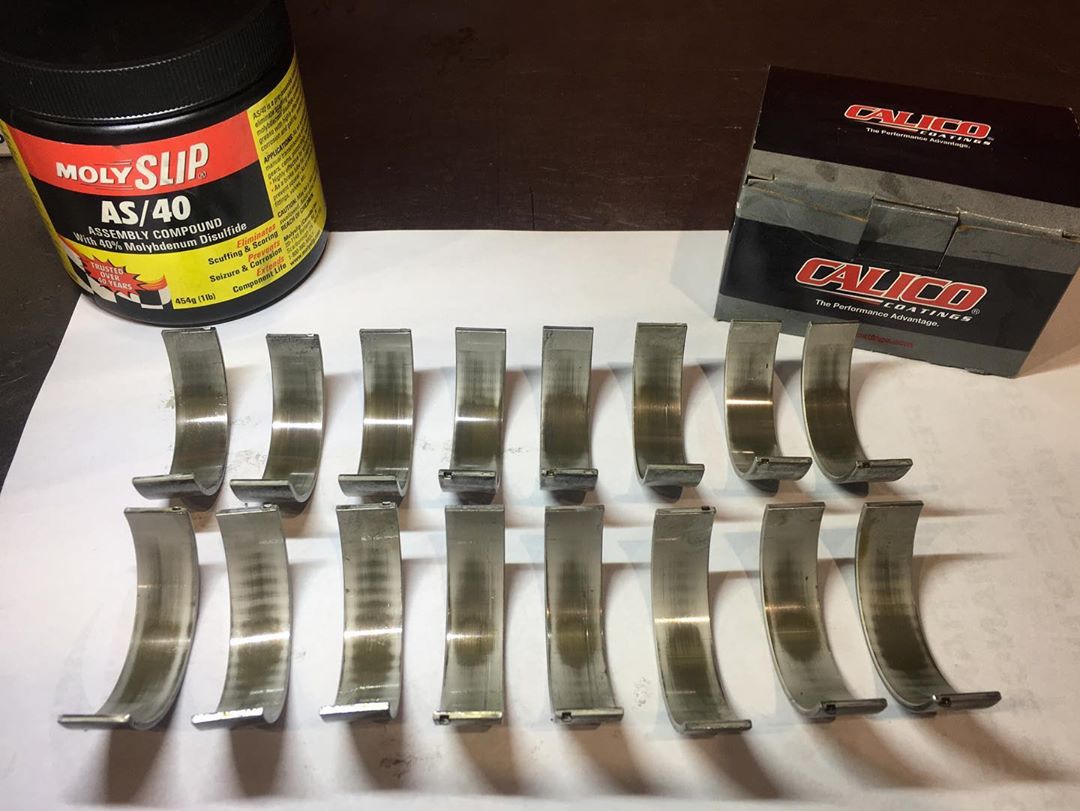
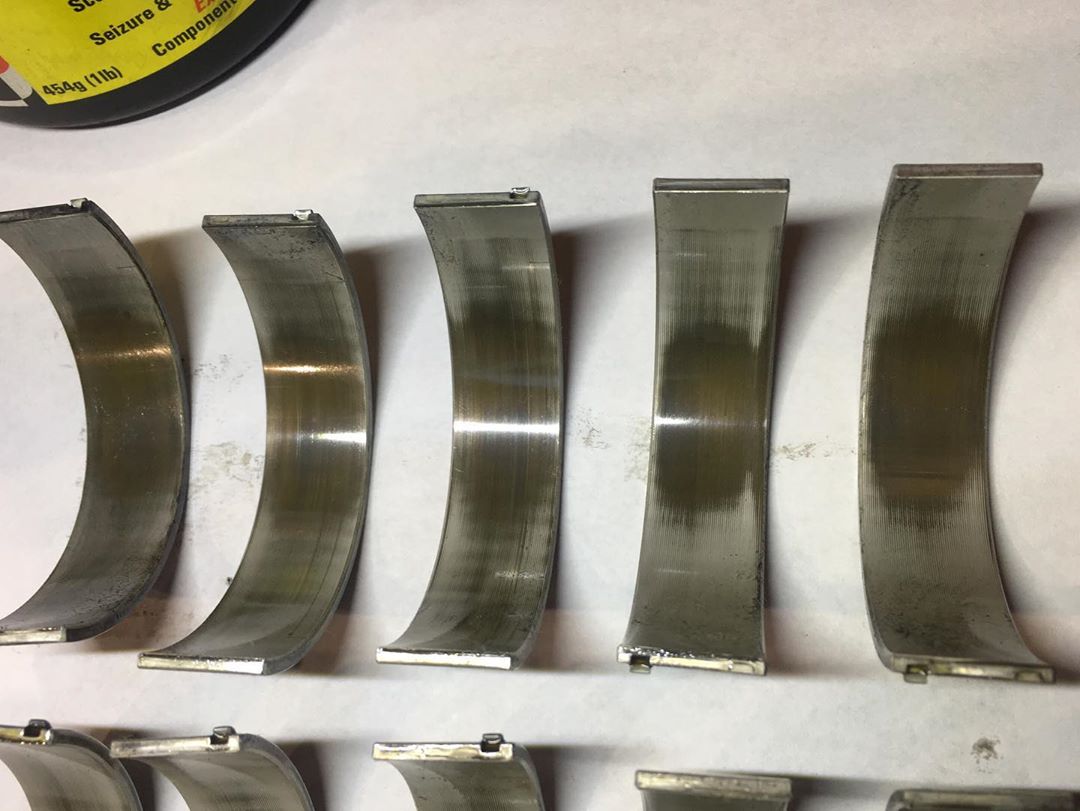
The first photo is from the post linked above. Perfect "wear" pattern on the BE shell.
The second photo are my factory bearings with 30,000KM. Oil changed 6 times by dealer in 27,000KM (7 years) by previous owner... My factory bearings are one of the cleaner examples that I have seen come out of an S65. That said, they still show signs of unacceptable babbitt wear.
Here is hoping that some more people pull their BE, ACL, VAC bearings with reasonable mileage on them to give us some more data points.
Cheers,
Great post and explanation. Thanks guys. I love this car and the V8 engine's sweet response especially around 4k very much (as much as my Turbo's Mezger engine), does seem like I have little choice but to replace bearings.
The next question is whether BE is the "best", and what other notable alternatives. I am searching through all the threads on this forum but any input is very welcome.
From this thread, seems like BE bearings and ARP bolts are the favorite, or at least the most popular? https://www.m3post.com/forums/showthread.php?t=1504908
Other choices:
1. WPC Treated ECS bearings: https://www.ecstuning.com/BMW-E92-M3-S65_4.0L/Engine/Mechanical/
2. VAC, performance coated with Extra Clearance: https://store.vacmotorsports.com/vac-performance-coated-rod-bearing-set-bmw-s65-shells-only-p2932.aspx/
3. ACL, on Amazon and so inexpensive (??) it almost makes me worried . Thread: https://www.m3post.com/forums/showthread.php?t=1490200&page=5
Are these all US made? Also seems WPC treatment is not necessary?
The next question is whether BE is the "best", and what other notable alternatives. I am searching through all the threads on this forum but any input is very welcome.
From this thread, seems like BE bearings and ARP bolts are the favorite, or at least the most popular? https://www.m3post.com/forums/showthread.php?t=1504908
Other choices:
1. WPC Treated ECS bearings: https://www.ecstuning.com/BMW-E92-M3-S65_4.0L/Engine/Mechanical/
2. VAC, performance coated with Extra Clearance: https://store.vacmotorsports.com/vac-performance-coated-rod-bearing-set-bmw-s65-shells-only-p2932.aspx/
3. ACL, on Amazon and so inexpensive (??) it almost makes me worried
. Thread: https://www.m3post.com/forums/showthread.php?t=1490200&page=5Are these all US made? Also seems WPC treatment is not necessary?
And to the most over-hyped least understood "problem" that ever existed. So nice to see how many people throw their money away on this considering less than 1% failure globally. I doubt you would change your eating habits if you had less than 1% chance of catching a disease but hey, why not join in on the stupidity. Add this to the DME hype on post 996 911's and I could open my own shop replacing parts.
And keep in mind, when you replace the rod bearings the tolerances are exactly the same so while you may have changed the material it's the tolerance that causes the failure.
And keep in mind, when you replace the rod bearings the tolerances are exactly the same so while you may have changed the material it's the tolerance that causes the failure.
cannga wroteNo one has the data to say which option really is the most popular, but it's at least reasonable to imagine that BE is up there. BE is the only company that has done any real work to figure out what the problem might be and how to fix it, and most of the info out there on this topic is from them, so it's not unreasonable to imagine they're the best option as well.The next question is whether BE is the "best", and what other notable alternatives. I am searching through all the threads on this forum but any input is very welcome.
From this thread, seems like BE bearings and ARP bolts are the favorite, or at least the most popular? https://www.m3post.com/forums/showthread.php?t=1504908
Other choices:
1. WPC Treated ECS bearings: https://www.ecstuning.com/BMW-E92-M3-S65_4.0L/Engine/Mechanical/
2. VAC, performance coated with Extra Clearance: https://store.vacmotorsports.com/vac-performance-coated-rod-bearing-set-bmw-s65-shells-only-p2932.aspx/
3. ACL, on Amazon and so inexpensive (??) it almost makes me worried
Are these all US made? Also seems WPC treatment is not necessary?
Using tentative language here because the hard data isn't in yet. That'd require OE-level bench testing and/or a LOT of real-world miles (60k-100k+ times many engines), followed by tear-downs and a lot of measurements. That's orders of magnitude more work and resources than even the impressive amount that BE has put in, so don't hold your breath for anyone to step up. We'll have to wait for info to trickle in from the field, which will probably take years.
Since you asked about notable alternatives: I personally went with updated OE bearings and OE bolts. I wouldn't argue that that's necessarily the best option; I just always default to OE unless I have hard data to suggest that aftermarket is meaningfully better.
That said, there's no shortage of engines that have run a fair number of miles on any of the bearing options you listed, and the theory behind extra clearance and/or performance coatings/treatments from reputable manufacturers is pretty hard to argue with. There have been extremely few tear-downs so far to validate any of them, but there have been few-to-no obvious rod bearing failures, either. So at least in the short term, if not longer, you'd probably be fine with whatever your own reasoning points you to.
bmwtmx wroteAsk any of the hundreds who have suffered expensive motor failures how they feel. And 90% of the bearings that come out look bad. You probably throw money away reducing risks that concern you, such as on life, health and car insurance. I view rod bearing replacement as insurance. Cost me $500 and a day of my time.And to the most over-hyped least understood "problem" that ever existed. So nice to see how many people throw their money away on this considering less than 1% failure globally. I doubt you would change your eating habits if you had less than 1% chance of catching a disease but hey, why not join in on the stupidity. Add this to the DME hype on post 996 911's and I could open my own shop replacing parts.
And keep in mind, when you replace the rod bearings the tolerances are exactly the same so while you may have changed the material it's the tolerance that causes the failure.
As for the tolerances, you are right the internal engine components will be the same. But the most popular rod bearings are ones with extra clearance, which addresses the tolerance issue.
cannga wroteACL run their own design and production (Australia), i.e. no middle hands. They've done this for many years shipping to various applications in large volumes, hence assumingly different pricing structure.
1. WPC Treated ECS bearings: https://www.ecstuning.com/BMW-E92-M3-S65_4.0L/Engine/Mechanical/
2. VAC, performance coated with Extra Clearance: https://store.vacmotorsports.com/vac-performance-coated-rod-bearing-set-bmw-s65-shells-only-p2932.aspx/
3. ACL, on Amazon and so inexpensive (??) it almost makes me worried
Are these all US made? Also seems WPC treatment is not necessary?
BE is a design company with outsourced production (Clevite), focusing on a few different products hence small volumes in comparison which assumingly impact part pricing. BE also add resource/investment on measuring and organize shells withing different thicknesses (binning), which then are matched in pair to achieve the same "total" bearing thickness. This is an elegant solution, which they may have more reason to do as their quoted bearing thickness variance is some 50% greater than for instance ACL’s.
Helmsman wroteThanks guys for the well thought out and greatly helpful answers. I understand well the predicaments we find ourselves in. The real problem with very unusual rod bearing wear and incidents of blown engine, and the difficult burden of proof of intervention result.ACL run their own design and production (Australia), i.e. no middle hands. They've done this for many years shipping to various applications in large volumes, hence assumingly different pricing structure.
BE is a design company with outsourced production (Clevite), focusing on a few different products hence small volumes in comparison which assumingly impact part pricing. BE also add resource/investment on measuring and organize shells withing different thicknesses (binning), which then are matched in pair to achieve the same "total" bearing thickness. This is an elegant solution, which they may have more reason to do as their quoted bearing thickness variance is some 50% greater than for instance ACLÂ’s.
Could you clarify the bold part above? Are you saying BE has *worse* variance than ACL? Is "greater variance" bad? Sorry if this is such a basic question.
59,000 miles rod bearing replacement with ACL.
https://imgur.com/JRAZdce
ACL Bearings
https://imgur.com/hN9WVQg
Old bearings.. still looks ok.
https://imgur.com/ymOq7IN
https://imgur.com/JRAZdce
ACL Bearings
https://imgur.com/hN9WVQg
Old bearings.. still looks ok.
https://imgur.com/ymOq7IN
cannga wroteLike any processed piece of metall the bearings comes out with slightly different dimensions including thickness. Like ACL I believe Clevite's (which BE are using) shells comes out with a 0.008mm variation between Max/Min thickness. However in BE's case the shell is coated in order to reduce cold start friction. This extra layer adds variance, according to their spec ~0.013mm. The coating is certainly not a bad thing quite the contrary, and as mentionen they then are binning/matching the bearings resulting in a negligible variance in "total" thickness and between the pairs.Thanks guys for the well thought out and greatly helpful answers. I understand well the predicaments we find ourselves in. The real problem with very unusual rod bearing wear and incidents of blown engine, and the difficult burden of proof of intervention result.
Could you clarify the bold part above? Are you saying BE has *worse* variance than ACL? Is "greater variance" bad? Sorry if this is such a basic question.
Imagin you want a total thickness of 4mm both shells put together, some are perfect 2mm so two makes 4mm, some are 1.9 others 2.1, matched still gives 4. Makes sense?
Helmsman wroteGot it thanks. Very interesting....
Imagin you want a total thickness of 4mm both shells put together, some are perfect 2mm so two makes 4mm, some are 1.9 others 2.1, matched still gives 4. Makes sense?
For giggles, while we're on this topic:
I threw this together using the numbers BE has published on measured rod bearing-to-journal clearances when installed. Everything's in mm. I thought it might be interesting to look at clearance tolerances for several bearings side-by-side -- not just in terms of absolute numbers, but also as percentages of the nominal clearance.
Not sure what conclusions can be drawn from this, if any... but man, do the original 088/089 bearings look like crap here!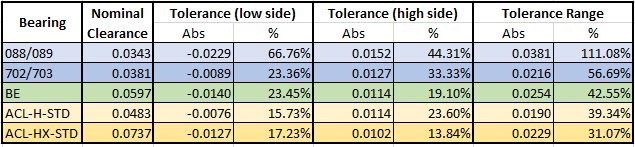
I threw this together using the numbers BE has published on measured rod bearing-to-journal clearances when installed. Everything's in mm. I thought it might be interesting to look at clearance tolerances for several bearings side-by-side -- not just in terms of absolute numbers, but also as percentages of the nominal clearance.
Not sure what conclusions can be drawn from this, if any... but man, do the original 088/089 bearings look like crap here!
bmwtmx wroteAs another pointed out the variance on all the other parts still exist. For non-BE bearings, the variance on those still exists also. Since BE Bearings are all individually hand-measured and assembled as matching sets, the variance of BE Bearings for a set you'll actually buy and install is effectively zero.And to the most over-hyped least understood "problem" that ever existed. So nice to see how many people throw their money away on this considering less than 1% failure globally. I doubt you would change your eating habits if you had less than 1% chance of catching a disease but hey, why not join in on the stupidity. Add this to the DME hype on post 996 911's and I could open my own shop replacing parts.
And keep in mind, when you replace the rod bearings the tolerances are exactly the same so while you may have changed the material it's the tolerance that causes the failure.
IamFODI wroteThe data posted at the BE site are actual measurements of single sets or two. So the variance from those posted numbers may not be the best way to compare and look at it. Or saying it another way: the data posted doesn't represent the entire spread of manufacturing variance because only a few dozen shells have been measured. You would need to measure 1000-2000 shells to get the entire spread of manufacturer variance.For giggles, while we're on this topic:
I threw this together using the numbers BE has published on measured rod bearing-to-journal clearances when installed. Everything's in mm. I thought it might be interesting to look at clearance tolerances for several bearings side-by-side -- not just in terms of absolute numbers, but also as percentages of the nominal clearance.
Not sure what conclusions can be drawn from this, if any... but man, do the original 088/089 bearings look like crap here!
Bert has the measurements and variance of every single BE Shell ever sold. But that's not what appears in the table. The data in the table for BE is taken from the first few sets that arrived. However, as I just pointed out above, since every BE Bearing shell is measured and the sets are hand-matched, the variance of the shells a customer receives is effectively zero.
Bert also has the manufacturer data and theoretical variance for all of those manufacturers -- maybe except one. The problem, if any, is whether or not the manufacturers ship product outside of their stated variance. I know from Bert's experience, the answer is yes. Bert has to throw away a few shells from every batch that fall outside of the stated specs. The point is: Bert throws them away! Other manufacturers who don't measure like BE does would ship the product without knowing. If there's any interest, I'll get Bert to share the theoretical variance data.
I was just going to change my beloved M3's rod bearings then leave the thread, but find myself sucked into this discussion more and more. 
Thanks guys for the interesting posts.
Thanks guys for the interesting posts.
