

bmwtmx wroteBE, ACL and VAC all sell increased clearance bearings. BMW, BE, ACL and VAC also sell standard clearance bearings.The issue I have with this problem is that the replacement bearings sold by virtually every vendor including BMW has the same tolerances so you will be replacing the bearings for the entire time you own the car. BE and ACL are the only companies that make bearings with increased clearance.
1.2MVIEWS
3.2KREPLIES
3.1KAPPRECIATES
06-01-2026LAST POST
deansbimmer wroteThanks for taking time to post these links. I know it is tiring every few months someone new coming by to ask same questions again, but that's the nature of internet forum. Keep up the good work and keep answering.Correct. But nobody knows all these things when they're just starting out. There are many resources out there from BEbearings, Clevite, King, etc. to help you change that. Check them out and be educated. Become informed and be part of the solution instead of the problem.
Engines are not all built to the same tolerances, research "tolerance stacking" and its effects. Additionally, you're evidently not aware that the vast majority of owners now are replacing with aftermarket bearings like BE or ACL which increase the clearances, not stock with the same clearances prone to failure.
And yes, there is in fact a class action suit currently in litigation.
Try these resources:
http://bebearings.com/Overview.html
http://www.kingbearings.com/technical-info/
http://www.kingbearings.com/wp-content/uploads/2014/10/Engine-Bearings-and-how-they-work.pdf
https://www.mahle-aftermarket.com/media/local-media-north-america/pdfs-&-thumbnails/catalogs-and-literature/engine-bearings/ceb-2-1114-engine-bearing-failures-brochure.pdf

BTW, did I read it right Clevite is the OEM manufacturer for BMW bearings?
bmwtmx wroteI was hoping you'd answer my question how all of this damage was possible within the first 2.0 - 2.6 seconds after starting the engine -- which is before the bearings reach full oil pressure and oil flow. Based on your later posts, it sounds like you're reading up on this situation and probably no longer believe what you said earlier....
This is explained in many threads on this forum, and in the bearing wiki on this forum too.So I guess I know nothing and every single S65 motor will detonate and they are all just piles of metal all waiting for the garbage bin. So if every motor made has this issue how are any still in existence if they are all built to the same tolerance?
There are in fact two class action lawsuits against BMW for this issue. One of them is moving forward, I'm not sure about the other. In the first one, the judge already ruled against BMW's motion for summary judgement (dismissal), and ordered discovery to proceed. Recalls don't happen based on good will. Recalls only happen after lawsuits are settled. (Also explained in multiple threads and the bearing wiki on this forum.)It's all just 1 big conspiracy by BMW who built a motor that can't last 5k miles! As I said, go out and spend $2500 every 10k miles cause that's what Joe on the forum told you to do. If there was a problem this big there would be a recall, a class action lawsuit or something.
The guys who investigated, discovered this issue, are in fact people with F1 engine design experience. The three people are:Instead, it's the forum full of mechanical geniuses each waiting for their job to develop the next F1 engine because they can build them better.
* BMW S14 engine designer, and BMW M10 engine designer (F1 engine).
* Indy-500 winning engine builder
* NASCAR winning engine builder
(Also explained in multiple threads and the bearing wiki on this form.)
bmwtmx wroteIf the issue is bearing clearance, then replacing with increased clearance bearings should solve the problem. That means change them once, not throughout the entire life of the car.Trust me. I am not just starting out. The issue I have with this problem is that the replacement bearings sold by virtually every vendor including BMW has the same tolerances so you will be replacing the bearings for the entire time you own the car.
There are quite a few people, just like you, convinced there really isn't a problem. That's fine, they're entitled to their own opinion. One of the loudest critics blew his motor due to rod bearing failure, and left the forum. It's true that the risk is small, and the failure rate is probably around 2%. It's also true, there's a problem with bearing clearance and an apparent solution is available.BE and ACL are the only companies that make bearings with increased clearance. I do not doubt that there is an issue here but I think changing them at 50k to 60k miles is the way to go for preventative maintenance and not at any mileage and then showing that a bearing has wear is proof the motor was going to detonate. As some members have pointed out, they have a substantial amount of miles on their cars with no issue and lets keep in mind this is an M3 with a NA V8 that revs to 8400 rpm so the typical user is someone who revs them to redline quite a bit as that is the point of the car. I just don't subscribe to the hysteria which I saw when I raced E30 M3's, the numerous Porsche's I owned and tracked and other cars as well. I am a firm believer that most of the time it is the driver that causes the issue unless proven otherwise.
cannga wroteYes. The original S65 bearings were made by Clevite. The current bearings for 2010.5 and later -- which were done to meet EU standards to eliminate lead in engine components -- are made by Glyco, a subdivision of Federal Mogul.BTW, did I read it right Clevite is the OEM manufacturer for BMW bearings?
330indy wroteThere are 3 kinds of lies: lies, damn lies and statistics.Change your oil
You cannot use macro statistics on a micro scale.
😎
330indy wroteAFAIK, controlling debris is more about quality filtration and good sealing in the intake and vacuum systems.Change your oil
But yes, change your oil as well. :]
Green-Eggs wroteThanks. Both American companies? A touch surprised to see good ol' American-made parts in the heart of this Teutonic engine.Yes. The original S65 bearings were made by Clevite. The current bearings for 2010.5 and later -- which were done to meet EU standards to eliminate lead in engine components -- are made by Glyco, a subdivision of Federal Mogul.
Federal Mogul bought a German company, Glyco, in 1990, and there are factories in other countries. Clevite was sold to a German company, Mahle, in 2007, but all the bearings are made in the US.
I was waiting until 60K miles on my 2009 M3 DCT to complete the bearing replacement myself. I have been researching this topic since I purchased this car in the first part of 2016, with 48K miles on the clock. I slipped past 60k miles with other things that took my time, but I did not want to go much farther. So here are the bearings from my car. I am the 3rd owner, and I know that this car was babied for the first 5-6 years of its life, most likely warmed up religiously and never saw rain for the first 3 years of its life. Then the second owner was running 5W-40 in it when I picked it up and probably did not treat it as I would. I was not happy, but that just put the bearings on the faster track than the 80K I was figuring on waiting. This car is in exceptional shape and the other fluids that I also changed during this service were pristine, although the DCT pan was leaking. I did go back with the BE Bearings kit.

Not terrible, but certainly not what I would say my Honda race engines see, even after years of abuse. Glad I did it, and for those that think they can get away with it, please do us a favor and change the bearings so we can keep the M3s on the road, with the original engines!
Not terrible, but certainly not what I would say my Honda race engines see, even after years of abuse. Glad I did it, and for those that think they can get away with it, please do us a favor and change the bearings so we can keep the M3s on the road, with the original engines!
Hondaman23 wroteNice work. And the 0.002 is measured with plastigage?I was waiting until 60K miles on my 2009 M3 DCT to complete the bearing replacement myself. I have been researching this topic since I purchased this car in the first part of 2016, with 48K miles on the clock. I slipped past 60k miles with other things that took my time, but I did not want to go much farther. So here are the bearings from my car. I am the 3rd owner, and I know that this car was babied for the first 5-6 years of its life, most likely warmed up religiously and never saw rain for the first 3 years of its life. Then the second owner was running 5W-40 in it when I picked it up and probably did not treat it as I would. I was not happy, but that just put the bearings on the faster track than the 80K I was figuring on waiting. This car is in exceptional shape and the other fluids that I also changed during this service were pristine, although the DCT pan was leaking. I did go back with the BE Bearings kit.
Not terrible, but certainly not what I would say my Honda race engines see, even after years of abuse. Glad I did it, and for those that think they can get away with it, please do us a favor and change the bearings so we can keep the M3s on the road, with the original engines!
Ps. Sh@it, you forgot to torque the bolts, no values there...

I'll admit I may have "jumped the gun" with my full understanding of the issue but I will stand by the fact that when less than 1% of the cars are affected by an issue that has tarnished the reputation of an entire model that sold nearly 60K units worldwide I do think it is over-hyped. I do think replacing them at 60k miles or so (if you know the car's history) is good prudent preventative maintenance but I don't think every E9X M3 is a bomb waiting to happen if not replaced. With that, keep up the thread and when my 6400 mile E92 reaches 60k miles in a very long time I'll consider replacing them.
Not driving your car is one way to preserve it. I think there has been only one rod bearing failure on a motor with 6000 miles.
pbonsalb wroteIt was Dinan modded and tracked. Failed at the track. Was a 6 speed, 2013.Not driving your car is one way to preserve it. I think there has been only one rod bearing failure on a motor with 6000 miles.
I know the guy.
It was also a lease
This was after the track event in his garage
330indy wroteDinan modded? Just bolt on parts?It was Dinan modded and tracked. Failed at the track. Was a 6 speed, 2013.
I know the guy.
It was also a lease
This was after the track event in his garage
Cheers,
bmwtmx wroteIf most shells coming out of S65s looked good, I would tend to agree. But, the vast majority of shells look like absolute garbage for the mileage. And I do not get this 60K mile thing. If the bearings are really tight, they will likely fail before 60K miles. Why wait?I'll admit I may have "jumped the gun" with my full understanding of the issue but I will stand by the fact that when less than 1% of the cars are affected by an issue that has tarnished the reputation of an entire model that sold nearly 60K units worldwide I do think it is over-hyped. I do think replacing them at 60k miles or so (if you know the car's history) is good prudent preventative maintenance but I don't think every E9X M3 is a bomb waiting to happen if not replaced. With that, keep up the thread and when my 6400 mile E92 reaches 60k miles in a very long time I'll consider replacing them.
Also, if it were a simple $2500 engine swap, I would not worry about it regardless. Unfortunately, BMW does not have any new S65s in the warehouse because they have all been used due to the horrendous number of failed engines. Used engines are not cheap or easy to find a really good one. Rebuild costs are ridiculously expensive when done properly due to the complexity of the engine and the cost of parts. Regardless to which option you choose, the labor to replace the engine is also not cheap.
But everyone is entitled to their own opinions.
Cheers,
bmwtmx wroteIf there's nothing to worry about why change the rod bearings at all?I'll admit I may have "jumped the gun" with my full understanding of the issue but I will stand by the fact that when less than 1% of the cars are affected by an issue that has tarnished the reputation of an entire model that sold nearly 60K units worldwide I do think it is over-hyped. I do think replacing them at 60k miles or so (if you know the car's history) is good prudent preventative maintenance but I don't think every E9X M3 is a bomb waiting to happen if not replaced. With that, keep up the thread and when my 6400 mile E92 reaches 60k miles in a very long time I'll consider replacing them.
A change interval is easier to accept than a possibly fatal engine flaw. The only problem with the arbitrary 60k mile interval is that engines have failed with fewer miles. The interval for me was the expiration of my extended warranty, which coincidentally coincided with 60k miles.
bmwtmx is at low risk with 6k miles.
bmwtmx is at low risk with 6k miles.
pbonsalb wroteWe've seen wear even at 18K miles, here's an example Blackstone report and bearing pictures:A change interval is easier to accept than a possibly fatal engine flaw. The only problem with the arbitrary 60k mile interval is that engines have failed with fewer miles. The interval for me was the expiration of my extended warranty, which coincidentally coincided with 60k miles.
bmwtmx is at low risk with 6k miles.
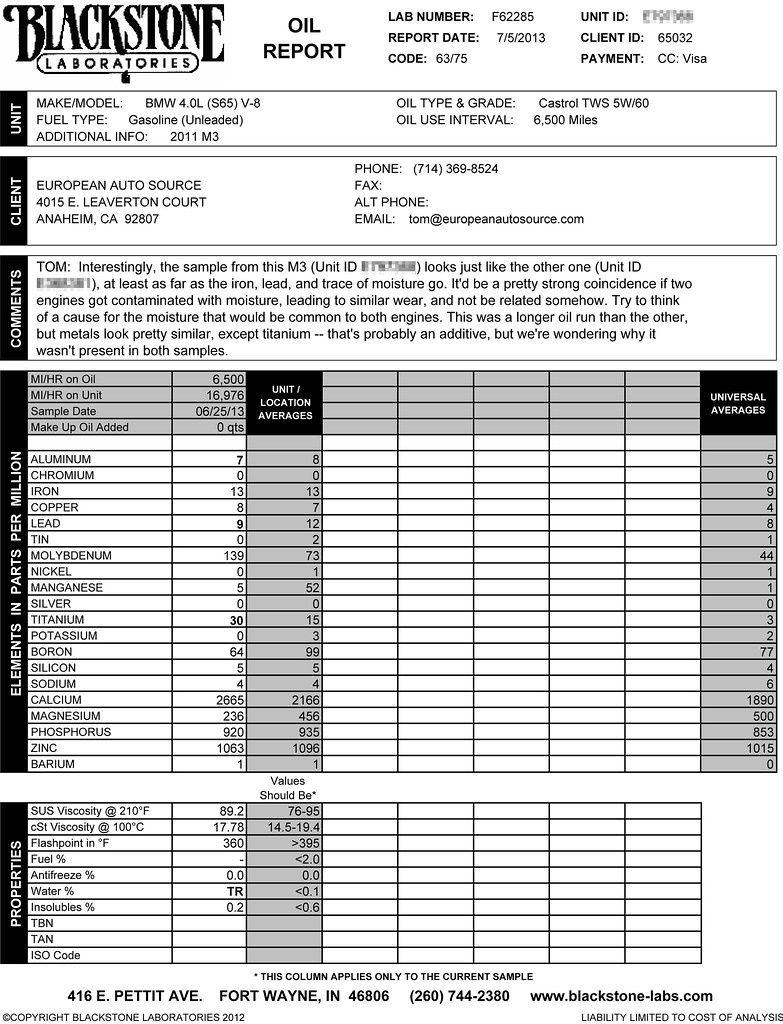
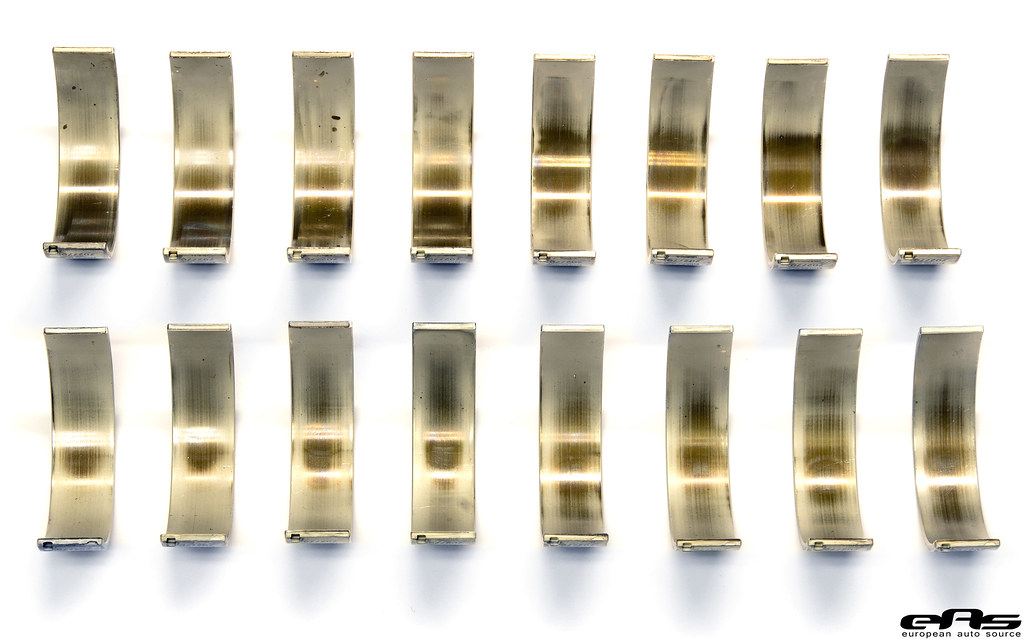
Post referenced by Assimilator1 in S65 Oil reports collation - does oil analysis work for tracking bearing wear? 02-26-2020
Hondaman23 wroteI just changed my bearings at 128,000 miles because I didn't have the means to change them sooner. I'm glad I did. mine are not as bad as those and the wear was more even. Mine were the lead copper ones. I went with extra clearance BE bearings and the BE arp bolts. I bought my 2010 m3 with just 40,000 miles 5 years ago.I was waiting until 60K miles on my 2009 M3 DCT to complete the bearing replacement myself. I have been researching this topic since I purchased this car in the first part of 2016, with 48K miles on the clock. I slipped past 60k miles with other things that took my time, but I did not want to go much farther. So here are the bearings from my car. I am the 3rd owner, and I know that this car was babied for the first 5-6 years of its life, most likely warmed up religiously and never saw rain for the first 3 years of its life. Then the second owner was running 5W-40 in it when I picked it up and probably did not treat it as I would. I was not happy, but that just put the bearings on the faster track than the 80K I was figuring on waiting. This car is in exceptional shape and the other fluids that I also changed during this service were pristine, although the DCT pan was leaking. I did go back with the BE Bearings kit.
Not terrible, but certainly not what I would say my Honda race engines see, even after years of abuse. Glad I did it, and for those that think they can get away with it, please do us a favor and change the bearings so we can keep the M3s on the road, with the original engines!
Just got the car about 4 weeks ago at around 65k miles as 2nd owner. Changed RBs at 66k, work done by Malek at MRF. Not sure what the previous owners' driving habits were or if the car was ever tracked.
2008 E93 M3
See attached image.
2008 E93 M3
See attached image.
Helmsman wroteYeah, I did plastigage each one to ensure I could see the additional clearance provided by the BE total system. It certainly opened the clearances up to what I would run on my race engines with 20W-50 oils. I have to let them warm up just the same!Nice work. And the 0.002 is measured with plastigage?
Ps. Sh@it, you forgot to torque the bolts, no values there...
I thought someone would catch that I did not fill in the torque, but the ARP bolts said “hells to the naw!” with that mess of torquey nonsense!
To tell the truth, I wish I had done this at 50K miles, but needed to spend some time with the “Fat Bottomed Girl” to know if I was to keep her. I fell in love, so she has to live forever.
I really like the BE bearings and the way they appeared before installation. I sure hope there are those in the community that will pull their BE’s at 60K so we can see if the problem is truly a permanent repair. At my rate, I will not get to 120k for 10 years!
Hondaman23 wroteInteresting, so in order to confirm increased clearanse (which obviously should be there but anyhow), did you also measure some of the original shell pair to compare?Yeah, I did plastigage each one to ensure I could see the additional clearance provided by the BE total system. It certainly opened the clearances up to what I would run on my race engines with 20W-50 oils. I have to let them warm up just the same!
I thought someone would catch that I did not fill in the torque, but the ARP bolts said “hells to the naw!” with that mess of torquey nonsense!
To tell the truth, I wish I had done this at 50K miles, but needed to spend some time with the “Fat Bottomed Girl” to know if I was to keep her. I fell in love, so she has to live forever.
I really like the BE bearings and the way they appeared before installation. I sure hope there are those in the community that will pull their BE’s at 60K so we can see if the problem is truly a permanent repair. At my rate, I will not get to 120k for 10 years!
Your note says >0.002 on most, means just a hair more or around the targeted 0.0023-25?
Also, you mention 20w50 oil but you'll stick with 10w60 for the M3 right?
Thanks
