
DCT M3 102K
My car was about to die .
swapped them with be bearing with apr bolts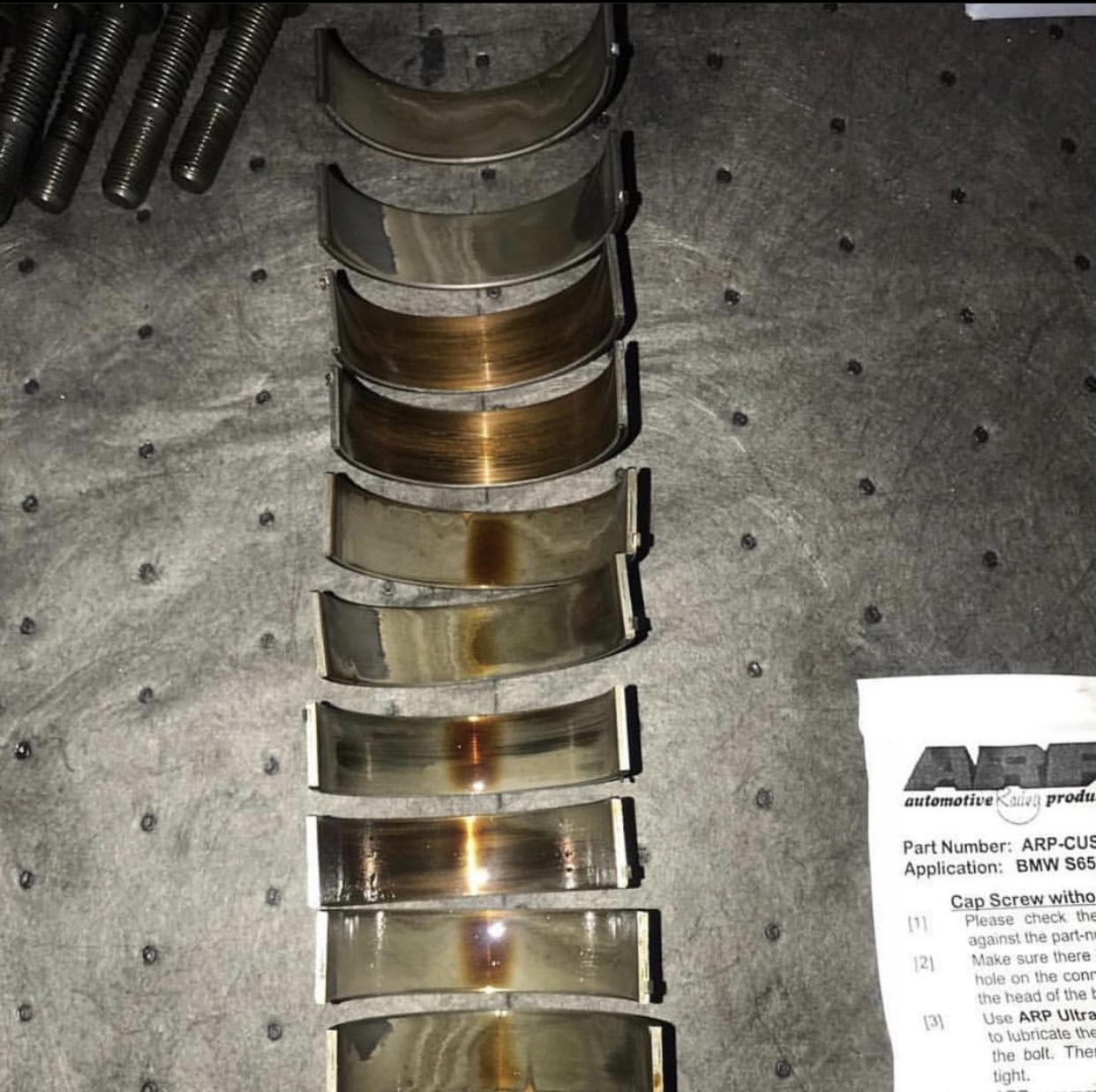
My car was about to die .
swapped them with be bearing with apr bolts

AndriTheGiant wroteGood catch!!DCT M3 102K
My car was about to die .
swapped them with be bearing with apr bolts


 deansbimmer MPORIUM for RB service, here is the result:
Assimilator1 wroteInteresting, I recall seeing similar wear patterns on higher milage cars. I haven't visually inspected them but I did see some uneven surfaces on a few of the lower bearings.Yea the alu bearings usually come out looking like that, including the wavy pattern.
Apparently it's down to the way the babbitt layer is applied.
Scharbag wroteGoing back to this point, as I don't think it was answered.Plastigauge is meaningless. Plain and simple.
.....
Cheers,
Assimilator1 wroteNot a ball park, you can get very accurate measurements with plastigauge.russiamutha
Not bad those shells for a 99k S65.
Going back to this point, as I don't think it was answered.
I'm getting mixed info on this, on the one hand I'm hearing it'll give you a decent ball park figure, & yet other people are saying it's pointless.
I shall be replacing the bearings on my M3 within the next 2 months, should I bother with plastigauges?
, have you used & compared plastigauges to other ways of measuring? , oh & hope that'll be enough, otherwise, like you said, without more drastic work I'm stuck with what I've got.
Assimilator1 wrotePlastigauge is only really useful as a sober second thought. It will let you know if you are super tight/loose. It only returns a ballpark. And it can be inconsistent and easily affected by improper use. It also can expire due to age.russiamutha
Not bad those shells for a 99k S65.
Scharbag wroteGoing back to this point, as I don't think it was answered.Plastigauge is meaningless. Plain and simple.
.....
Cheers,
I'm getting mixed info on this, on the one hand I'm hearing it'll give you a decent ball park figure, & yet other people are saying it's pointless.
I shall be replacing the bearings on my M3 within the next 2 months, should I bother with plastigauges?
Assimilator1 wroteNo, .xxmm won't get you anywhere with bearings. Some relatively inexpensive starrett, SPI, or Mitutoyo micrometers (must have a ball anvil) have resolution to .001mm. Plastigage is OK but not consistent, and has been shown to be off by as much as .002x. It's use is ok to see if you're in the ballpark but not to use during an attempt to make changes to clearances.Good to hear
Not entirely pointless for me, I think lol. I have a micrometer (hopefully good enough!) & I intend to measure the shells as per Deansbimmer recommendations. I figure if I find a bearing with noticeably tight clearances (via plastigauges) I could put the skinniest shells with the fattest journal
Deansbimmer
Regarding measuring shells, my metric micrometer goes down to 2 decimal places (0.xx incase I've described it wrong), will that be enough to measure shells accurately?
Assimilator1 wroteYou'll get more accurate measurements with a micrometer and a dial bore gauge no doubt, but that wont be possible with a replacement through the sump. I would think you'd want to check clearance between the housed bearings with the crank journal, not just checking shell thickness. Plastigauge is really the only way to do that, and is an industry accepted method, and even built into the ISTA workshop manual for rod bearing replacements. I mean you can just assume theres too much error in the measurement, but really isnt it better than going in blind? If it was me and I got an off measurement, I'd be taking the engine out and sending it to a machine shop to look at.Not entirely pointless for me, I think lol. I have a micrometer (hopefully good enough!) & I intend to measure the shells as per Deansbimmer recommendations. I figure if I find a bearing with noticeably tight clearances (via plastigauges) I could put the skinniest shells with the fattest journal
Deansbimmer
Regarding measuring shells, my metric micrometer goes down to 2 decimal places (0.xx incase I've described it wrong), will that be enough to measure shells accurately?
).
Scharbag wroteAndriTheGiant wroteGood catch!!DCT M3 102K
My car was about to die .
swapped them with be bearing with apr bolts
That is a lot of copper showing for sure!!
Scharbag wroteRight caught just in time .AndriTheGiant wroteGood catch!!DCT M3 102K
My car was about to die .
swapped them with be bearing with apr bolts
That is a lot of copper showing for sure!!
Assimilator1 wroteWow! You definitely dodged a bullet there!
What made you decide to change them? Oil report? New owner & decided it was a good idea? Funny noises?
Btw, welcome to the forum
Scharbag wroteAndriTheGiant wroteGood catch!!DCT M3 102K
My car was about to die .
swapped them with be bearing with apr bolts
That is a lot of copper showing for sure!!
Assimilator1 wroteJust for peace of mind , I bought the car with high mileage so I thought it would be a very good idea to swap them out and no I didn't hear any noises .Wow! You definitely dodged a bullet there!
What made you decide to change them? Oil report? New owner & decided it was a good idea? Funny noises?
Btw, welcome to the forum

cognoscenti wroteThose look good! Glad you did the BE for preventative measures.Hi all,
Glad to offer my first contribution to the thread. My car is a 2011.75, and swapping for BE Bearings and ARP bolts at 75K miles is just part of the regular maintenance schedule, as far as I'm concerned. I also had them swap in new OEM motor mounts as preventative maintenance while they were in there, and have definitely noticed less NVH afterwards. The stock ones were not leaking yet but were pretty much finished.
Thanks to Eurowise in Charlotte, for doing a great job!
I feel like the pic shows that I'm doing the right thing with my easy warm-up, low-rev routine and 5K changes with Liqui-Moly Synthetic 10W-60.
At last analysis for these bearings, Blackstone had reported: "This is the least amount of metal to come out of this engine so far. There's just 2 ppm aluminum, and iron is in great shape at 9 ppm. Your BMW is wearing well for the type, and shows no signs of poor bearing wear, or any other issues for that matter. Insolubles tested at just a trace level, so oil filtration is working well, and there's no contamination in the sample. You're taking great care of this M3!".
Future Blackstone reports will establish a new bearing material baseline for this S65, but that's two oil changes away because I plan the first change to occur at just 2K miles so we can cut open the filter to check for anything unusual.
cognoscenti wroteWow, great looking 75k shells!Hi all,
Glad to offer my first contribution to the thread. My car is a 2011.75, and swapping for BE Bearings and ARP bolts at 75K miles is just part of the regular maintenance schedule, as far as I'm concerned. I also had them swap in new OEM motor mounts as preventative maintenance while they were in there, and have definitely noticed less NVH afterwards. The stock ones were not leaking yet but were pretty much finished.
Thanks to Eurowise in Charlotte, for doing a great job!
I feel like the pic shows that I'm doing the right thing with my easy warm-up, low-rev routine and 5K changes with Liqui-Moly Synthetic 10W-60.
At last analysis for these bearings, Blackstone had reported: "This is the least amount of metal to come out of this engine so far. There's just 2 ppm aluminum, and iron is in great shape at 9 ppm. Your BMW is wearing well for the type, and shows no signs of poor bearing wear, or any other issues for that matter. Insolubles tested at just a trace level, so oil filtration is working well, and there's no contamination in the sample. You're taking great care of this M3!".
Future Blackstone reports will establish a new bearing material baseline for this S65, but that's two oil changes away because I plan the first change to occur at just 2K miles so we can cut open the filter to check for anything unusual.


