

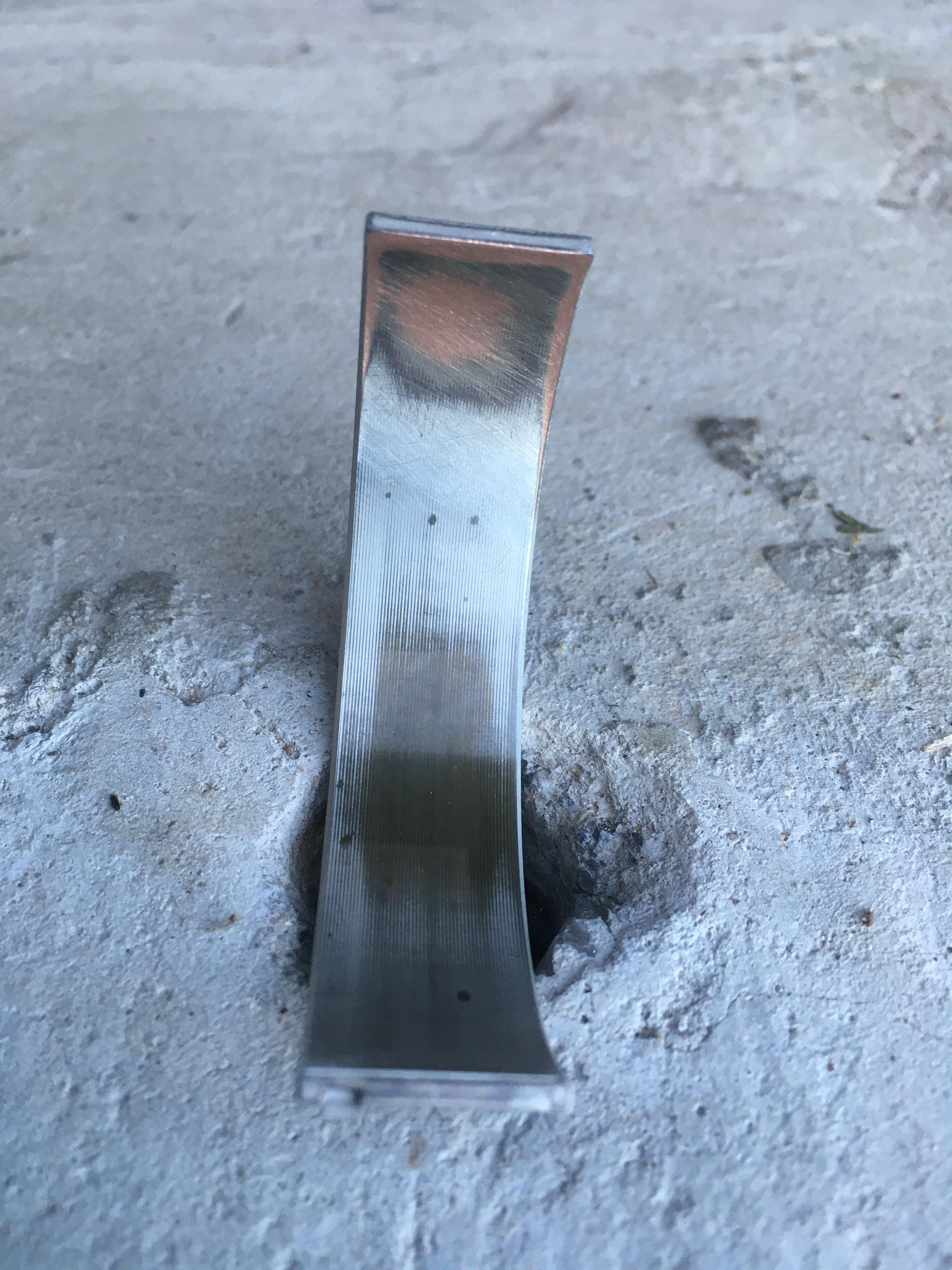
The little experiment is simply to rub down a portion of an old shell (or shells) using emery paper or sandpaper until either it returns to a silver colour or you expose the copper (and yes they do have copper! See pics below), if rubbing down exposes the silver colour layer then you can stop there.
Use the most worn shell(s), and rub through the middle of the dark patch. Then post a good quality close up photo of it please (not blurred, off colour, too dark or over exposed! ).
).
Why do this? Because some of us want to see if any of the Alu/Tin/Copper bearings have actually worn through their babbitt (top) layer.
If they haven't, it'll clean up the Alu/tin layer to return it back to a silver colour, and if it has worn through, you'll clearly see the copper coming through as you rub through the dark patch, the dark patch cleaned off fairly quickly when I did the shell below.
It would also be interesting to see if simply polishing them would remove the dark patch.
On the shell below you can see on the fringes of where I rubbed it down the dark patch has been 'cleaned' off and it's returned to a silver colour. I carried on going to see how obvious the copper is (as you can see, it is very obvious!), any volunteers don't need to go that far (unfortunately I didn't photo the silver only stage).
Thanks to Helmsman for the shell below
  .
.


Now don't get me wrong, I'm not saying that a large swath of the Alu/Tin bearings are not significantly worn where they shouldn't be (e.g this recent set of shells at just ~25k miles), they are worn way beyond what they should be. And with a good photo, or a close look, you can clearly see the oil retaining micro-grooves are typically completely worn away where the dark patches are, even when their is still a babbitt layer left.
But in looking through over 500 pictures of shells recently, a mix of lead/copper and Alu/Tin, I've yet to see a single one of the latter worn through to copper. It seems they don't fare as bad as the lead/copper ones.
It would be nice to get some data on that though, hence my request.
Hopefully we'll get some volunteers!
TIA
Thanks to E90M3Ross for this photo - https://drive.google.com/file/d/1T2DhJkhejkaEPPAV43CeNUtE7SbGd2W-/view?usp=sharing
Use the most worn shell(s), and rub through the middle of the dark patch. Then post a good quality close up photo of it please (not blurred, off colour, too dark or over exposed!
).Why do this? Because some of us want to see if any of the Alu/Tin/Copper bearings have actually worn through their babbitt (top) layer.
If they haven't, it'll clean up the Alu/tin layer to return it back to a silver colour, and if it has worn through, you'll clearly see the copper coming through as you rub through the dark patch, the dark patch cleaned off fairly quickly when I did the shell below.
It would also be interesting to see if simply polishing them would remove the dark patch.
On the shell below you can see on the fringes of where I rubbed it down the dark patch has been 'cleaned' off and it's returned to a silver colour. I carried on going to see how obvious the copper is (as you can see, it is very obvious!), any volunteers don't need to go that far (unfortunately I didn't photo the silver only stage).
Thanks to
Helmsman for the shell below .Now don't get me wrong, I'm not saying that a large swath of the Alu/Tin bearings are not significantly worn where they shouldn't be (e.g this recent set of shells at just ~25k miles), they are worn way beyond what they should be. And with a good photo, or a close look, you can clearly see the oil retaining micro-grooves are typically completely worn away where the dark patches are, even when their is still a babbitt layer left.
But in looking through over 500 pictures of shells recently, a mix of lead/copper and Alu/Tin, I've yet to see a single one of the latter worn through to copper. It seems they don't fare as bad as the lead/copper ones.
It would be nice to get some data on that though, hence my request.
Hopefully we'll get some volunteers!
TIA
Thanks to E90M3Ross for this photo
- https://drive.google.com/file/d/1T2DhJkhejkaEPPAV43CeNUtE7SbGd2W-/view?usp=sharing
 , I did get one volunteer


 , so barely any data = no conclusion yet.


