

spammysammich wroteI misread it, thought he might have meant "spun" instead of spin. Was hoping that wasn't the case, that would suck.That’s not what he said… at all.
1.2MVIEWS
3.2KREPLIES
3.1KAPPRECIATES
06-01-2026LAST POST
IamFODI wroteThanks for the honest and detailed response. I'll pm you.Not many here will break with the "consensus" that OE rod bearings suck. For the longest time, everyone blindly accepted that narrative and anyone who questioned it got mobbed (sometimes understandably; some of the questioners behaved very badly).
Thankfully, that's starting to change now. Long past time in my opinion, but better late than never. Some points in the "OE rod bearings suck" narrative have been cast into serious doubt; a few have been outright debunked. At this point so many people have done BE and other aftermarket bearings that the confirmation bias will be hard to overcome. But at least the shout-downs and condescension are less common.
I went with new OE bearings 74k miles ago and I lose exactly zero sleep over them. My thinking back then was that I hadn't seen hard evidence showing that engines with other bearings lasted any longer than ones with the updated OE bearings. That's still true, as far as I can tell. People have posted some good-looking pics of used BE bearings, but that means nothing to me. What I care about are engine failure rates, and no one's gathering those stats in a way I'm comfortable with. In fact, every time an engine fails with aftermarket rod bearings, people blow it off as "the main bearings failed first" and assume it has nothing to do with the rod bearings. That scares me TBH.
We've also seen evidence that the updated OE bearings don't seem to wear nearly as much as people had assumed. What a lot of us had assumed was critical wear actually seems to be superficial discoloration of the top layer. I have yet to see a single updated OE rod bearing that has definitely worn down to the actual copper layer in anything like normal use. And, barring a few early failures, engines with these bearings seem to be holding up just fine after tons of street miles and track use. I had originally planned on replacing my rod bearings again after 60k-80k miles; now, I suspect I won't touch them for the rest of the time I own the car.
Happy to go into this more over PM if you want.
Clevite VAC bearings after 65k miles, supercharged. Some damage on shell 6 thought to be from a foreign body that cleared before it caused too much trouble. Car with 130k miles overall.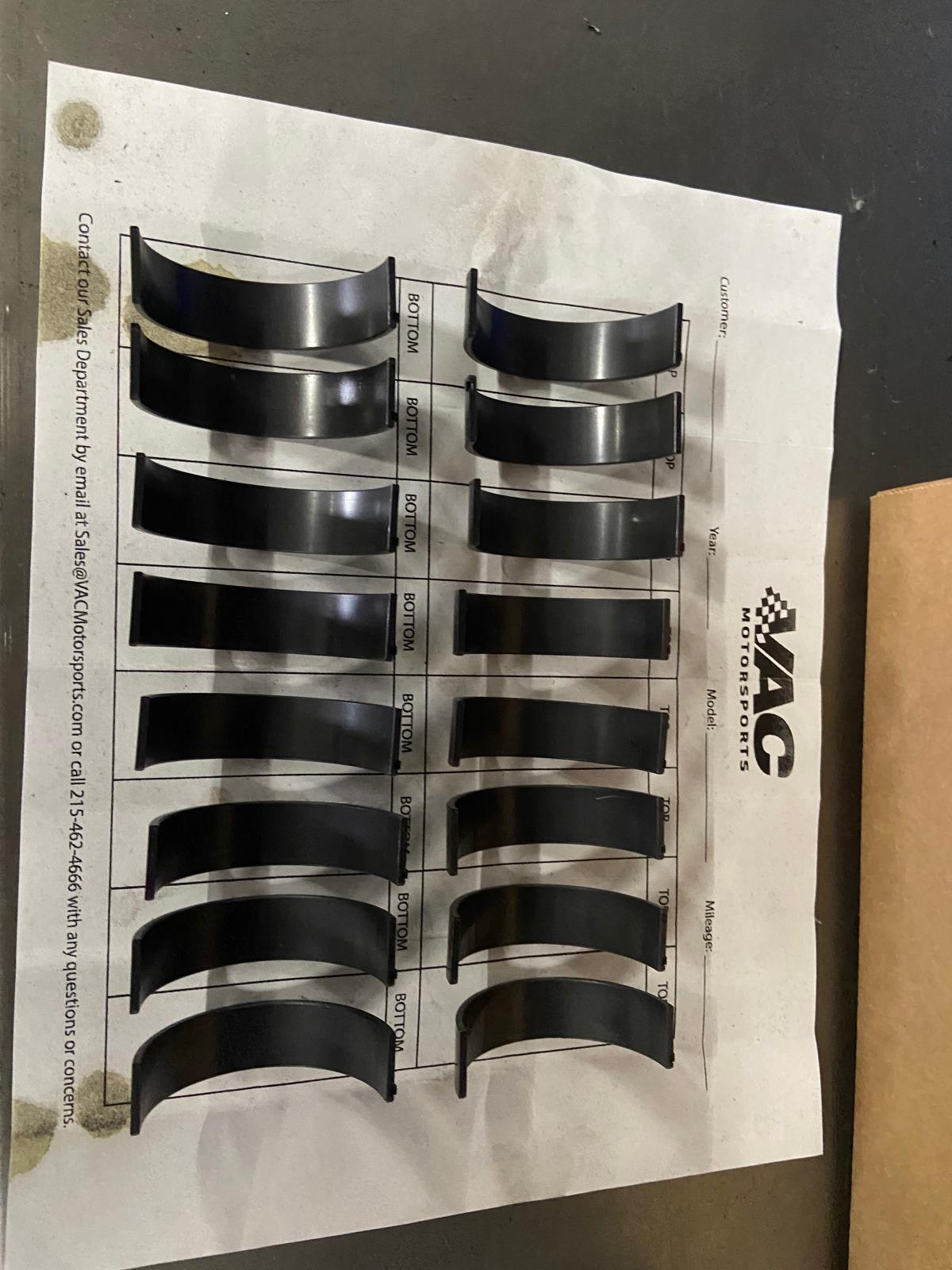
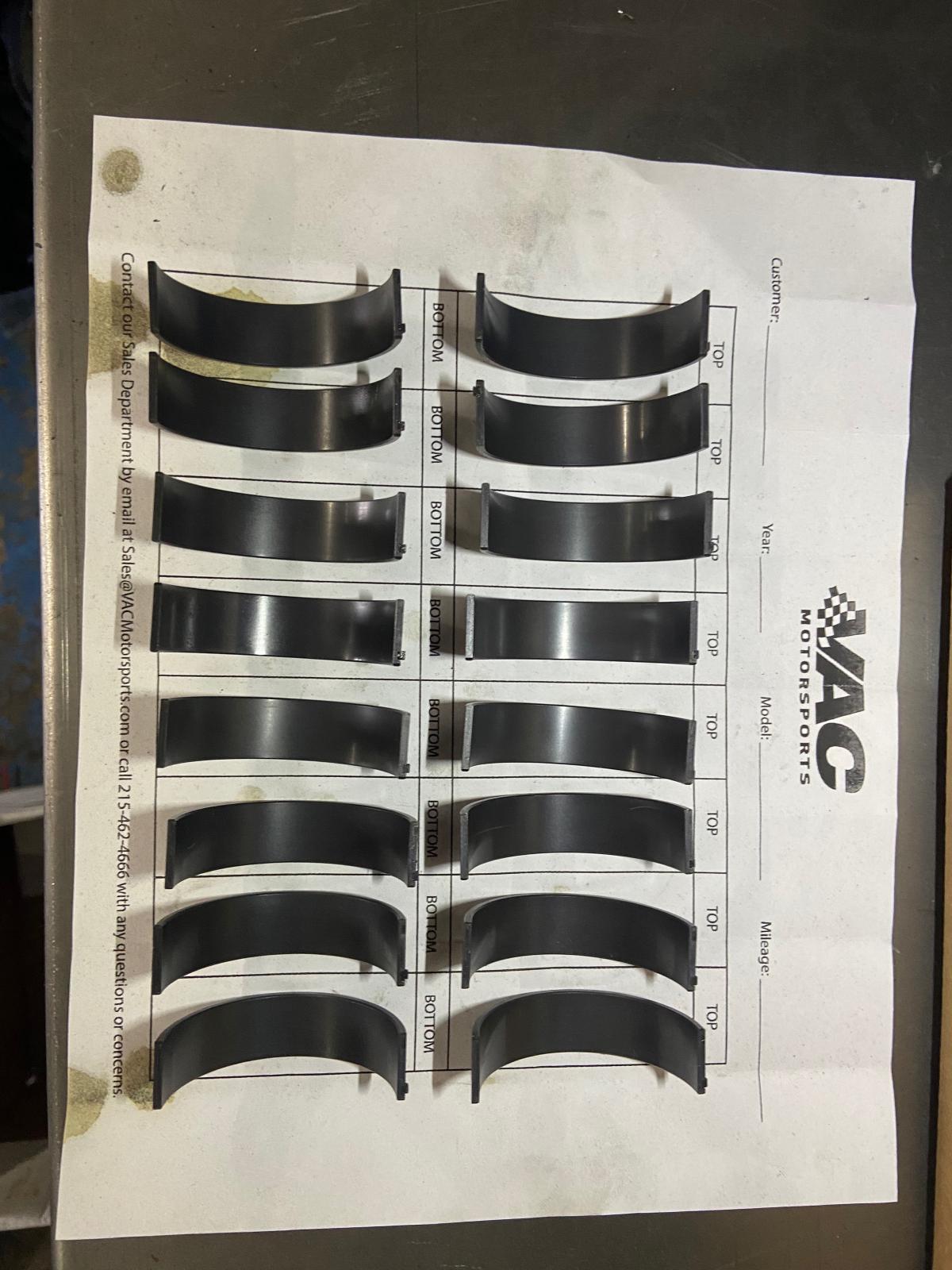
CamasM3e93 wroteLooks soo clean! And remind me, these have some level increased clearance? And the bolts?Clevite VAC bearings after 65k miles, supercharged. Some damage on shell 6 thought to be from a foreign body that cleared before it caused too much trouble. Car with 130k miles overall.
Thanks
Helmsman wroteI may be wrong but I believe VAC made extra clearance bearings and oem clearance with a coating at various times. They also sold coated bmw bearings at times. When I got home next week I’ll look to see any identifying marks. But agree, they are pristine (I don’t fault them for the damage on shell 6) and it bodes well for the one and done idea.Looks soo clean! And remind me, these have some level increased clearance? And the bolts?
Thanks
CamasM3e93 wroteWhat was your reason for the bearing change? Just preventative maintenance?Clevite VAC bearings after 65k miles, supercharged. Some damage on shell 6 thought to be from a foreign body that cleared before it caused too much trouble. Car with 130k miles overall.
I wonder if with the extra clearance bearings, if anyone has been able to measure if there is any drop in oil pressure. I'm sure it's insignificant but wonder what the pressure drop is and if it has any long-lasting implications on rest of the engine. Just wondering.
BimmerRob08 wroteGood question, there are interesting oil pressure measurements performed by BE Bearings: https://www.m3post.com/forums/showthread.php?t=1337998. This obviously doesn't reflect the oil film "pressure" (whatever called in English) but still very interesting.What was your reason for the bearing change? Just preventative maintenance?
I wonder if with the extra clearance bearings, if anyone has been able to measure if there is any drop in oil pressure. I'm sure it's insignificant but wonder what the pressure drop is and if it has any long-lasting implications on rest of the engine. Just wondering.
IamFODI wroteYour view is to me interesting. Over the years (10) with the S65 my uneducated view of the RBs have changed from OE total crap to similar to you, the latter LCI is clearly holding up well. Yes there is the infamous tolerance stack up that takes some engines, but generally they clearly do the job judging from the tons of these days old engines still running.Not many here will break with the "consensus" that OE rod bearings suck. For the longest time, everyone blindly accepted that narrative and anyone who questioned it got mobbed (sometimes understandably; some of the questioners behaved very badly).
Thankfully, that's starting to change now. Long past time in my opinion, but better late than never. Some points in the "OE rod bearings suck" narrative have been cast into serious doubt; a few have been outright debunked. At this point so many people have done BE and other aftermarket bearings that the confirmation bias will be hard to overcome. But at least the shout-downs and condescension are less common.
I went with new OE bearings 74k miles ago and I lose exactly zero sleep over them. My thinking back then was that I hadn't seen hard evidence showing that engines with other bearings lasted any longer than ones with the updated OE bearings. That's still true, as far as I can tell. People have posted some good-looking pics of used BE bearings, but that means nothing to me. What I care about are engine failure rates, and no one's gathering those stats in a way I'm comfortable with. In fact, every time an engine fails with aftermarket rod bearings, people blow it off as "the main bearings failed first" and assume it has nothing to do with the rod bearings. That scares me TBH.
We've also seen evidence that the updated OE bearings don't seem to wear nearly as much as people had assumed. What a lot of us had assumed was critical wear actually seems to be superficial discoloration of the top layer. I have yet to see a single updated OE rod bearing that has definitely worn down to the actual copper layer in anything like normal use. And, barring a few early failures, engines with these bearings seem to be holding up just fine after tons of street miles and track use. I had originally planned on replacing my rod bearings again after 60k-80k miles; now, I suspect I won't touch them for the rest of the time I own the car.
Happy to go into this more over PM if you want.
I have ACL HX i.e. "larger" clearance myself since more than 5 years and 21k miles, all good so far, my daily (non track seldom redline) drive style probably helps. Should I replace today I'd go with a tighter shell, maybe even OE LCI.
My original (LCI) shells where a bit worn though (37k miles), but as you say not through layers but more than discolored.
BimmerRob08 wroteThe testingI wonder if with the extra clearance bearings, if anyone has been able to measure if there is any drop in oil pressure. I'm sure it's insignificant but wonder what the pressure drop is and if it has any long-lasting implications on rest of the engine. Just wondering.
 Helmsman linked to suggests slightly lower oil pressure and significantly higher flow rates as measured outside the engine. Predictable consequence of drastically opening up clearances deep inside the system while measuring outside the engine in a location where the pump's regulation can pick up a lot (but not all) of the slack.
While this confirms one of BE's stated design goals / touted benefits (increased oil flow), it doesn't tell us what we really need to know about what's happening within the engine. Lower oil pressure and higher flow rate upstream of the rod bearings, due to bigger rod bearing clearance, necessarily means lower pressure within the rod bearings themselves. Also noteworthy that the measurements were taken upstream of all the important parts, so everything in the engine must be seeing at least the same pressure loss. So, even if added clearance makes the rod bearings immortal, that's far from the end of the story; we also need to know if the pressure loss has any significant effect on the longevity of anything else in the engine (one reason it scares me that main bearing failures with aftermarket rod bearings are considered unrelated and dismissed).
Again, the important question here isn't which rod bearings lasts the longest without showing visible wear or seizing. It's which rod bearings allow the engine to run longer before something fails, rod bearings or not. And if there's any chance of a tradeoff between rod bearing longevity and the longevity of any other part, that will need to be assessed. Either way, the point is that the system needs to be considered as a whole, and that hasn't even been seriously attempted in public.
BE is betting that some pressure drop is worth having in exchange for the benefits of increased flow rate through the rod bearings (mainly cooling AFAIK). To assess that claim would require running a bunch of engines with BE and BMW bearings until the engines fail one way or another, and then tearing them down. I ain't holding my breath for that.
I think driving style and warm up routines are an important factor when making this decision. Since you’re an original owner, you can say exactly how the engine has been treated over its lifetime.
I’m not, and I have no idea of how the engine was treated during previous ownerships. I have maintenance records, sure, but they only tell part of the story.
I knew they needed to be changed. I could have gone with OE bearings knowing how I will treat the car going forward. However, I saw zero downsides of going with BE bearings. They’re not worse, and community opinion matters (even if maybe unfounded) when it comes to resale. People switch to ARP bolts just because it makes the job easier and saves on labour. Stock bolts have a complicated and time intensive torquing spec.
I’m not, and I have no idea of how the engine was treated during previous ownerships. I have maintenance records, sure, but they only tell part of the story.
I knew they needed to be changed. I could have gone with OE bearings knowing how I will treat the car going forward. However, I saw zero downsides of going with BE bearings. They’re not worse, and community opinion matters (even if maybe unfounded) when it comes to resale. People switch to ARP bolts just because it makes the job easier and saves on labour. Stock bolts have a complicated and time intensive torquing spec.
timelyfinch wroteI did not know about the ARP bolts being less labor intensive. Still on the fence about the bearings. Good discussion.I think driving style and warm up routines are an important factor when making this decision. Since you’re an original owner, you can say exactly how the engine has been treated over its lifetime.
I’m not, and I have no idea of how the engine was treated during previous ownerships. I have maintenance records, sure, but they only tell part of the story.
I knew they needed to be changed. I could have gone with OE bearings knowing how I will treat the car going forward. However, I saw zero downsides of going with BE bearings. They’re not worse, and community opinion matters (even if maybe unfounded) when it comes to resale. People switch to ARP bolts just because it makes the job easier and saves on labor. Stock bolts have a complicated and time intensive torquing spec.
Nothing wrong with the BMW bearing material choice if you don’t mind treating them as a wear item to be switched out every 60k miles or so like the other S motors. BMW didn’t get the bearings wrong. They got the bearing clearance wrong based on the journal diameter.
BimmerRob08 wroteOE rod bolt procedure:I did not know about the ARP bolts being less labor intensive. Still on the fence about the bearings. Good discussion.
- Torque
- Torque
- Angle
- Loosen
- Torque
- Torque
- Angle
- Loosen
- Torque
- Torque
- Angle
ARP rod bolt procedure:
- Torque
That's for every single bolt. 16 bolts, so it adds up fast.
(I went OE)
spammysammich wroteVery true.Nothing wrong with the BMW bearing material choice if you don’t mind treating them as a wear item to be switched out every 60k miles or so like the other S motors. BMW didn’t get the bearings wrong. They got the bearing clearance wrong based on the journal diameter.
I once spoke with Steve Dinan on this as this also applies to the s65…even with aftermarket extra clearance bearings or the more durable clevite bearings does not fix the issue but would just provide extra cushion for service life. The only permanent fix is to re-spec the crank, rods, and bearings which he does with his bore and stroke motors. Otherwise, just consider rod bearings a regular maintenance item.
IamFODI wroteIt's actually 6nm, 20nm, 120°, loosen.OE rod bolt procedure:
Torque
Angle
Angle
Loosen
Torque
Angle
Angle
Loosen
Torque
Angle
Angle
ARP rod bolt procedure:
Torque
That's for every single bolt. 16 bolts, so it adds up fast.
(I went OE)
Brandoch wroteDerp. Thanks for the correction. Will edit accordingly.It's actually 6nm, 20nm, 120°, loosen.
DrFerry wroteYes, I think you’re correct.Assimilator1 cited B.E. v2 bearings @ 0.0681mm clearance which is more clearance than MAHLE’s bearings cited by Evolve at 0.055mm.
B.E. wiki:
http://wiki.rcollins.org/core/index.php/Engine_Specs_-_S65_Rod_Bearings#Bearing_Clearance_Specifications_2
So it appears the MAHLE bearings fall between the OEM spec clearance and the B.E. Bearing V2 spec. The MAHLE 0.055mm spec is a sort of a "half-way-house".
.
Helmsman wasn’t a white paper I guess I was remembering this wiki
spammysammich wroteAh, yes now I remember - thanks!
The 0.068mm nominal and up to 0.076mm is surprisingly high. Thought 0.0025inch/0.063mm was the "golden" clearance for higher power motors. The nominal is higher than for instance ACL HX which are claimed (by BE) to have too much clearance.
Anyways, can be me getting something wrong here.
Helmsman wroteI’ve seen the general rule of thumb being 0.001 inches of clearance per inch of journal diameter. But I suppose other things factor in. I’m sure it’s in the wiki. I recall BMW nominal clearance being close to 0.0016” if I recall correctly. Yikes.Ah, yes now I remember - thanks!
The 0.068mm nominal and up to 0.076mm is surprisingly high. Thought 0.0025inch/0.063mm was the "golden" clearance for higher power motors. The nominal is higher than for instance ACL HX which are claimed (by BE) to have too much clearance.
Anyways, can be me getting something wrong here.
spammysammich wroteCorrect, 0.001/inch plus 0.0005 for "power motors". S65 diameter is 2 inch, whether powerful engine up for debate.I’ve seen the general rule of thumb being 0.001 inches of clearance per inch of journal diameter. But I suppose other things factor in. I’m sure it’s in the wiki. I recall BMW nominal clearance being close to 0.0016” if I recall correctly. Yikes.
Cheers
IamFODI
As you know I largely agree with you, but I pick you up again on the term discolouration .
.
Wear on the micro grooves shows that it is not just a colour change (say from some chemical reaction) but physical wear, albeit to a light degree.
Higher flow rate due to bigger rod bearing clearance necessarily means lower pressure within the rod bearings themselves, at least on average
I don't know why you say that when the variable volume pump compensates for the greater flow, so therefore no pressure drop in the rod bearings, and no issues for the mains.
Am I missing something?
As you know I largely agree with you, but I pick you up again on the term discolouration
.Wear on the micro grooves shows that it is not just a colour change (say from some chemical reaction) but physical wear, albeit to a light degree.
Higher flow rate due to bigger rod bearing clearance necessarily means lower pressure within the rod bearings themselves, at least on average
I don't know why you say that when the variable volume pump compensates for the greater flow, so therefore no pressure drop in the rod bearings, and no issues for the mains.
Am I missing something?
BimmerRob08 wroteAs per BE bearings wiki, they've covered this, IIRC they connected oil flow as well as pressure sensors, due to the oil pump being variable flow pumps, their was no significant loss of oil pressure.What was your reason for the bearing change? Just preventative maintenance?
I wonder if with the extra clearance bearings, if anyone has been able to measure if there is any drop in oil pressure. I'm sure it's insignificant but wonder what the pressure drop is and if it has any long-lasting implications on rest of the engine. Just wondering.
CamasM3e93 wroteThis is how bearings should look after such mileage! (bar the scratch).Clevite VAC bearings after 65k miles, supercharged. Some damage on shell 6 thought to be from a foreign body that cleared before it caused too much trouble. Car with 130k miles overall.
I'll add your post to my small collection of pulled aftermarket bearings

Any luck on identifying if they're extra clearance bearings or not?
