105.5KVIEWS
373REPLIES
201APPRECIATES
03-29-2025LAST POST
fe1rx wrote
amg6975's user avataramg6975 is correct.

The following post is pretty sobering, if you are considering tapered washers:

https://www.m3post.com/forums/showpost.php?p=29083646&postcount=212

That failure looks like a fatigue failure to me, not a shear failure, but the fact remains that the conical washers fundamentally change the loading on the bolt, and any shear that makes it to the bolt is reacted on threads, not shank, which is bad.

Personally, I wouldn't use the conical washer solution.
I think it was posted that the cheap mcgill washers did not actually mate properly to the hub. The degree of radius to the cone is different? The washers are also thicker reducing bolt thread engagement by almost 3mm. The cnc washers mimic the stock arms with the exception of it being a separate piece. So, only the flat back-side of the washers matters for any change.

In that particular picture the bolt snapped clean with the hub. Either the washer wasn't mating right on the cone side or the bolt loosened up and fatigued. If loosening bolts is the issue then I am not seeing using washers as the root cause. More than likely not it's the re-use of stock bolts and the failure to torque to spec. spec is 74 ftlb + 90°? Doubt pretty much anyone touching their control arms is doing the 90* stretch on fresh bolts.

Looks like post #259 is saying they broke a bolt twice with STOCK bushings before even doing the washer mod... a majority of the other posts are mentioning the mcgill washers... and a handful of others have all found their bolts loose upon inspection. A few people are saying they torqued to spec but then mention the completely wrong torque spec/sequence... that's vastly more telling than anything to do with the washers themselves.
houtan wrote
So if APR is used, would you go chro moly again or stainless steel?
https://arp-bolts.com/p/technical.php#:~:text=ARP2000%C2%AE%3A%20ARP2000%20is%20an,clamp%20load%20at%20220%2C000%20psi.
Stainless Steel: ... Tensile strength is typically rated at 170,000 psi

8740 Chrome Moly: ... tensile strengths between 180,000 and 210,000 psi.
As a car that doesn't see winter but does see a ton of track time, I'm picking Chrome Moly every time.
amg6975 wrote
https://arp-bolts.com/p/technical.php#:~:text=ARP2000%C2%AE%3A%20ARP2000%20is%20an,clamp%20load%20at%20220%2C000%20psi.


As a car that doesn't see winter but does see a ton of track time, I'm picking Chrome Moly every time.
I notice these aftermarket bolts have a smaller washer at the bolt head. The washer is now a hair smaller than the face of the bushing whereas the stock bolts washer is larger in diameter.

Are you concerned about that at all increasing the shear load there and thus negating some of the increased strength of the aftermarket bolts?
amg6975 wrote
Torque spec is 98 ft-lbs for the ARP bolt. There are three locations on each side.
Just curious, where did you get this torque value from? The stock torque is 74 ft-lbs +90 degrees for these arms on the hub side. Is that the equivalent to roughly 98 ft-lbs? I know the ARP bolt can handle 98 ft-lbs, but is there a concern to strip out the hub if the torque is too high?
bbnks2 wrote
I think it was posted that the cheap mcgill washers did not actually mate properly to the hub. The degree of radius to the cone is different? The washers are also thicker reducing bolt thread engagement by almost 3mm. The cnc washers mimic the stock arms with the exception of it being a separate piece. So, only the flat back-side of the washers matters for any change.

In that particular picture the bolt snapped clean with the hub. Either the washer wasn't mating right on the cone side or the bolt loosened up and fatigued. If loosening bolts is the issue then I am not seeing using washers as the root cause. More than likely not it's the re-use of stock bolts and the failure to torque to spec. spec is 74 ftlb + 90°? Doubt pretty much anyone touching their control arms is doing the 90* stretch on fresh bolts.

Looks like post #259 is saying they broke a bolt twice with STOCK bushings before even doing the washer mod... a majority of the other posts are mentioning the mcgill washers... and a handful of others have all found their bolts loose upon inspection. A few people are saying they torqued to spec but then mention the completely wrong torque spec/sequence... that's vastly more telling than anything to do with the washers themselves.
I was thinking the same thing. Seeing the McGill washer, I was not surprised when reports came in of the bolt snapping.

Per my suspension cheat sheet, the correct torque is as you mentioned, 74 ft-lbs + 90 degrees.
bbnks2 wrote
I notice these aftermarket bolts have a smaller washer at the bolt head. The washer is now a hair smaller than the face of the bushing whereas the stock bolts washer is larger in diameter.

Are you concerned about that at all increasing the shear load there and thus negating some of the increased strength of the aftermarket bolts?
No, the bolt head has no effect on the shear surface which is on the opposite side of the bearing. The clamp load is the same. The bolt head actually matches up almost perfectly with the bearing face.

The large washer on the stock bolt is to "catch" the arm if the bushing fails. I'm only mildly concerned with that on my set up since it's inspected so often.
houtan wrote
Just curious, where did you get this torque value from? The stock torque is 74 ft-lbs +90 degrees for these arms on the hub side. Is that the equivalent to roughly 98 ft-lbs? I know the ARP bolt can handle 98 ft-lbs, but is there a concern to strip out the hub if the torque is too high?
I have no concern of stripping the hub with 98 ft-lbs so I went with ARP's spec.
amg6975 wrote
No, the bolt head has no effect on the shear surface which is on the opposite side of the bearing. The clamp load is the same. The bolt head actually matches up almost perfectly with the bearing face.

The large washer on the stock bolt is to "catch" the arm if the bushing fails. I'm only mildly concerned with that on my set up since it's inspected so often.


I have no concern of stripping the hub with 98 ft-lbs so I went with ARP's spec.
If adding washers did not change the shear load on the bolt head then we wouldn't add them at all? They're not lock washers. They're there to distribute shear load across a greater surface area. The arp washer is close enough to the same diameter as the bearing face. I was just wondering if you thought it might impact anything. Maybe the picture perspective just makes it look smaller by a few mm.
houtan wrote
Just curious, where did you get this torque value from? The stock torque is 74 ft-lbs +90 degrees for these arms on the hub side. Is that the equivalent to roughly 98 ft-lbs? I know the ARP bolt can handle 98 ft-lbs, but is there a concern to strip out the hub if the torque is too high?
I want to say that 74+90* is closer to trying to torque to 250ftlbs. That last 90*, past an already pretty "good and tight" 74ftlbs, takes massive effort. You get maybe another 10-15* to hit 100ftlbs then the rest of the angle easily maxes out a 3/8" 100ftlb torque wrench. Gotta switch to a breaker bar with an angle gauge...

I believe BMW specs a TTY bolt in this application for a reason. Probably has to do with heat cycling on the hub side. I have no clue though how aftermarket fasteners play into that. APR specs 98ftlb but this is just a generic bolt and recommendation. They don't know your intended application. Would be really interesting to know what the clamping load of a ARP chromoly bolt at 98ftlbs is vs the stock BMW bolt. If you use ARP in this application you should probably be re-torqueing them to 98ftlbs after some heat cycles.

Edit:
I am googling out of curiosity but can't find anything worthwhile for TTY bolts. The ARP bolts at 98ftlbs have a preload of 14,472lbs but I can't really find anything to compare the clamping force of the two. I see a video from felpro torqueing one of their TTY head bolts and achieving over 14,000lb preload but not sure on the bolt size. Looks pretty skinny like M10/M12. I do know TTY touts it's ability to achieve greater, and consistant, clamping loads with smaller bolts across heatcyles.

Edit edit:
I am seeing a test of an M10 1.5 bolt achieving over 15,000lbf preload at 80Nm of torque...
https://journals.sagepub.com/doi/full/10.1177/1687814018797033

Also found the proof load of an M12 10.9 fastener is 70kN or 15,736.625788 lbf so if stock bolts are yielding they'll be achieving an even higher preload than the proof load up to as high as 19,xxx lbf max if stretched to the max (not likely).

Doesn't seem like the ARP bolt at the recommendation torque of 98ftbls is offering much advantage outside of being re-useable?
bbnks2 wrote
If adding washers did not change the shear load on the bolt head then we wouldn't add them at all? They're not lock washers. They're there to distribute shear load across a greater surface area. The arp washer is close enough to the same diameter as the bearing face. I was just wondering if you thought it might impact anything. Maybe the picture perspective just makes it look smaller by a few mm.
The washer and bolt head are on opposite sides of the bearing. I'm not following what you're talking about at all... :confused2
fe1rx wrote
Personally, I wouldn't use the conical washer solution.
Hi fe1rx's user avatarfe1rx , thanks for chiming in. What do you suggest as an alternative to the custom washer?
amg6975 wrote
The washer and bolt head are on opposite sides of the bearing. I'm not following what you're talking about at all... :confused2
Why did you put a washer on your arp bolts?
Redd wrote
Hi fe1rx's user avatarfe1rx , thanks for chiming in. What do you suggest as an alternative to the custom washer?
Something with a tapered bushing rather than a tapered washer, like these:

Attached image

Such a bushing could be made and the bearing counterbored to accept it. At that level of effort though, I would rather just use the SPL arms. (That is what I use.)
But race arms with exposed ball joints don't last. That's the whole reason I went with press-in sealed bearings.
Redd wrote
But race arms with exposed ball joints don't last. That's the whole reason I went with press-in sealed bearings.
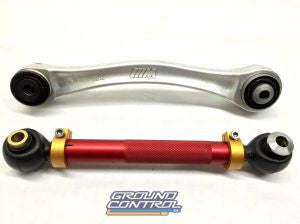
GC rear arms come with dust boots.
Image hosted on: groundcontrolstore.com
bbnks2 wrote
Why did you put a washer on your arp bolts?
I didn't, they came like that. I think I see where the disconnect is... the bolt head is not in shear. The only shear surface is between the bearing the conical washer. Hence, single shear.

EDIT: apparently "Slip plane" is the right term. The bolt head is not the slip plane.
amg6975 wrote
I didn't, they came like that. I think I see where the disconnect is... the bolt head is not in shear. The only shear surface is between the bearing the conical washer. Hence, single shear.

EDIT: apparently "Slip plane" is the right term. The bolt head is not the slip plane.
and I think the term for what I am referring to is bolt "stress" and how the washer changes the concentration of that stress. More stress impacts a variety of the bolts attributes but it's likely immaterial especially if you retorque after a few heat cycles.
It seems my theory was not wrong.

"2) Mounting position of bearing on arm
The ball bearing is wider than the stock bushing, and the bearing is mounted to the outside of the arm by the difference in order not to change the position of the stock arm.
So, the center axis of motion of the ball bearing shifted outward by a few millimeters. This puts more stress on the bolt as the arm moves, like a lever.
If the bearing is less wide than the stock bushing, so the center axis of the bearing is closer to the knuckle, the stress on the bolt will be reduced.
(Honestly, I wonder if arm's movement will be the same as stock.)"


A bolt broke while driving on the track. It was an ARP bolt.
I do not recommend this method of using ball bearings that do not match the size of the stock rubber bushing.
Attached image
maicol76 wrote
It seems my theory was not wrong.

"2) Mounting position of bearing on arm
The ball bearing is wider than the stock bushing, and the bearing is mounted to the outside of the arm by the difference in order not to change the position of the stock arm.
So, the center axis of motion of the ball bearing shifted outward by a few millimeters. This puts more stress on the bolt as the arm moves, like a lever.
If the bearing is less wide than the stock bushing, so the center axis of the bearing is closer to the knuckle, the stress on the bolt will be reduced.
(Honestly, I wonder if arm's movement will be the same as stock.)"


A bolt broke while driving on the track. It was an ARP bolt.
I do not recommend this method of using ball bearings that do not match the size of the stock rubber bushing.
Was this bearing installed with the 3mm offset? If no could that be why?
Redd wrote
Was this bearing installed with the 3mm offset? If no could that be why?
right you should be pressing the bushing in to the correct depth to match the stock pickup point. really highly doubt a 3mm difference would matter anyway. It looks like the bushing is sticking out the wrong side of the arm? That would make for a 6mm offset in the wrong direction?

Seems odd this guy has broken like 5 bolts now including an ARP bolt. I wonder if something else is different with his suspension?
I still have not done this install, but with the 3 mm offset it looks like the bearing center is not centered in the arm. Does that have any impact on the load the bolt sees and why it’s breaking?
houtan wrote
I still have not done this install, but with the 3 mm offset it looks like the bearing center is not centered in the arm. Does that have any impact on the load the bolt sees and why it’s breaking?
The arm is forged alu and should be fine with the offset. However, if the attachment point is not the same as stock arm, there will be excessive angle when the arm moves. If it hits the limit of bearing articulation then the load on the bolt increases exponentially.
Thread referenced by Redd in bushing breakdown 12-31-2023
Sorry for the dumb question, but is this conversion equivalent to getting the gc rear arms kit, without the worries of this bolt shearing issue? Looks like their arms have sealed spherical bearings and the added benefit of adjustable length. I started off looking to do this conversion but at 150k miles I should probably get new arms too, and then the savings aren’t as noticeable.
kolosy wrote
Sorry for the dumb question, but is this conversion equivalent to getting the gc rear arms kit, without the worries of this bolt shearing issue? Looks like their arms have sealed spherical bearings and the added benefit of adjustable length. I started off looking to do this conversion but at 150k miles I should probably get new arms too, and then the savings aren’t as noticeable.
Yes, just get GC.