20.1KVIEWS
24REPLIES
31APPRECIATES
03-14-2026LAST POST
Guys,
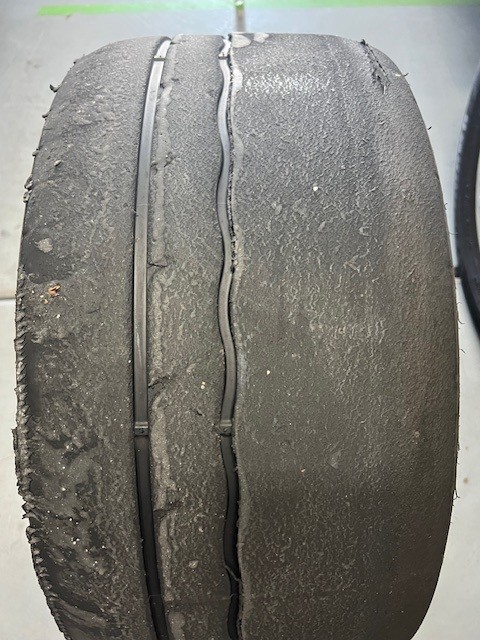
I need some advice. I'm running V730's (275-35-18) that are shredding the outside shoulder. I finally split the rt front after a day at Thunderhill's 3mi layout.
The camber is 3.7, with a bit of toe out. You will see by the pics, the inner part of the tire is hardly worn.
The hot pressures are under 40psi. I try to start with 30psi.
Im running Ohlins Trackday Coilovers w Swift springs, 120 N/MM front, 180 N/MM rear.
Also running a Dinan front sway bar in the second hole (rear is the factory bar).
all joints are spherical, with a SPL adjustable front lower arm.

I really dont know where to go with this. Could there be enough body roll to cause the front end to loose camber on the outside tire?

- Should i move the waybar link to the stiffest?
- go to a stiffer spring up front?

-Steve
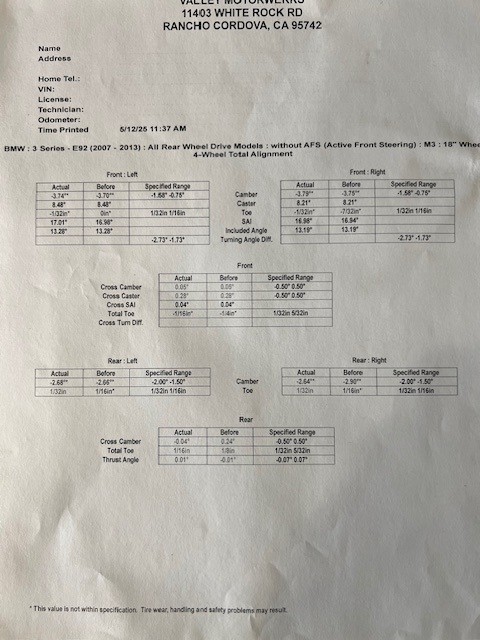
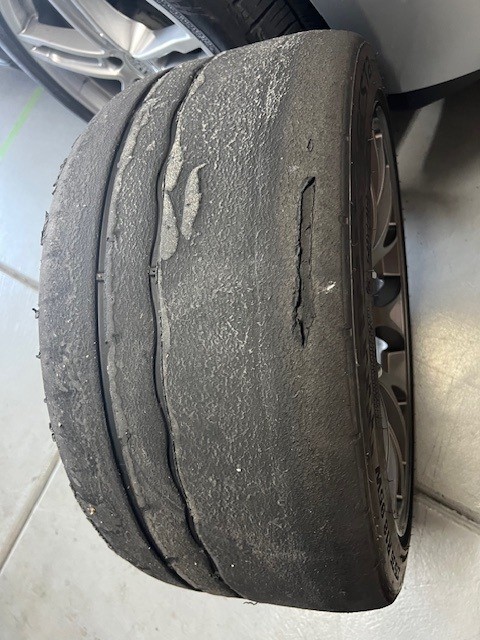
Attached imageAttached imageAttached image
Thats super interesting. I don’t have any bmw specific suggestions, but generally speaking… run zero toe up front and reduce caster.
There's far too much understeer in the car now with the Dinan front bar and stock OEM rear bar - and/or you're using too much steer angle in slow speed corners when at the understeer limit of grip (scrubbing the tires). Reduce the understeer by decreasing the front axle roll stiffness and adjusting driving style. The most effective way(s) to do that is to:

A) Remove the front sway bar, or at the very least adjust it to its softest setting. You left the rear bar stock i.e. OEM, so now the front to rear roll stiffness is unbalanced...

B) Decrease the cold start rear tire pressures considerably.

C) Decrease static rear camber (less negative).

D) Set front axle toe-in to zero or slight toe-in (i.e. about 1/16th to 1/8th of an inch total toe-in at the front axle).

E) Reduce the front axle spring rates.

F) Use wider front wheels.

G) Increase the front axle track width (perhaps with spacers).

H) Use less steer angle when at the limit of the front tires by adding some over steer balance by doing the things listed above.

I) Soften the front shocks in bump setting
dinan bar is causing you to push into corners probably.

on V730s i targeted 32psi hot on my car at 3500lbs.

probably not related: also that tire seems to be eating up the whole wheel? what size wheel is that?

the V730s like some stretch.
DrFerry wrote
There's far too much understeer in the car now with the Dinan front bar and stock OEM rear bar - and/or you're using too much steer angle in slow speed corners when at the understeer limit of grip (scrubbing the tires). Reduce the understeer by decreasing the front axle roll stiffness and adjusting driving style. The most effective way(s) to do that is to:

A) Remove the front sway bar, or at the very least adjust it to its softest setting. You left the rear bar stock i.e. OEM, so now the front to rear roll stiffness is unbalanced...

B) Decrease the cold start rear tire pressures considerably.

C) Decrease static rear camber (less negative).

D) Set front axle toe-in to zero or slight toe-in (i.e. about 1/16th to 1/8th of an inch total toe-in at the front axle).

E) Reduce the front axle spring rates.

F) Use wider front wheels.

G) Increase the front axle track width (perhaps with spacers).

H) Use less steer angle when at the limit of the front tires by adding some over steer balance by doing the things listed above.

I) Soften the front shocks in bump setting
I am strictly here to learn:

Would a stiffer rear bar help here?
F4rmost wrote
I am strictly here to learn:

Would a stiffer rear bar help here?
Yes, because stiffening the rear roll stiffness is equivalent to reducing the front roll stiffness regarding the affects on understeer / oversteer balance and the “work” the tires on each axle do (the proportion of load transfer)..
Thank you for everyone's input.

I should have included a few more things:

1) 275/35/18 square on 18x10
2) it has plenty of front end grip, actually kind of "pointy".

I do get understeer, but only on very slow, 90 deg plus corners.

I have been rotating the tires (F-R only) after every event.

If the front was 'skating' more than the rear, wouldn't i see significant wear from the center of the tire as well (assuming the front is gaining camber by nature of BMW geometry)?

Is caster doing anything related to camber gain/loss?
omgzirra_exe wrote

on V730s i targeted 32psi hot on my car at 3500lbs.

.
Agree, the V730's like less pressure than others. I start off cold in the mid to high 20's and keep below 32 hot as OMGZIRRA mentioned. I would bet that has a direct impact on your situation.

Rubin
sperkins wrote
Thank you for everyone's input.

I should have included a few more things:

1) 275/35/18 square on 18x10
2) it has plenty of front end grip, actually kind of "pointy".

I do get understeer, but only on very slow, 90 deg plus corners.

I have been rotating the tires (F-R only) after every event.

If the front was 'skating' more than the rear, wouldn't i see significant wear from the center of the tire as well (assuming the front is gaining camber by nature of BMW geometry)?

Is caster doing anything related to camber gain/loss?
pic is from Buttonwillow CW13. Not sure if this tells anything
Attached image
Now that you mentioned Buttonwillow, that track surface has gone to shit after the repave lol. That place absolutely destroys tires now, compared to The Circuit which is newer and easier on them.

Caster also plays a role here since it affects camber dynamically. I’m sure you already know this, but there’s the whole static vs dynamic camber thing as well. Even if you’re running a good amount of static camber, once the car takes a set and rolls in the corner you can lose some of that negative camber, which could explain the outside shoulder wear you’re seeing.

We actually run pretty similar spring rates (different coilovers though), and I also have a full SPL front end setup.

But no sway bar.

The fact that the car feels pretty pointy also makes sense with the Dinan front bar. With the Dinan bar, especially if it’s not on the softest setting, it could be transferring more load onto the outside tire in the longer corners (Riverside probably).

That might explain why the inner part of the tire still looks ok while the outer shoulder is getting shredded. The bar probably gives you nice initial response, but it doesn’t necessarily stop the car from leaning onto the outside tire once the load really builds.

Personally I’d probably try removing the front bar or softening it before going stiffer on springs.

Someone else can verify what I'm saying or disprove, I'm not a professional, just watch a lot of youtube and sit on a racing sim. LOL
sperkins wrote
If the front was 'skating' more than the rear, wouldn't i see significant wear from the center of the tire as well (assuming the front is gaining camber by nature of BMW geometry)? Is caster doing anything related to camber gain/loss?
You are seeing wear in the center of the tire. See the marked up image below showing the intermediate rib edge is lower than the preceding edge. Yes, when compressed by bump forces (lateral load transfer) nearly all suspension designs gain camber but also toe-out. Yes, the more caster you run or is designed into a suspension then the more camber will be gained in bump but some of that gain is offset by cornering forces and suspension bushing compliance.. As a general rule try to run as much caster as you can or until the steering effort torque becomes uncomfortable. Consider reducing the static toe to zero. Get the car aligned with you sitting in the driver's seat and a half a tank of gas. Reduce cold pressures. Respect the cool down lap.
.
Attached image
DrFerry wrote
You are seeing wear in the center of the tire. See the marked up image below showing the intermediate rib edge is lower than the preceding edge. Yes, when compressed by bump forces (lateral load transfer) nearly all suspension designs gain camber but also toe-out. Yes, the more caster you run or is designed into a suspension then the more camber will be gained in bump but some of that gain is offset by cornering forces and suspension bushing compliance.. As a general rule try to run as much caster as you can or until the steering effort torque becomes uncomfortable. Consider reducing the static toe to zero. Get the car aligned with you sitting in the driver's seat and a half a tank of gas. Reduce cold pressures. Respect the cool down lap.
.
This uneven wear looks like my tires with zero toe AND stock camber. Very weird for a car with -3 degrees.

I still vote to reduce caster. Set it to stock levels.
BigTee wrote
This uneven wear looks like my tires with zero toe AND stock camber. Very weird for a car with -3 degrees. I still vote to reduce caster. Set it to stock levels.
As far as I can tell from the alignment sheet the O.P. posted above he's running stock caster.
.
Attached image
stock caster is 8.4?? TIL.

I'm at like 7.2
Below is my benchmark specs I shoot for each time. Car does everything I want it to do. Car has great rotation at low speeds but very neutral in high speed corners.

Rubin
Attached image
Again- thank you everyone for the input!

Understand that the pic of BW CW13 was the first and only time i've been there. I just wanted to illustrate what the roll looks like when entering a turn. The majority of the time is spent at Thunderhill East. This is a CC direction with long highspeed left hand sweepers that abuse the rt side tires.

I want to add/update that the next set of tires will be on Apex VS5RS in 18x10.5
Tire size will be 285/30-18 (REZ1RZ) air pressure recommendation?

For caster, am I decreasing the positive angle (standing the kingpin up)?

Is there any science to increasing the track width by adjusting the SPL FLCA?

Again, the car has plenty of front end grip, just trying to figure out the wear issue.
I haven't run the new RZ variant yet, hope you enjoy it! For the RE71RS, I try to target 32-34 PSI hot and that has been good for me.
DrFerry wrote
You are seeing wear in the center of the tire. See the marked up image below showing the intermediate rib edge is lower than the preceding edge. Yes, when compressed by bump forces (lateral load transfer) nearly all suspension designs gain camber but also toe-out. Yes, the more caster you run or is designed into a suspension then the more camber will be gained in bump but some of that gain is offset by cornering forces and suspension bushing compliance.. As a general rule try to run as much caster as you can or until the steering effort torque becomes uncomfortable. Consider reducing the static toe to zero. Get the car aligned with you sitting in the driver's seat and a half a tank of gas. Reduce cold pressures. Respect the cool down lap.
.
Thank you DrF!

That's a very good highlight on the treadwear pattern.

So more castor is leaning the kingpins back, correct?
BTW, i had the car corner balanced (and aligned) with a half tank, and a bunch of sandbags to simulate my weight.
sperkins wrote
Thank you DrF! That's a very good highlight on the treadwear pattern. So more castor is leaning the kingpins back, correct?
BTW, i had the car corner balanced (and aligned) with a half tank, and a bunch of sandbags to simulate my weight.
Kingpin inclination is a term more often used with double A-arm suspension designs. However, it still applies to the MacPherson strut front suspension design of the BMW E9X. The Kingpin axis on the strut is an imaginary line that runs from the strut top down the body of the strut and intersects the ball joint. So by moving the top mount of the strut back towards the firewall, caster angle can be increased. In order to do this one would need adjustable strut top mounts.
omgzirra_exe wrote
stock caster is 8.4?? TIL. I'm at like 7.2
Stock E9X M3 caster angle range is from 6.2 to 8.2 degrees. The left side caster angle in the O.P.'s original post is slightly higher than stock range by 0.2 degrees.
sperkins wrote
Is there any science to increasing the track width by adjusting the SPL FLCA?
Reducing lateral load transfer for any given axle generally improves tire wear.
.
Attached image
DrFerry wrote
Kingpin inclination is a term more often used with double A-arm suspension designs. However, it still applies to the MacPherson strut front suspension design of the BMW E9X. The Kingpin axis on the strut is an imaginary line that runs from the strut top down the body of the strut and intersects the ball joint. So by moving the top mount of the strut back towards the firewall, caster angle can be increased. In order to do this one would need adjustable strut top mounts.
My “kit” has Vorshlag camber plates, so should be able to get the correct angles.