

Yesterday I came across Vorsteiner's Web site and saw that their CFRP has a tensile strength of 82.3 ksi, 5.21 times stronger than steel, or 6.28x stronger than aluminium. Is this really true? Does Vorsteiner have any testing data to support their claim?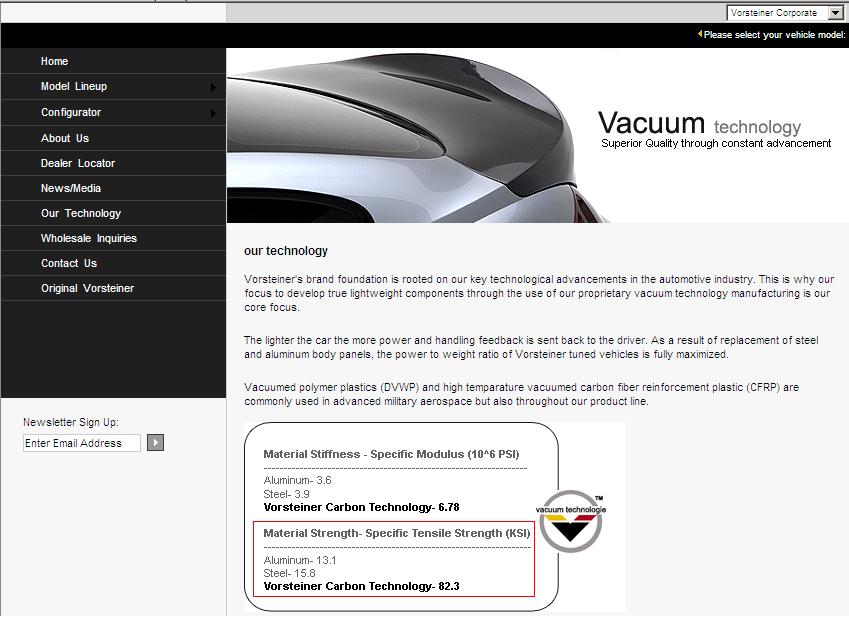
21.3KVIEWS
19REPLIES
0APPRECIATES
03-19-2009LAST POST
I'd throw it on the Instron for you if I was still in school. 
Carbon fiber may be that strong. But I doubt fiberglass is.
Keep in mind material differences vs. part differences. Material strengths are lb / square inch. So an apples to apples coupon material test of CF vs. aluminum will have the aluminum part heavier since it is more dense. On a per area basis really good CF can be over 10 times as strong as aluminum. Is a CF automotive aero part 10 times as strong as the same part would be in aluminum? No. Also keep in mind stiffness, not the same as strength. Typical high quality CF is about 3 times stiffer than aluminum. But again an actual part will not be 3 times as stiff. As you mentioned the amount of fiberglass vs. amount of CF makes a huge difference as well. Composites, both CF and CF mixed with other composites such as fiberglass can have a HUGE range of strength and stiffness.
swamp2 wroteman you have the longest ways to say very simple things. all what u said can be summed up in a simple noKeep in mind material differences vs. part differences. Material strengths are lb / square inch. So an apples to apples coupon material test of CF vs. aluminum will have the aluminum part heavier since it is more dense. On a per area basis really good CF can be over 10 times as strong as aluminum. Is a CF automotive aero part 10 times as strong as the same part would be in aluminum? No. Also keep in mind stiffness, not the same as strength. Typical high quality CF is about 3 times stiffer than aluminum. But again an actual part will not be 3 times as stiff. As you mentioned the amount of fiberglass vs. amount of CF makes a huge difference as well. Composites, both CF and CF mixed with other composites such as fiberglass can have a HUGE range of strength and stiffness.

!Xoible wroteI do like to add details as well as give answers. However, I guess it can't be summed up simply as you state because my answer is actually "yes". At least very likely yes.man you have the longest ways to say very simple things. all what u said can be summed up in a simple no

Great explanation Swamp2. Which leads to the next two questions:
1) Why does it even matter what the material stiffness is for an aero part? ( I can't imagine any benefit to having it stiffer than aluminum or steel?)
2)Why does tensile strength matter for an aero part?
Although these statistics showing them stronger and stiffer than aluminum and steel look impressive. They serve absolutely no benefit as I see it. Now if you were comparing weight of making an aero piece of 100% CF vs. other materials then I could see advantages.
1) Why does it even matter what the material stiffness is for an aero part? ( I can't imagine any benefit to having it stiffer than aluminum or steel?)
2)Why does tensile strength matter for an aero part?
Although these statistics showing them stronger and stiffer than aluminum and steel look impressive. They serve absolutely no benefit as I see it. Now if you were comparing weight of making an aero piece of 100% CF vs. other materials then I could see advantages.
J08M3 wroteSwamp2 offered a very good answer. Let me piggyback off that since he has it completely right.Great explanation Swamp2. Which leads to the next two questions:
1) Why does it even matter what the material stiffness is for an aero part? ( I can't imagine any benefit to having it stiffer than aluminum or steel?)
2)Why does tensile strength matter for an aero part?
Although these statistics showing them stronger and stiffer than aluminum and steel look impressive. They serve absolutely no benefit as I see it. Now if you were comparing weight of making an aero piece of 100% CF vs. other materials then I could see advantages.
It matters if you, like me, scrape your lip a lot, slam your bootlid a lot, etc etc. I had a Fiberglass trunk on my E46 and after a while the shocks started to crack the bootlid at the hinges... sucked. I also had a lip that was wet carbon fiber overlaid on wet lay low grade fiberglass, and i bumped it once - it cracked completely, all the way down. On the other hand, I hit a parking stopper with my Vorsteiner lip once... (ok, I hit a couple things... lay off me, ok?) and only the resin on the outside cracked. Over the summer I will have it sanded down and resprayed - the carbon fiber is still perfectly intact! Basically, strength is important for a lot of things, but the main reason it's up there is to show "hey, our parts are a fraction of the weight of OEM, but don't worry, because they are just as strong and won't break easily during regular use!"
Also, Vorsteiner does not profess to use 100% carbon fiber in any of their parts (see above where they call it CFRP!), although some of them do use 100% CF. They use a proprietary method whereby S-Glass is used in the pre-preg process (much stronger than fiberglass). This makes their parts stronger, while only compromising a 5-10% increase in weight over 100% CF parts such as Ericsson. This is similar to what AC Schnitzer, Techart, Novitec Rosso, and many others do - though some companies (Hamann, AC Schnitzer, and others) will just use Fiberglass on some of their parts.
Point is, like you said, you just need weight savings and strength that is equal to or greater than OEM so that the parts can withstand daily use and abuse.
If you are concerned about weight, or just want to know your parts are 100% carbon, Vorsteiner offers a Race Program whereby they will substitute any S-Glass for Carbon Fiber - but you can expect prices in the Ericsson range, ala $3,500 for a front lip, $10,000 for a front bumper, etc. We sell a Sportec bootlid for the 997 GT2 that is $28,500 - to give you an idea.
Does this answer your questions?

Also, one other thing to make you go "ohhh.. duhh!" - Vorsteiner's supplier for a lot of their carbon-related consumables supplies Boeing. You know, those people who make the Jets you can't sleep on?
If it weren't stronger than most metal alloys (and lighter), why would Boeing use it? Furthermore, why would Lamborghini, McLaren, Bugatti... You get the idea
Carbon fiber is amazing stuff!
If it weren't stronger than most metal alloys (and lighter), why would Boeing use it? Furthermore, why would Lamborghini, McLaren, Bugatti... You get the idea
Carbon fiber is amazing stuff!
Jlevi SW wroteWhen it is used as a wrap its strong. Planes cars etc. are not just carbon fiber by itself. Carbon fiber by itself actually has very poor tensile strength. Its when it is used in conjunction with alloys etc. that it shines.Also, one other thing to make you go "ohhh.. duhh!" - Vorsteiner's supplier for a lot of their carbon-related consumables supplies Boeing. You know, those people who make the Jets you can't sleep on?
If it weren't stronger than most metal alloys (and lighter), why would Boeing use it? Furthermore, why would Lamborghini, McLaren, Bugatti... You get the idea
Carbon fiber is amazing stuff!
Jlevi SW wroteThanks for the condescending remark....Also, one other thing to make you go "ohhh.. duhh!" - Vorsteiner's supplier for a lot of their carbon-related consumables supplies Boeing. You know, those people who make the Jets you can't sleep on?
If it weren't stronger than most metal alloys (and lighter), why would Boeing use it? Furthermore, why would Lamborghini, McLaren, Bugatti... You get the idea
Carbon fiber is amazing stuff!
And after I stuck up for you being a good vendor on the last Vorsteiner thread. Sorry I missed the "ohhh...duhh" point about driving my front lip into stuff. Didn't cross my mind that I need to buy a part I can run into curbs with. I just figured when I bought my Vorsteiner lip that I would be careful and leave an extra couple of inches between me and the curb. I got the idea a long time ago when I chose to go with an authentic Vorsteiner part and defend them in numerous threads on the forum.
Jlevi SW wroteHi JL,This is similar to what AC Schnitzer, Techart, Novitec Rosso, and many others do - though some companies (Hamann, AC Schnitzer, and others) will just use Fiberglass on some of their parts.
I'd like to clarify your statement regarding AC Schnitzer and Techart parts. All of Techart's carbon parts are real prepreg dry carbon fiber parts, and not wet laid on any fiber glass, resin, plastic, or anything. Same goes for all AC Schnitzer's E9X M3 parts.
Thanks

swamp2 wroteYou are right about the CF having higher strength-to-weight ratio than metals. But here, I am only talking about tensile strength, which is not a function of weight. I am asking the simple question: are Vorsteiner's CFRP in fact 5-6x stronger than steel/aluminium?Keep in mind material differences vs. part differences. Material strengths are lb / square inch. So an apples to apples coupon material test of CF vs. aluminum will have the aluminum part heavier since it is more dense. On a per area basis really good CF can be over 10 times as strong as aluminum. Is a CF automotive aero part 10 times as strong as the same part would be in aluminum? No. Also keep in mind stiffness, not the same as strength. Typical high quality CF is about 3 times stiffer than aluminum. But again an actual part will not be 3 times as stiff. As you mentioned the amount of fiberglass vs. amount of CF makes a huge difference as well. Composites, both CF and CF mixed with other composites such as fiberglass can have a HUGE range of strength and stiffness.
Jlevi SW wroteI, as a mechnical engineer, of course know that properly made CF/CFRP has a higher strength-to weight ratio than aluminium. What I am asking here is whether Vorsteiner's pieces with such high glassfiber content would be as strong as they claim it to be.Also, one other thing to make you go "ohhh.. duhh!" - Vorsteiner's supplier for a lot of their carbon-related consumables supplies Boeing. You know, those people who make the Jets you can't sleep on?
If it weren't stronger than most metal alloys (and lighter), why would Boeing use it? Furthermore, why would Lamborghini, McLaren, Bugatti... You get the idea
Carbon fiber is amazing stuff!
J08M3 wroteGood questions/points. The Jlevi SW fellow made some good points too. Generally a better strength part is always an advantage. However, a large reason most of these parts are carbon fiber (whatever % or process) is simply looks. These parts like splitters, lips, diffusers have a strong racing heritage. In that world stiffness, weight and strength are absolutely critical. At speeds <~ 130 mph (very roughly speaking), CF simply is not "required". Fiberglass and SMC (sheet molding compounds - just another type of fiber reinforced plastic) are perfectly suitable.Great explanation Swamp2. Which leads to the next two questions:
1) Why does it even matter what the material stiffness is for an aero part? ( I can't imagine any benefit to having it stiffer than aluminum or steel?)
2)Why does tensile strength matter for an aero part?
camaross305 wroteNot correct. The typical application for fiber wrapped or composite reinforced metallics are to offer strength and impact resistance (foreign object damage; birds strike, ordnance, etc.). You also have the part about "by itself" wrong. CF alone is just that fibers, they have incredible tensile strength but no ability to resist compression and shear. That is why you lay up the material in different directions and stabilize it with the resin. When most folks say "CF" they mean the resulting composite made from the fibers and the cured resin. Then with such a composite you can get amazing tensile, shear and compressive strength. Lastly, modern aircraft both military and commercial are almost "pure CF", not wrapped. By "almost" I mean a vast majority of the load bearing structure.When it is used as a wrap its strong. Planes cars etc. are not just carbon fiber by itself. Carbon fiber by itself actually has very poor tensile strength. Its when it is used in conjunction with alloys etc. that it shines.
rldzhao wroteAgain depends, tensile strength specification of the material is not a function of weight but tensile strength of a part always is. So without testing their actual material nor parts all I can say is I definitely believe their claim that their MATERIAL is that much stronger, as they advertise. High end, pure CF composites can be substantially stronger than the Vorsteiner numbers, like 10x specifically on the yield strength (in pressure, force/area) compared to aluminum or low strength steel.You are right about the CF having higher strength-to-weight ratio than metals. But here, I am only talking about tensile strength, which is not a function of weight. I am asking the simple question: are Vorsteiner's CFRP in fact 5-6x stronger than steel/aluminium?
...
I, as a mechnical engineer, of course know that properly made CF/CFRP has a higher strength-to weight ratio than aluminium. What I am asking here is whether Vorsteiner's pieces with such high glassfiber content would be as strong as they claim it to be.
swamp2 wroteHow exactly is weight involved in tensile strength? By definition, tensile strength is in units of force per unit area, commonly known in the US as lbf/in^2, where does weight come into play?Again depends, tensile strength specification of the material is not a function of weight but tensile strength of a part always is.
And what is the "tensile strength of a part"? The total force it takes to pull something apart? That doesn't involve weight either... Please describe the definition and process of determining such a property (if it actually exists).
Finally, if you look at my OP: on Vorsteiner's site it says "material strength, specific tensile strength" in ksi (kilo-poundforce per square inch), or "tensile strength of the material" as you put it.
rldzhao, to answer you original question, from memory, tensile strength of steels are in the 400-1000 MPa range, and CF materials are in the 2000-5000 MPa range, so Vorstenier claim about their CF materials being 5x stronger than steel in material properties is possible. I wish they stopped focusing on trunk lids and came up with low cost CF external door panels as those things weigh a lot; the Ericsonn stuff is way to expensive. Did you ever go for the Braille battery by the way? I read that people have been using them with their Z06s without problems. I am thinking about going for it...
lucid wroteDoor panels may have safety requirements... though I am not really sure. Also the condition of doors when you sell your car is extremly important. Many appraisers look very closely at whether the bolts have been removed, so I wouldn't mess with it.I wish they stopped focusing on trunk lids and came up with low cost CF external door panels as those things weigh a lot; the Ericsonn stuff is way to expensive. Did you ever go for the Braille battery by the way? I read that people have been using them with their Z06s without problems. I am thinking about going for it...
This rest of the reply is in your weight savings thread.
rldzhao wrotePerhaps I am not being clear. Furthermore, I don't want to patronize you being an engineer who certainly knows these very basics already. For anyone else: "Tensile" is just pulling and strength is just a limit (could be force or pressure). A 1 square in cross section bar placed under increasing load in tension will yield (loosely permanently deform) or fail (reach "ultimate") at twice the force of a 1/2 square in part. Same pressure, different load or different strength. Similarly, the larger cross section bar weighs more, either per unit length or similarly for a given length of each. The way to get a stronger part is simply better material, more material or better shape. Same for a diffuser or any other part. The strength of the part is a function of both its material and geometry. Diffuser A that is 6 mm thick certainly has a higher strength (under any load conditions) than diffuser B at 3 mm thick, although each will fail at the same pressure in the material, given the same material of construction.How exactly is weight involved in tensile strength? By definition, tensile strength is in units of force per unit area, commonly known in the US as lbf/in^2, where does weight come into play?
And what is the "tensile strength of a part"? The total force it takes to pull something apart? That doesn't involve weight either... Please describe the definition and process of determining such a property (if it actually exists).
Finally, if you look at my OP: on Vorsteiner's site it says "material strength, specific tensile strength" in ksi (kilo-poundforce per square inch), or "tensile strength of the material" as you put it.
swamp2 wroteI know this and agree it has to be at least 130. But I don't think any racecar is putting a vorsteiner lip on the front. Thanks for the good answerGood questions/points. The Jlevi SW fellow made some good points too. Generally a better strength part is always an advantage. However, a large reason most of these parts are carbon fiber (whatever % or process) is simply looks. These parts like splitters, lips, diffusers have a strong racing heritage. In that world stiffness, weight and strength are absolutely critical. At speeds <~ 130 mph (very roughly speaking), CF simply is not "required". Fiberglass and SMC (sheet molding compounds - just another type of fiber reinforced plastic) are perfectly suitable.
