

elp_jc wroteYes, thanks.Hope this helps.
187.7KVIEWS
72REPLIES
5APPRECIATES
09-10-2021LAST POST
How much pressure do you put in the bleeder?
At ~23 PSI, I still had trouble bleeding the RR one! The 3 other ones were a piece of cake, even at 20 PSI.
At ~23 PSI, I still had trouble bleeding the RR one! The 3 other ones were a piece of cake, even at 20 PSI.
Wow that's a lot of pressure! Anyway as the title says, do you actually flush or bleed? The article is more like bleeding the system. Be careful when you guys bleed the system, find out first if the M3 braking system is diagonal or front and back split. Bleeding doesn't always start from the RR of the vehicle. Flushing requires you to completely drain the system which causes the ABS/TCS to malfunction and then DRB scan tool to be used. By the way, I use Phoenix bleeding tools. 25 psi is way too much. You're looking at damaging the seals. I hope my 2 cents helps.
MTROIS wroteI personally don't like pressure bleeders, but I'd never put that much pressure man.At ~23 PSI, I still had trouble bleeding the RR one! The 3 other ones were a piece of cake, even at 20 PSI.
What you need to do is bleed that valve with the pedal, and hopefully dislodge the restriction. Did you check the lines? Make sure they're not kinked or otherwise damaged around the wheel well area. Remove the wheel and check thoroughly. Good luck.
Any feedback between these two units?
Reverse bleeder:
http://www.griotsgarage.com/product/tools/specialty+tools/reverse+brake+bleeder+kit.do?search=basic&keyword=bleeder&sortby=newArrivals&page=1
Regular brake bleeder:
http://www.griotsgarage.com/product/tools/specialty+tools/one-person+brake+bleeder.do?search=basic&keyword=bleeder&sortby=newArrivals&page=1
Isn't there a pressure bleeder too?
Reverse bleeder:
http://www.griotsgarage.com/product/tools/specialty+tools/reverse+brake+bleeder+kit.do?search=basic&keyword=bleeder&sortby=newArrivals&page=1
Regular brake bleeder:
http://www.griotsgarage.com/product/tools/specialty+tools/one-person+brake+bleeder.do?search=basic&keyword=bleeder&sortby=newArrivals&page=1
Isn't there a pressure bleeder too?
aus wroteYou only want to use a reverse bleeder when you screw up and let air into the system, AND can't purged it out with regular bleeding. This rarely happens on vacuum-assisted brake systems, like on most cars.Any feedback between these two units?
Only vehicles that might need it are those with servo-assisted brakes (4 independent systems), depending where you suck air. The circuits to the calipers can be bled normally even if you open the wrong line (like I did once - oops), But if you let the reservoirs gulp air, which feed pressure to a special diaphragm that pressurizes the caliper circuits, reverse bleeding is the only way to get them to work again. Many BMW bikes and some MB cars of a few years back have them. My K1200 bike had 11 valves to bleed, so you get the idea how complex the system is. I really liked them since with the brake lever you activated all brakes, but with the pedal just the rear. And all you needed was a finger for a 'panic' stop. They still had great feel IMO, but many purists argued they lacked feedback. Or they were spooked that you needed much heavier pressure without the ignition on. I never had any problems, but just like many things with our M3s, it was an unnecessary complication.
Anyway, I have a bleeder from Griots, but it's the larger one. The little one you linked is enough for the job, however.
And yes, you can reset any maintenance item yourself; do a search on instructions.
So with the Griot's bleeder, you suck out the fluid from the reseviour to the filter and then refill with fresh stuff? Then bleed from the calipers? Or does someone have to pour in fresh fluid as you're bleeding?
Then with the Motiv, you just pour the brake fluid into the Motiv unit, uncap the brake reseviour and screw it on. Then pressurize and bleed at each caliper into the water bottle? Thanks.
Then with the Motiv, you just pour the brake fluid into the Motiv unit, uncap the brake reseviour and screw it on. Then pressurize and bleed at each caliper into the water bottle? Thanks.
aus wroteHey man, before anything else, it seems to me you don't have experience doing this, and I don't want you to have an accident because you did something wrong. Bleeding brakes is easy, but you need to know what you're doing. How about starting a thread in the regional forum and invite to your house other forum members with brake bleeding experience for a 'tech daze'? BMW bikers do this all the time. Say pizza is on you and I bet at least one member will sign up. Just want you safe buddyThanks.
 .
.Having said that, you have to watch reservoir fluid level regardless of method, and don't let it get below MIN, which is right at the bottom of the screen insert (nice 'feature'). And no, no need to remove that screen (you'd destroy it anyway).
After you suck all the old fluid you can (down to the MIN level, as mentioned), add new fluid to the top and you can start bleeding from the calipers (RR, RL, FR, FL) by vacuum or pressure while watching fluid level. With the first caliper (RR), suck the reservoir to MIN, close valve, fill it up again, and suck some more before moving on to the next. Reason is first fill-up will have about 1/4 of dirty fluid mixed in. That's why I like to change fluid early, before it's too nasty. I usually change it every year; it's only $10, plus you get to check and clean everything around. Good luck.
Cool thanks.
this post is helpful. ive always been a little scared to do this but will do it myself now. can you confirm its 1/4 inch tubing?
Great post, how much brake fluid does the system hold?
Just read through this DIY.
Brake system holds about 1 liter. That would mean full pads, full reservoir. Remember as your pads wear, the level goes down. If your pads are low, don't add fluid or you'll push it out when you attempt to replace your pads. It's a semi-sealed system.
An alternative to sucking out all of the old fluid from the reservoir is to do one/two dumps down to MIN line at the front left caliper. That way crap doesn't have to get pushed to the back. The front left is a REALLY short run so be ready for a quick flush. Then just start the process and redo the front left.
Also...flush does not mean you should drain your fluid and add more. You never want to empty your system unless you have a flat bed to the dealer lined up. If you know I'm wrong, I'm not talking to you.
Brake system holds about 1 liter. That would mean full pads, full reservoir. Remember as your pads wear, the level goes down. If your pads are low, don't add fluid or you'll push it out when you attempt to replace your pads. It's a semi-sealed system.
An alternative to sucking out all of the old fluid from the reservoir is to do one/two dumps down to MIN line at the front left caliper. That way crap doesn't have to get pushed to the back. The front left is a REALLY short run so be ready for a quick flush. Then just start the process and redo the front left.
Also...flush does not mean you should drain your fluid and add more. You never want to empty your system unless you have a flat bed to the dealer lined up. If you know I'm wrong, I'm not talking to you.
Does anyone have verification from a factory service manual that it is the tried and true standard of furthest from the master cylinder and then keep working closer to it? My 2007 Acura TL Type-S has a goofy order that does not follow this, and the front OEM Brembos have two bleeders each. I would never have done any other pattern of bleeding except that I have the Helm factory service manual.
I often hear that the bleeding order is not as important as it once was. What order is your Honda?
So, a question. Would 1 liter of brake fluid be enough to do a SS line swap and fluid flush? Or is that pushing it? (I know it's better to be safe than sorry, but just wondering.....)
Buy 2 litres, try not to open the second one but be prepared. There's another variable...if you're going from no brakes to new pads, that's more fluid displacement than what's in the lines. Then I'd say you'd be safe with 1 litre. Also...depending on how fast you work, how you kink your lines, and generally how much fluid you drip out with changing the lines plays.
Get 2 litres and try to store the second one on the shelf. Lasts years on a shelf unopened, I'd only go 6 months once you open it. Leave the lid on as much as possible.
Good luck!
Get 2 litres and try to store the second one on the shelf. Lasts years on a shelf unopened, I'd only go 6 months once you open it. Leave the lid on as much as possible.
Good luck!
Car54 wroteBuy 2 litres, try not to open the second one but be prepared. There's another variable...if you're going from no brakes to new pads, that's more fluid displacement than what's in the lines. Then I'd say you'd be safe with 1 litre. Also...depending on how fast you work, how you kink your lines, and generally how much fluid you drip out with changing the lines plays.
Get 2 litres and try to store the second one on the shelf. Lasts years on a shelf unopened, I'd only go 6 months once you open it. Leave the lid on as much as possible.
Good luck!
Thanks sir!
Car54 wroteThe Acura TL with Brembos isI often hear that the bleeding order is not as important as it once was. What order is your Honda?
Driver Front
Passenger Front
Passenger Rear
Driver Rear
It would be like having the master cylinder above your driver rear tire. It is quite odd.
Additionally, those 4 piston Brembos have an inner and an outer bleeder. You must do outside first and then inside on each of the front wheels.
Hey guys,
Newbie questions:
1. My brake fluid maintenance is due (I believe is every 2 yrs) and the dealer is charging me $200.00, so I decided to buy the bleeder kit from Bavarian Auto. I read that if I flush the system I need to replace all 4 brake pads? My car is showing like 18K left for Front and 28K for Rear...I don't track my car. Do I have to replace my brake pads also??
*I know I have to change the Microfilter everytime y flush the brakes...
2. When I flush my brakes system, I won't get any warning errors (ABS)? Just reset my maintenance warning message?
3.If the master cylinder is located in the Passenger side, I will start the flush process from RR Passenger, RR Driver, FR Passenger and FR Driver?
Thanks alot!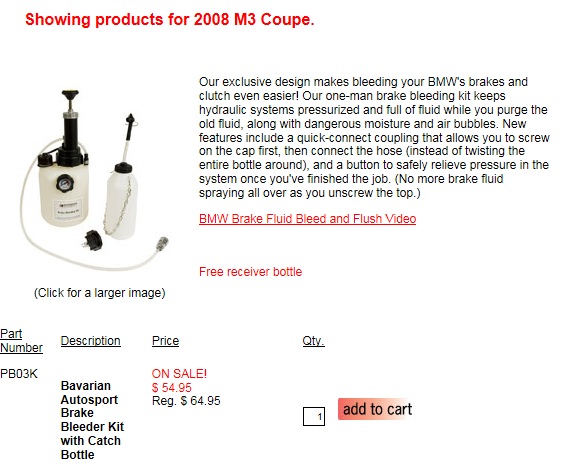
Newbie questions:
1. My brake fluid maintenance is due (I believe is every 2 yrs) and the dealer is charging me $200.00, so I decided to buy the bleeder kit from Bavarian Auto. I read that if I flush the system I need to replace all 4 brake pads? My car is showing like 18K left for Front and 28K for Rear...I don't track my car. Do I have to replace my brake pads also??
*I know I have to change the Microfilter everytime y flush the brakes...
2. When I flush my brakes system, I won't get any warning errors (ABS)? Just reset my maintenance warning message?
3.If the master cylinder is located in the Passenger side, I will start the flush process from RR Passenger, RR Driver, FR Passenger and FR Driver?
Thanks alot!
you dont need new pads with new fluid. you shouldnt get any warnings. not sure on the location of the master cylinder in our car.
