497.6KVIEWS
1.2KREPLIES
181APPRECIATES
08-12-2026LAST POST
blankstar43 wrote
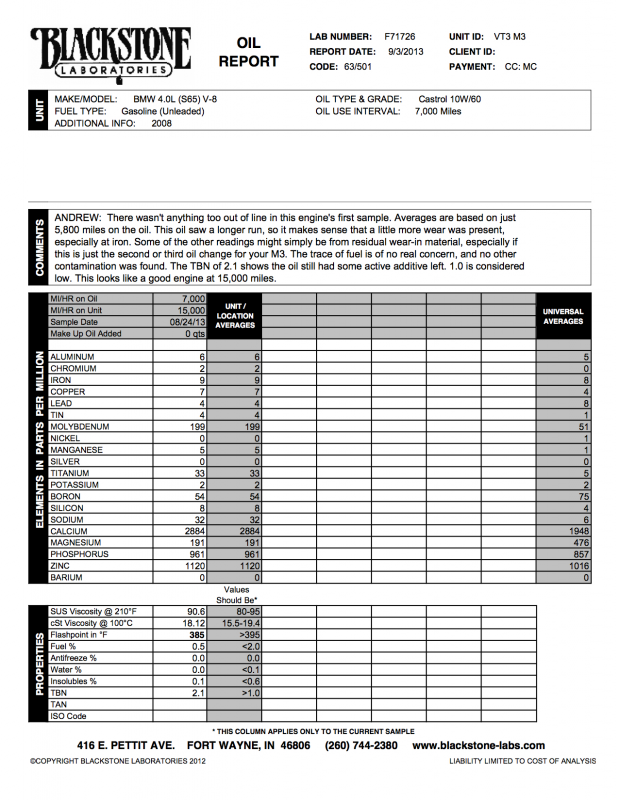
just got my results back after a good amount of track time on the oil
Blankstar43: FWIW I think that's a great report. There is one thing, however, you may want to keep an eye on and that's fuel dilution. It can negatively affect the viscosity or thickness of the oil, and it will also negatively affect the flash point of the oil, making it more likely to vaporize and drop deposits. Your report shows both vis and flash point below the norms for a 6k M3 oil change. Usually when both these metrics are sub-par, fuel dilution may be the culprit.

I know your report shows fuel dilution as nil (<.5%). That's a problem with Blackstone uoa's. They report fuel dilution, but don't really measure it - - they estimate it using a formula that I believe compares the flash point of the virgin oil (if they have it ) and the used oil. My experience is that they can be off. I once submitted a sample from the same drain to a lab that actually uses gas chromatography to test fuel dilution, and a sample from the same drain to Blackstone. Blackstone showed fuel dilution as nil while the other lab (Polaris) showed fuel dilution as almost 2% (what some consider the limit).

It's no big deal, and this is no rant against Blackstone, but if you want to verify fuel dilution, you might use a lab like Polaris that actually measures it.

So if you have high fuel dilution, what can you do about it? Assuming you don't have leaking fuel injectors or some other physical problem with the car (e.g. overly rich mixture), the only other thing you can do is look at how the car is driven. Lots of operation at wide open throttle will add fuel dilution, and frequent cold starts with short trips, and lots of extended idling, will all contribute.

If you want to try an actual measurement of fuel dilution next time, I'd suggest a lab called Oil Analyzers, Inc. They are a private label operation for Polaris. In other words, all the actual lab testing is done by Polaris (ISO accredited for accuracy). Order the kit02 and you will get a test kit that you can send back to OAI (Polaris) by prepaid UPS. So you'll get the results faster than if by US post. You'll also get TBN, oxidation, and nitration included in the uoa report.

http://www.oaitesting.com/index.htm

http://www.polarislabs.com/

Sorry for the bandwidth!
m6pwr wrote
Blankstar43: FWIW I think that's a great report. There is one thing, however, you may want to keep an eye on and that's fuel dilution. It can negatively affect the viscosity or thickness of the oil, and it will also negatively affect the flash point of the oil, making it more likely to vaporize and drop deposits. Your report shows both vis and flash point below the norms for a 6k M3 oil change. Usually when both these metrics are sub-par, fuel dilution may be the culprit.

I know your report shows fuel dilution as nil (<.5%). That's a problem with Blackstone uoa's. They report fuel dilution, but don't really measure it - - they estimate it using a formula that I believe compares the flash point of the virgin oil (if they have it ) and the used oil. My experience is that they can be off. I once submitted a sample from the same drain to a lab that actually uses gas chromatography to test fuel dilution, and a sample from the same drain to Blackstone. Blackstone showed fuel dilution as nil while the other lab (Polaris) showed fuel dilution as almost 2% (what some consider the limit).

It's no big deal, and this is no rant against Blackstone, but if you want to verify fuel dilution, you might use a lab like Polaris that actually measures it.

So if you have high fuel dilution, what can you do about it? Assuming you don't have leaking fuel injectors or some other physical problem with the car (e.g. overly rich mixture), the only other thing you can do is look at how the car is driven. Lots of operation at wide open throttle will add fuel dilution, and frequent cold starts with short trips, and lots of extended idling, will all contribute.

If you want to try an actual measurement of fuel dilution next time, I'd suggest a lab called Oil Analyzers, Inc. They are a private label operation for Polaris. In other words, all the actual lab testing is done by Polaris (ISO accredited for accuracy). Order the kit02 and you will get a test kit that you can send back to OAI (Polaris) by prepaid UPS. So you'll get the results faster than if by US post. You'll also get TBN, oxidation, and nitration included in the uoa report.

http://www.oaitesting.com/index.htm

http://www.polarislabs.com/

Sorry for the bandwidth!
Thanks for the input and suggestion! I'll definitely send my next samples out for the extra testing here in a few thousand more miles.

Forgive my ignorance, but how can I tell if its something physically wrong with the car and are there any serious side effects/damage that can be caused by high fuel dilution? I do drive the car hard once its warmed up and use it for daily driving (so it might see a handful of trips between 5-25 mile each day on avg), but I don't let it idle more than a couple minutes for the cold start to finish.

I had the BMW dealer take this previous sample we are referring to. Could it be a possibility they let the car idle for 5-10 minutes prior to putting it up on a lift to change the oil and this could be the culprit in this case?
Hi Blankstar. I'm afraid I can't be of much help re problems with the car itself - - have to leave that to the dealer and their diagnostics. BUT, you've only had this one uoa that MAYBE shows high fuel dilution. I would just try to keep an eye on it with the next couple of uoa's - - try to get a handle on what's normal for your car.

I'm too new to the S65 engine to know whether or not fuel dilution is usually present to any degree - - and part of that is due to using Blackstone for many, many years on other past M BMWs.

The way the sample is drawn can definitely affect the resulting report. If the car has been jockeyed around by the dealer with a lot of idling just prior to drawing the sample from luke warm oil, it would I expect show more than normal fuel dilution. FWIW I did a uoa on the first 1200 mi "break-in" drain (done at the dealer) and the uoa showed 1.5% fuel dilution. That's a lot for just 1200 mi., but I bought the M3 from dealer stock with about 50 mi on the clock (lots of short test drives?). Maybe high fuel dilution is normal in the M3.

The fuel itself in the oil does no damage. It's what it does to the oil that has to be watched. Your uoa still looked ok to me in that regard. I was told some interesting things by a lubricant engineer who worked for Castrol and had direct experience with TWS. He said the Castrol-supported Audi and VW teams at the 24 hr Nurburgring race used TWS 10w60 even though their normal service fills were 5w40. They did it to counter the expected fuel dilution over the course of the long distance race. I think BMW expects fuel dilution over the course of extended drains on M engines and maybe that's why they spec 10w60. The lube engineer also said that some fuel dilution is good. It counters the effects of oxidative thickening of the oil over an extended drain.

Hope this helps. Sometimes I think doing uoa's is counterproductive. People get too wound up over one report when copper is high, or iron spikes a few ppm, or 3 or 4 ppm lead shows up. Sometimes ignorance is bliss.
Can somebody put my mind at ease please :)
Just got my 1st report back & my lead was 32! My car is a 2010 with 40k miles(at time of sample) on it. I had ~10500 miles on the oil & 12 months. I got SC'd at 38k miles. He said unless leaded fuel or an octane booster was used, it shows bearing wear. Well, I did use Torco race fuel concentrate twice around sample time. Would that do anything for lead amounts?? Thoughts??
I'm pretty sure Torco race fuel concentrate is unleaded. I used Lucas octane booster pretty every other tank fill during my 3000mi M1 0W40 OCI, and I had zero lead when I got my report back from Blackstone.

I'd do a shorter run of your oil (~5000mi or so) and monitor that rod bearing lead wear.
Tim B. wrote
Can somebody put my mind at ease please :)
Just got my 1st report back & my lead was 32! My car is a 2010 with 40k miles(at time of sample) on it. I had ~10500 miles on the oil & 12 months. I got SC'd at 38k miles. He said unless leaded fuel or an octane booster was used, it shows bearing wear. Well, I did use Torco race fuel concentrate twice around sample time. Would that do anything for lead amounts?? Thoughts??
Also take it easy on cold starts. That's a prime time for bearing wear. Take it easy with your right foot until the oil comes up to temperature, as well.
Tim B. wrote
Can somebody put my mind at ease please :)
Just got my 1st report back & my lead was 32! My car is a 2010 with 40k miles(at time of sample) on it. I had ~10500 miles on the oil & 12 months. I got SC'd at 38k miles. He said unless leaded fuel or an octane booster was used, it shows bearing wear. Well, I did use Torco race fuel concentrate twice around sample time. Would that do anything for lead amounts?? Thoughts??
Before you do anything further, or maybe forget about it, talk to Torco and make absolutely sure the concentrate you used contains no lead (maybe Torco has two versions: leaded and unleaded; make sure). If it did have lead in it, then you're off the hook.

20 ppm lead is the upper limit most labs and oem's use, even for oem's extended drain intervals. Your uoa was way past that. I would be a bit concerned. You can rely on the advice of us amateurs (speaking of myself in particular), or you can consult with a professional like Terry Dyson:
http://www.dysonanalysis.com/Dyson_Analysis/Welcome.html. Many people who have used his services speak highly of him:
http://www.bobistheoilguy.com/forums/ubbthreads.php?ubb=showflat&Number=2153901.

It might be cheaper in the long run than a possible bottom end rebuild.
m6pwr wrote  
Tim B. wrote
Can somebody put my mind at ease please :)
Just got my 1st report back & my lead was 32! My car is a 2010 with 40k miles(at time of sample) on it. I had ~10500 miles on the oil & 12 months. I got SC'd at 38k miles. He said unless leaded fuel or an octane booster was used, it shows bearing wear. Well, I did use Torco race fuel concentrate twice around sample time. Would that do anything for lead amounts?? Thoughts??
Before you do anything further, or maybe forget about it, talk to Torco and make absolutely sure the concentrate you used contains no lead (maybe Torco has two versions: leaded and unleaded; make sure). If it did have lead in it, then you're off the hook.

20 ppm lead is the upper limit most labs and oem's use, even for oem's extended drain intervals. Your uoa was way past that. I would be a bit concerned. You can rely on the advice of us amateurs (speaking of myself in particular), or you can consult with a professional like Terry Dyson:
http://www.dysonanalysis.com/Dyson_Analysis/Welcome.html. Many people who have used his services speak highly of him:
http://www.bobistheoilguy.com/forums/ubbthreads.php?ubb=showflat&Number=2153901.

It might be cheaper in the long run than a possible bottom end rebuild.
I'll look into it. Torco says unleaded so that shouldn't be it. The plan is to do another sample in 3-4 months when I have about 6-7k miles on the oil. Hopefully nothing will happen in the meantime. Not sure I can deal with this again.....back in 2002 when my e46 m3 was just 6 months old I got my engine replaced due to a bearing issue! Why does BMW have issues with bearings like this?!
Tim B. wrote
I'll look into it. Torco says unleaded so that shouldn't be it. The plan is to do another sample in 3-4 months when I have about 6-7k miles on the oil. Hopefully nothing will happen in the meantime. Not sure I can deal with this again.....back in 2002 when my e46 m3 was just 6 months old I got my engine replaced due to a bearing issue! Why does BMW have issues with bearings like this?!
Well, maybe there are some "operational" issues. Radiation Joe's advice is good. Also, avoid any "lugging" of the engine. Roll on the power. You're not going to lug it when blasting off from standstill, rowing from 1st up thru the gears to close to redline. It's more likely when you accelerate out of the corners, or suddenly decide you want to pass, and you're in a higher gear. Be sure the revs are up (maybe at 3k or above) before you pin it. The SC is delivering much more power and the rods are delivering much more force, trying to sit down on the crank and you've only got a less than paper thin film of oil separating the soft lead bearing from the hard metal crank journal. Won't take much to squeeze that oil film out. It's like the unstoppable force meeting the unmovable mass. Unless you give the motor some mechanical advantage through the gears, something has got to give. If you ride a ten speed or mountain bike, you know what I mean.

You might also consider going to an ester base oil like Redline or Motul 300V. Ordinarily the 10w60 TWS is more than adequate for a stock M3 engine, even at extended drain intervals. But the SC may add much more heat and probably more fuel dilution (blow-by past the rings) - - thinning factors that can negatively affect that all-important oil film. Ester base stocks are very resistant to high heat and fuel dilution. Radiation Joe knows about Redline. I'm more familiar with Motul 300V oils (their 10w40 would probably be right for your M3) and they advertise 100% ester base stock with zero shearback (thinning). These "racing"oils do have their downside: more expensive; hard to get; probably shorten the life of your cat converters; and short drain intervals. Don't know about Redline, but you will have to go to shortened drain intervals with the Motul 300V since it is a racing oil formulated with less detergent/dispersants. But they say it can be run on the street. Motul says to consult with your tuner for advice on appropriate drain interval (good luck!). Terry Dyson touts a relatively new ester oil made by Renewable Lubricants Inc. The renewable part comes from the fact the esters are vegetable esters - - very high performance. Castor oil (the original ingredient in Castrol R racing oil) is a vegetable ester.

Hope this doesn't sound too preachy. You may know all this already.
kawasaki00 wrote
That is the opposite. The tighter the clearance the less wear there will be. I have ran a test report on fresh 10w-60, here is the report in case anyone was wondering.
We have a oil machine at work so it is convenient. I had to block out certain things, sorry.
That's a lot more phosphorus (1619) and zinc (1760) than most used Castrol 10w60 analyses out there. Also it seems that about half the samples have <50ppm of moly while others have >150ppm...?
m6pwr wrote
Well, maybe there are some "operational" issues. Radiation Joe's advice is good. Also, avoid any "lugging" of the engine. Roll on the power. You're not going to lug it when blasting off from standstill, rowing from 1st up thru the gears to close to redline. It's more likely when you accelerate out of the corners, or suddenly decide you want to pass, and you're in a higher gear. Be sure the revs are up (maybe at 3k or above) before you pin it. The SC is delivering much more power and the rods are delivering much more force, trying to sit down on the crank and you've only got a less than paper thin film of oil separating the soft lead bearing from the hard metal crank journal. Won't take much to squeeze that oil film out. It's like the unstoppable force meeting the unmovable mass. Unless you give the motor some mechanical advantage through the gears, something has got to give. If you ride a ten speed or mountain bike, you know what I mean.

You might also consider going to an ester base oil like Redline or Motul 300V. Ordinarily the 10w60 TWS is more than adequate for a stock M3 engine, even at extended drain intervals. But the SC may add much more heat and probably more fuel dilution (blow-by past the rings) - - thinning factors that can negatively affect that all-important oil film. Ester base stocks are very resistant to high heat and fuel dilution. Radiation Joe knows about Redline. I'm more familiar with Motul 300V oils (their 10w40 would probably be right for your M3) and they advertise 100% ester base stock with zero shearback (thinning). These "racing"oils do have their downside: more expensive; hard to get; probably shorten the life of your cat converters; and short drain intervals. Don't know about Redline, but you will have to go to shortened drain intervals with the Motul 300V since it is a racing oil formulated with less detergent/dispersants. But they say it can be run on the street. Motul says to consult with your tuner for advice on appropriate drain interval (good luck!). Terry Dyson touts a relatively new ester oil made by Renewable Lubricants Inc. The renewable part comes from the fact the esters are vegetable esters - - very high performance. Castor oil (the original ingredient in Castrol R racing oil) is a vegetable ester.

Hope this doesn't sound too preachy. You may know all this already.
No, not at all. Any advice/suggestions are welcome! Thanks!
I got my blackstone-labs report. All looks good - No LEAD!

2011 e92 M3
Stock Oil
Miles on the car: 18k
Miles on the oil: 6.3K

_____________________________________________________
Attached image
Thread referenced by davesaddiction in Dropping out of warranty: suggestions? 08-14-2013
Another Blackstone Laboratories Oil Analysis. She's clean!

Image hosted on: alexroyphotography.com
Flipm3: Great report. The oil was in great condition. The moly, boron, and titanium are all antiwear adds that supplement the zddp. Titanium is supposed to be great stuff - - forms a very hard and durable antiwear film on metal parts.
m6pwr wrote
Flipm3: Great report. The oil was in great condition. The moly, boron, and titanium are all antiwear adds that supplement the zddp. Titanium is supposed to be great stuff - - forms a very hard and durable antiwear film on metal parts.
Thanks buddy! I also got a clean report from my E46 M3. My rod bearings seem to be happy :happyanim:
flipm3 wrote
Thanks buddy! I also got a clean report from my E46 M3. My rod bearings seem to be happy :happyanim:
Getting my second one done this weekend. Then switching the Mobil1 0W-40. Here goes nothing :lol:
W/// wrote
Getting my second one done this weekend. Then switching the Mobil1 0W-40. Here goes nothing :lol:
Just goes to show once again that they have changed the formulation of the TWS once again. They dropped the zinc and phosphorus down but added titanium. The 0-40 has more of both than the tws contains.
kawasaki00 wrote
Just goes to show once again that they have changed the formulation of the TWS once again. They dropped the zinc and phosphorus down but added titanium. The 0-40 has more of both than the tws contains.
The 0w40 has nominal 1000 ppm phosphorous according to Mobil's website; a recent 2013 voa of TWS shows 800+ ppm P: http://www.m3post.com/forums/showthread.php?t=839626. A 2009 voa of TWS showed 641 ppm P.

Was there a voa of TWS in between that showed higher P?

I think the Mobil 0w40 is a great oil. Is there a link to a recent voa of the 0w40?
m6pwr wrote
The 0w40 has nominal 1000 ppm phosphorous according to Mobil's website; a recent 2013 voa of TWS shows 800+ ppm P: http://www.m3post.com/forums/showthread.php?t=839626. A 2009 voa of TWS showed 641 ppm P.

Was there a voa of TWS in between that showed higher P?

I think the Mobil 0w40 is a great oil. Is there a link to a recent voa of the 0w40?
I will run the 0 40 at work tomorrow, I have a really old bottle of TWS (4 years) I checked it before at like 1700 zinc. The new stuff is down to 900 to 1000
kawasaki00 wrote
I will run the 0 40 at work tomorrow, I have a really old bottle of TWS (4 years) I checked it before at like 1700 zinc. The new stuff is down to 900 to 1000
1700 ppm in TWS has got to be an error of some kind, maybe contamination of some sort in the lab or in the sample handling. Mobil racing oils have 1700 ppm zddp and Mobil (on their web site) recommends it only for racing (and probably very short drains) and not for street use. I have a voa of TWS done in Jan 2009. It had 641/796 zddp, but was rated API SJ. That low a level of zddp would today qualify it as a low saps API SN fuel economy oil (good for your Tahoe). It must have had some ester in it, like castor oil, for antiwear, which wouldn't show up in a voa.

Back to Mobil 0w40: the buzz on BITOG is that it has recently been reformulated, as well, and is now a better oil - - it used to shear back rather quickly.
m6pwr wrote
1700 ppm in TWS has got to be an error of some kind, maybe contamination of some sort in the lab or in the sample handling. Mobil racing oils have 1700 ppm zddp and Mobil (on their web site) recommends it only for racing (and probably very short drains) and not for street use. I have a voa of TWS done in Jan 2009. It had 641/796 zddp, but was rated API SJ. That low a level of zddp would today qualify it as a low saps API SN fuel economy oil (good for your Tahoe). It must have had some ester in it, like castor oil, for antiwear, which wouldn't show up in a voa.

Back to Mobil 0w40: the buzz on BITOG is that it has recently been reformulated, as well, and is now a better oil - - it used to shear back rather quickly.
I think that is the kicker with the ester, our machine is one that the oil manufacturer themself uses. It is about a quarter of a million dollars and is like no other really. It has a built in alogarithm to factor in the ester base material. I have wondered about the error but have done a calibration then tested again then tested a basic quaker state synthetic 4x4 oil right behind it and it showed up as 850 on zinc so I am not convinced if it is a machine error or not. I checked a later bottle of the new Edge 10-60 and it shows up as 950ppm.
The 0-40 has been reformulated a while back, when it went to the sn rating it changed and for the better. This is why I run it in the M and I know a few other folks do as well. I change it every 3k miles so if it does shear it is not an issue anyway.
Good thread, they should make it a sticky -

Here's mine:

-2008 M3, DCT
-ESS VT3 700+HP Supercharger
-Built Motor ~12,000 miles not 15.

It looks pretty good for where I'm at.

Image hosted on: img.photobucket.com