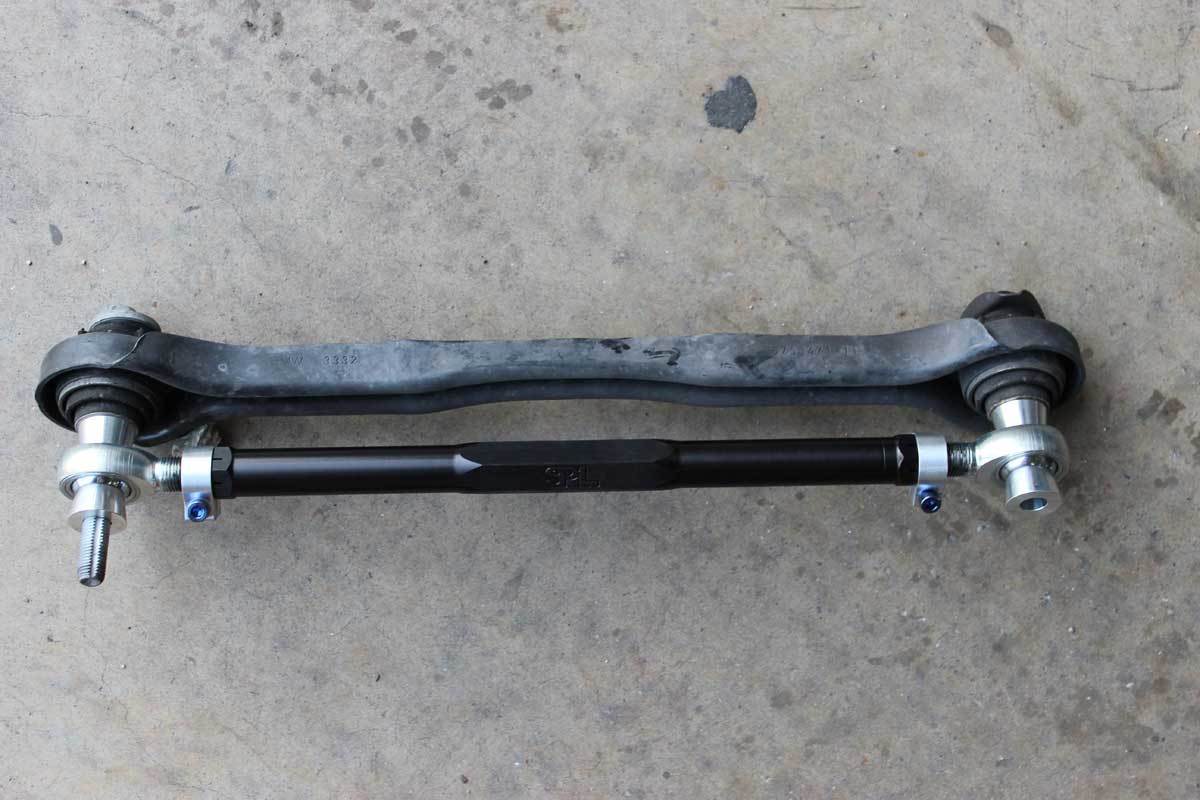
kolosy wroteThe GC arms don't use sealed bearings. They have exposed bearings and they put a rubber boot over the entire ball joint. Whether it will last as long as a proper sealed bearing or not, I have no data.Sorry for the dumb question, but is this conversion equivalent to getting the gc rear arms kit, without the worries of this bolt shearing issue? Looks like their arms have sealed spherical bearings and the added benefit of adjustable length. I started off looking to do this conversion but at 150k miles I should probably get new arms too, and then the savings aren’t as noticeable.
105.5KVIEWS
373REPLIES
201APPRECIATES
03-29-2025LAST POST
Redd wroteInteresting, I’ll have to look at the difference. Either way though, this is a track only car so I’m not super worried about the longevity of the boots. Thanks!The GC arms don't use sealed bearings. They have exposed bearings and they put a rubber boot over the entire ball joint. Whether it will last as long as a proper sealed bearing or not, I have no data.
If it's a track car then u might be better off with adjustable arms.
I'm also fairly sure that the GC just uses a standard bearing and conical washer like the OEM arm solution?
SPL is the only one I've seen that is definitely a conical seat on the bearing itself.
Happy to be corrected though.
SPL is the only one I've seen that is definitely a conical seat on the bearing itself.
Happy to be corrected though.
BW used to offer a complete set of R arms but now only offer two R arms + spl arms.
amg6975 wroteyeah, looking at another thread they include a conical washer. thing is though, i'm wondering if the issue really is the size of the bearing. if the GC arms have a bearing that's more in line with the OE size, it would be a smaller lever arm than the meyle / lemforder solution.I'm also fairly sure that the GC just uses a standard bearing and conical washer like the OEM arm solution?
SPL is the only one I've seen that is definitely a conical seat on the bearing itself.
Happy to be corrected though.
kolosy wroteI just finished doing my subframe, diff and suspension refresh which included new powerflex bushings for the trailing arms and spring arms. While at it, I added the GC rear arm set.yeah, looking at another thread they include a conical washer. thing is though, i'm wondering if the issue really is the size of the bearing. if the GC arms have a bearing that's more in line with the OE size, it would be a smaller lever arm than the meyle / lemforder solution.
I must say that I'm not too impressed with the quality and design (mostly design) of the GC rear arms. I mean like they'll work fine, but design could be improved. If I were to do it again, I would go SPL and add rubber covers on the rod end.
https://www.race-parts.com/raceparts-heim-joint-protective-rubber-boots
leftfootbr8king wroteI think the reason for the failures is the construction of the disc.This is what I have for pics from last fall. The rest of what I have is video.
I didn't do the install on these since the car was in for rear subframe bushings anyway. Work was done by a reputable race shop. Not saying they couldn't have messed the install up but 3 reported failures, 3 different shops in a just a few months. The consequences of failure are not insignificant.
Fwiw: BFG R1, Moton CS 2WR, big brakes, etc. The car was getting pushed pretty hard and made it through 1.5 days around VIR before letting go, so if you're into hard parking on street tires this washer hack might suit you just fine.
Originally the cone of the bearing sits in the cone of the steering knuckle.
This has the advantage that shear stress can almost never occur on the screw.
As soon as the bearing would shift, it would only increase the force on the screw in the longitudinal direction.
If you now install an adapter, this advantage is eliminated and the bearing can move on the flat side.
This creates shear stresses and the screw can tear off.
Even increasing the tightening torque wouldn't do much as this place is simply not designed for it.
Only a huge increase could make a difference, but the screw and thread won't be able to withstand that.
At this point, in my opinion, there are only two correct solutions.
1. Uniball arms where the cone is integrated
2. Also provide the bearing with a cone and install a washer that has a cone on both sides
regbf99 wroteAgreed, 100%. After one of my passenger side bolts sheared and sent the car into a spin while my drivers side bolt was loose I went with option 1.I think the reason for the failures is the construction of the disc.
Originally the cone of the bearing sits in the cone of the steering knuckle.
This has the advantage that shear stress can almost never occur on the screw.
As soon as the bearing would shift, it would only increase the force on the screw in the longitudinal direction.
If you now install an adapter, this advantage is eliminated and the bearing can move on the flat side.
This creates shear stresses and the screw can tear off.
Even increasing the tightening torque wouldn't do much as this place is simply not designed for it.
Only a huge increase could make a difference, but the screw and thread won't be able to withstand that.
At this point, in my opinion, there are only two correct solutions.
1. Uniball arms where the cone is integrated
2. Also provide the bearing with a cone and install a washer that has a cone on both sides
people keep insisting these things are fine.
If this failure’s consequences were just an inconvenience (like a failed throttle actuator) then go ahead and see what happens.
I'm curious, is it always the same bolt that shears? Those who had failures, do you remember exactly which arm bolt failed?
after reading this thread three separate times, my current opinion is that leaving my two OEM upper arms alone and dealing with a little more deflection is better than any gains I might see by changing the two rubber outer bushings to bearings with the possibility of suspension failures that lead to crashing  Especially if I do the trailing arm and lower spring/camber arms with all bearings.
I'll change the lower spring arm and trailing arm rubber bushings out, but only way I'd mess with the two upper arms is by going with SPL Parts arms (or equivalent). It's just not worth it for my simply HPDE track car.
Especially if I do the trailing arm and lower spring/camber arms with all bearings.I'll change the lower spring arm and trailing arm rubber bushings out, but only way I'd mess with the two upper arms is by going with SPL Parts arms (or equivalent). It's just not worth it for my simply HPDE track car.
Based on all this research and the fact that I already broke one bolt mid corner on the race track, I'll be removing my spherical bearings and replacing them with Powerflex bushings instead. Seems like these should fit properly, and without the high risk of bolts snapping.

So I got my missing groundcontrol washers, and ended up with a set of ones meant for the spherical conversion (bought them before changing my mind). it's an interesting comparison
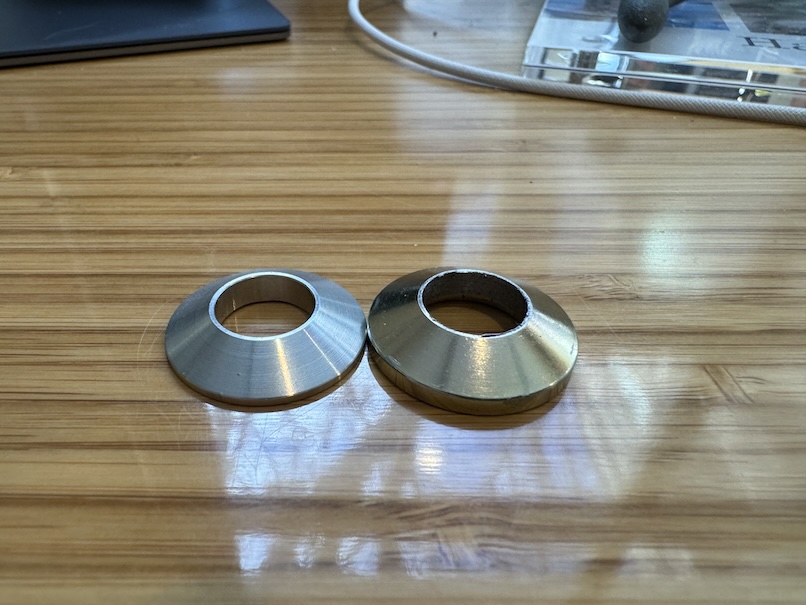
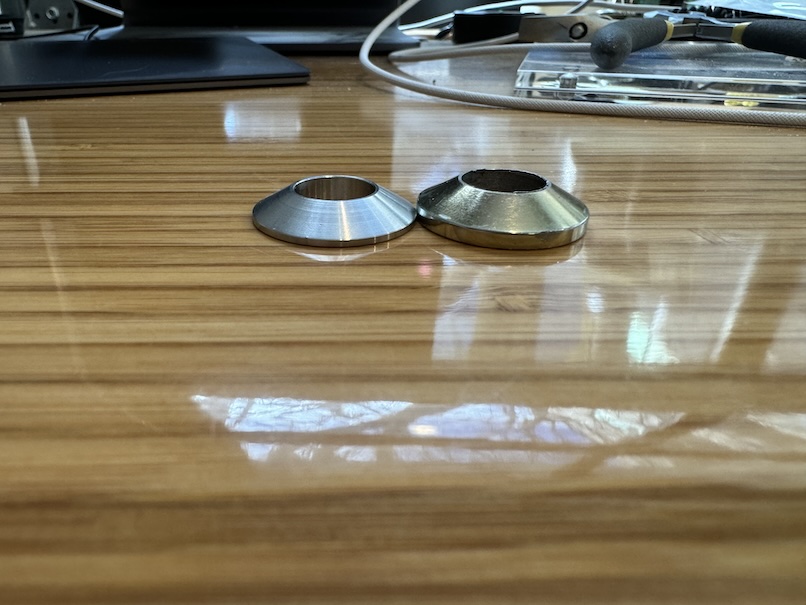
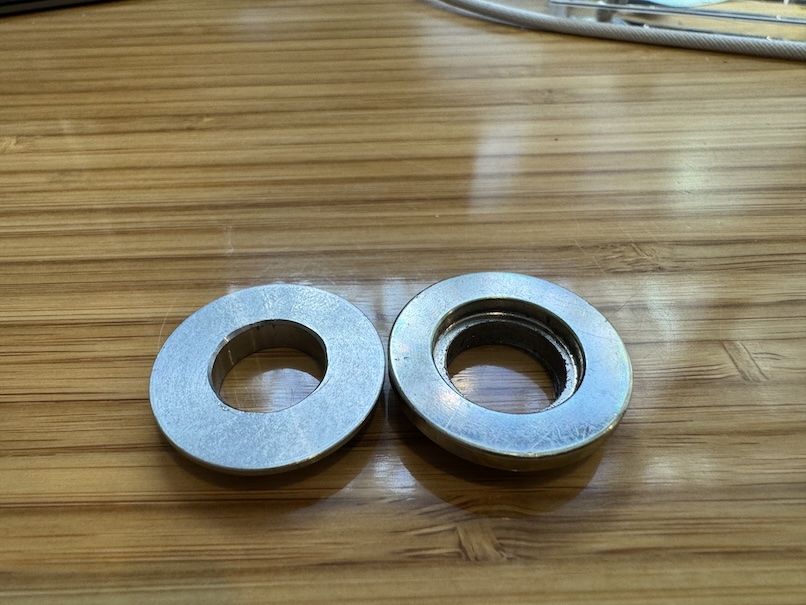
the GC ones are 1.5mm thicker, and have an odd lip on the flat side. i was going to say that it mates up with the spherical bushing inside the arm, but it doesn't -- the opening is smaller than the OD of the bushing. hopefully they aren't just wrong, but not sure what the purpose of that cut out is.
the GC ones are 1.5mm thicker, and have an odd lip on the flat side. i was going to say that it mates up with the spherical bushing inside the arm, but it doesn't -- the opening is smaller than the OD of the bushing. hopefully they aren't just wrong, but not sure what the purpose of that cut out is.
So in theory the GC arms would still introduce the same abnormal shear forces on the bolt as the spherical conversion.
Interesting to see the PF bush has the tapered washer integrated with the inner sleeve. That should eliminate the shear on the bolt as it spreads the load to the bush.
Interesting to see the PF bush has the tapered washer integrated with the inner sleeve. That should eliminate the shear on the bolt as it spreads the load to the bush.
mariusc wroteSo are these bushings supposed to be stiffer than the factory M3 bushings?Based on all this research and the fact that I already broke one bolt mid corner on the race track, I'll be removing my spherical bearings and replacing them with Powerflex bushings instead. Seems like these should fit properly, and without the high risk of bolts snapping.
Redd wroteHas anyone with GC arms managed to shear a bolt?So in theory the GC arms would still introduce the same abnormal shear forces on the bolt as the spherical conversion.
Interesting to see the PF bush has the tapered washer integrated with the inner sleeve. That should eliminate the shear on the bolt as it spreads the load to the bush.
MaximusB wroteNot to my knowledge but I don't keep track of those things.Has anyone with GC arms managed to shear a bolt?
can someone tell me the full height of the stack w/ washer on the spherical conversion? i'm still wondering if it's (at least partially) a lever arm issue, with the spherical just being too big.
mariusc wroteI like this solution a lot. I didn't realize it was an option but I think I'll be going with this.Based on all this research and the fact that I already broke one bolt mid corner on the race track, I'll be removing my spherical bearings and replacing them with Powerflex bushings instead. Seems like these should fit properly, and without the high risk of bolts snapping.
I would also say, I would not hesitate to run spherical on the toe link, the one on the very back side of the knuckle. I think that will see the most benefit from the spherical, has not had any issues, and doesn't even have the factory taper.
houtan wroteYes, they are solid PU.So are these bushings supposed to be stiffer than the factory M3 bushings?
amg6975 wroteOn the M3, the rear toe arms already have these (or similar) spherical bearings.I like this solution a lot. I didn't realize it was an option but I think I'll be going with this.
I would also say, I would not hesitate to run spherical on the toe link, the one on the very back side of the knuckle. I think that will see the most benefit from the spherical, has not had any issues, and doesn't even have the factory taper.
mariusc wroteI can't keep track of what we call them. This position:On the M3, the rear toe arms already have these (or similar) spherical bearings.
amg6975 wroteYes, they are solid.I can't keep track of what we call them. This position:

However, for the non-M models, the arms are shorter and not interchangable with M parts. These non-M arms are also sheet metal, with rubber bushing with similar dimensions as the spherical bearings this thread is all about.